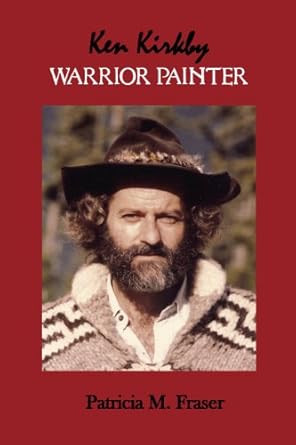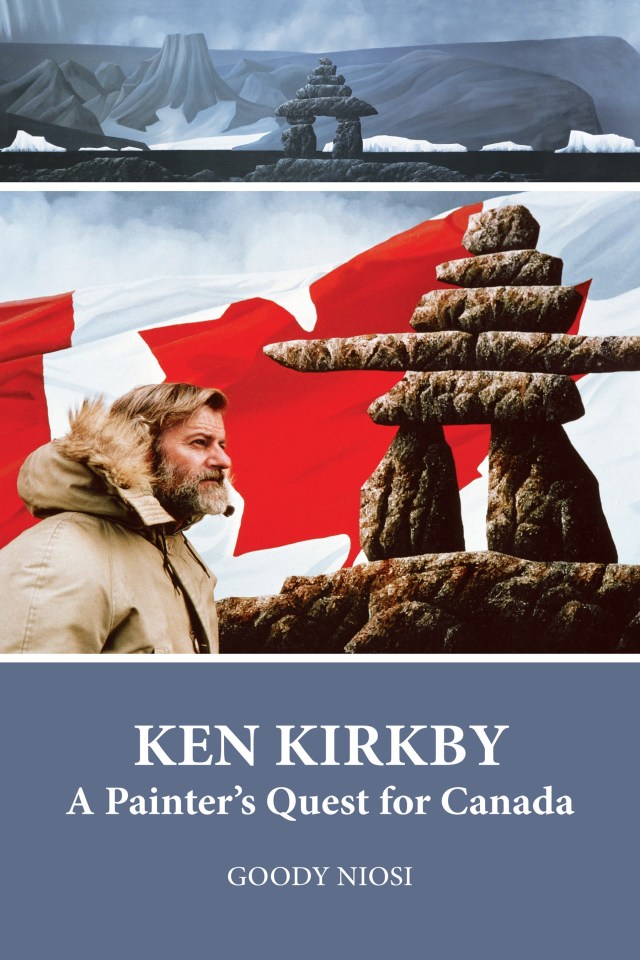

Ken Kirkby, A Painter’s Quest for Canada

excerpt

There is a deep hunger to have the sunshine of their former
homes, and of their great-grandparents’ former homes. There are these
stories that persist about how wonderful life was, and how sunny it was,
and how warm it was. But, with the exception of this little coastal strip,
this is a very cold country. You’re trying to give paintings of vast, distant
places that are freezing cold, to Canadians. Why would anyone, with the
psyche I’ve described, even think of buying one? They won’t even come
out to look at them.”
“Well, Jesus!”
“Go ahead – break my argument.”
“What else about these paintings then?
“One word – pretty. The Canadian art scene is almost non-existent,
but what passes for imagery in the public mind at large is pretty. Doreen!
Doreen! Bring some magazines!”
Fraser grabbed the top one, from the stack Doreen delivered, and
opened it at random. He turned two pages and pointed. “Look – here’s an
ad – it’s perfect. Isn’t that a pretty photograph? Do you notice that it has
a white, sandy beach, a scantily clad couple, and palm trees? People work
very, very hard to make money, so they can save some up and go to that
place – and it’s very pretty. That’s what is in their minds. You and I are the
children and grandchildren of peasants, and we have their tastes.”
Fraser reached into his pack of cigarettes, pulled out a fresh one, and lit
it from the butt that had almost burned down to his fingertips.
“It’s taken Europe an eon to get to its appreciation of art. You’re expecting
too much, too quickly.”
“But, if we don’t push we won’t get anywhere,” Ken said.
“It’s not just a matter of pushing the public. We have to find individuals
who will get behind this. It’s not just good old Alex and Ken who are
going to go and foist this on the country. It’s a much bigger story.”
Ken left the gallery deep in thought. Yes, there was truth in what Fraser
had said but it wasn’t the whole truth. Canada was ready for his paintings.
The Group of Seven was proof. Fraser thought they were rubbish too. If
he wanted to tell his story through his paintings, it wouldn’t be with Alex
Fraser by his side.
Unexpectedly, Ken received a letter from his Aunt Vicki in Madrid. She
had taken the photographs he had sent her, of his latest paintings, and
shown them to a popular gallery owner who wanted to exhibit them.
He tapped the note against his desk, read it again, and picked up a
pen. He wrote a letter to Mr. McEachern, the Minister of Foreign Affairs,
describing his good fortune in coming to Canada, and telling him how
he had arrived in this country. He wrote about his art and said that he
wished to go back to Europe for an exhibition in Madrid.

https://www.amazon.com/dp/0981073573

Arrows

excerpt

We followed the river until it converged with the same river
Guaire which ran the length of the valley.
We were one mile from our destination.
We crossed the Guaire from south to north, following the path of
those who had survived one of the two previous expeditions that
had made it this far. The Guaire was not deep, but, having lived all
my life near rivers, I knew how mighty it could become with the
proper amount of rain.
Soon after, we crossed a creek called Catuche, along which
soursop trees grew by the hundreds, hence the creek’s name, which
in Carib meant soursop. Tamanoa brought me one of its fruits and
ripped it open beforemyeyes. It was white, succulent and aromatic.
As the sun descended, the deep green of the cordillera mingled
now with soft blues and yellows. We had turned north and were
ascending the slope of the piedmont when Losada’s voice
resoundingly gave the order to stop. We had finally reached a
destination: the charred remains of what had been the settlement of
San Francisco, half-buried in the vegetation.
Francisco Fajardo had fled the settlement five years ago when he
knew the reinforcements he had pleaded for had been wiped out by
the Arbaco Indians of Terepaima. After painful losses, Fajardo had
divided his forces into two and fled in canoes and pirogues.
It was eerie being in that deserted place. The air smelled strongly
of rain, damp earth and plants. The howling monkeys, chachalacas,
parrots—they were all quiet. That night, as a full moon shone
through thick clouds, the ubiquitous night-song of frogs and
crickets was overridden by the deafening buzz of cicadas.
Losada paced nearly beyond range of the firelight, five strides to
the right, five to the left, hand combing his beard and moustache,
eyes fixed on the ground before him, his grizzled hair reflecting the
silvery moonlight. He anxiously awaited the return of the troupe led
by Diego de Paradas, who finally arrived after midnight, looking
seriously bedraggled.
“What happened?” asked Losada.
Diego de Paradas was wounded. Pánfilo spoke for him.

https://www.amazon.com/dp/0981073522

Jazz with Ella

excerpt

ROSTOV-NA-DONU, JULY 13, 1974
The Canadian student tour group were old hands at Soviet travel by the time their plane left Leningrad bound for Rostov-na-Donu in the Ukraine. The usual plump stewardesses, more relaxed on this domestic flight, handed out the usual sticky candy. The students played the now familiar game of who had the functioning seatbelts. David had no seatbelt, and he threatened to hang on to Paul’s leg for the duration of the flight should they meet turbulence.
Despite the gloom of parting from Volodya, Jennifer’s spirits lifted slightly. The plane was full of Ukrainians returning home—women in harem pants, swarthy men with metallic, toothy grins carrying bundles, carpets and, in one case, something alive in a cage that screeched at intervals. The passengers moved around the plane freely, paying no attention to the attendant yelling at them.
Jennifer wasn’t the only one who was mourning the loss of a friend in Leningrad. Ted had ended his stay there at a party with students from the institute. He had met them on the street, and over some powerful moonshine liquor they had discoursed heavily on the problems of the cold war and had resolved to bring peace to their various countries. Unfortunately, Ted couldn’t quite recall how they had proposed achieving this lofty aim. Lona had also found some friends in Moscow, it seemed, and was only now telling the group about them. Jennifer wondered if Lona would have admitted the liaison if she had not been spotted outside the hotel with a group of sharp and eager young men whom everyone suspected of being some kind of confidence tricksters. If anyone can take care of herself, it’s Lona, thought Jennifer, and she wondered if Lona’s swains had asked her to help them leave the country. Then, in an attempt to shake off…

https://www.amazon.com/dp/1926763246

Ken Kirkby, A Painter’s Quest for Canada

excerpt

While he studied, he periodically found himself distracted by the
thought of the one art gallery in Vancouver he had not approached with
his paintings – the Alex Fraser Gallery. Stories of Alex Fraser, and his
treatment of artists in his London and Vancouver galleries, had circulated
through the art community for years. Ken was angry with himself. He
was rarely afraid of anyone and had met no one in Canada yet who had
intimidated him. Alex Fraser’s reputation did.
He had heard that the man was irascible – so what? He had heard he
was powerful. Was it in his power to judge his work? What if he found it
wanting?
The only thing worse than his fear was the prospect of his disappointment
in himself if he refused to face it, so one day he screwed up his
courage, loaded his truck with paintings, and drove to 41st Avenue near
Boulevard in Kerrisdale.
He walked into the gallery, where an attractive middle-aged woman
asked if she could help him.
“Yes, I’m here to see Mr. Fraser if he’s about.”
“Mr. Fraser doesn’t see people without an appointment.”
“Oh, that’s a shame. I’m here and I have some paintings. Please, can
you ask if he’ll see me?”
She smiled and walked into a back room. A few minutes later, a small
man with slicked-back hair and icy, blue-green eyes walked out. He was
dressed in a perfectly fitted gray pinstriped suit, with knife pleats in the
trousers and shoes that shone like mirrors.
Exhaling a great puff of smoke, he lowered himself into a big armchair,
and placed two packages of Players unfiltered cigarettes and an ashtray
on the little gate-legged table beside it. Taking a fresh cigarette from one
of the packages, he lit it from the one in his yellowed fingers, and crushed
the stub in the ashtray.
Turning to the woman who had followed him out of the back room he
called, “Doreen! Doreen, I want you to tell the young man about manners.
Ask him does he understand the meaning of manners?”
“Mr. Fraser would like to know if you understand the meaning of manners,”
she said, turning to Ken.
“Indeed I do,” Ken said. “And I apologize for coming in without an appointment
but I was nervous and I managed to screw up all my courage
to come in – and here I am.”
“Doreen! Doreen, tell him he is quite right to be nervous in approaching
me. Ask him what it is that he wants.”
“I have some paintings and would like to show them to Mr. Fraser.”
“Tell the young man that I can’t bloody see his paintings, anywhere.
Where are his paintings?”

https://www.amazon.com/dp/0981073573

Arrows

Excerpt

Later that night she moved to Gregorio’s side, like a dog seeking
warmth on a cold night.
Benjamin raised himself on one elbow and tapped me on the
shoulder.
“A man is fire, a woman, pitch; comes the devil and blows!” he
said, winking at me. He lay down again with the satisfaction of one
who has delivered an important piece of information, and within
moments, he was snoring away peacefully.
I could hear Gregorio and Josefa conversing in whispers, and the
nagging worry about his possible secret religion made me vow to find
her a chaperone the very next day, lest things between them should
go too fast. She had no one to look after her reputation but me.

Indians say vultures take messages to God. Not for the last time, I
wondered whether they took souls, too.
On the day we faced Guacaipuro’s hosts conspicuously waiting
for us, several vultures circled high overhead, barely visible through
the thin fog dissipating rapidly in the first rays of sun. Having seen
them eating carrion, I was disinclined to hold them in high
regard—their presence was ominous.
We stood overlooking a valley and a river named San Pedro. We
were high in the mountains, and the air was pleasantly cool, like an
early spring dawn in Andalusia.
“May God be with you. In nomine Patris, et Filii, et Spiritus Sancti.
Amen.”
The men rose, for they had knelt to receive my blessing. No
chanting this time. Gregorio and Benjamin stood closest to me.
Josefa watched from a few paces behind, her face sallow. Gregorio
went to her and took her hands. She broke her silence with violent
sobs, and Gregorio lent her his shoulder and his worn handkerchief.
I realized how little I knew about women. She cuddled against
him as she had done with me after she had killed that young Indian.
Gregorio took her demeanor as a token of her regard for him.

https://www.amazon.com/dp/0981073522

He Rode Tall

Excerpt

“Well,” Tanya said, “you certainly have as nice a string of horses
as I have ever seen. You have a dozen good horses here that are
better than all the horses I have ridden in my entire life. What are
you going to do with them?”
“What do you mean?” Joel asked.
“Well, the word around the rodeo grounds is that, with you
running the Circle H, it isn’t going to be as easy as it has in the
past for a cowboy or horse trainer to pick up a CircleHhorse. You
know, a lot of those cowboys came to depend on your dad for
quality horses at a cheap price. I used to hear them say that they
were only afraid of one thing—that your dad would leave the
ranch one day and discover what other people were selling their
horses for. I heard that there are a couple of trainers that aren’t
too pleased with you, Joel.”
“Well, news certainly does travel fast in these hills, doesn’t it?”
“So what are you going to do?” Tanya pressed.
“I am not sure. After the success of selling the old blonde mare,
I started to figure out that I have some pretty sought-after stock
here. I am just trying to figure out what would work best. Do you
know Cindy at the auction yard? We had lunch a week or so ago
and she was saying that she might be able to interest her boss,
Roy, in doing a special sale right out here at the ranch. I don’t
know about that, but, with these horses coming along the way
they are and the end of summer around the corner, I guess I
better figure out what would work best. What would you do if
these were your horses?”
“The first thing I would do is pinch myself to make sure that I
am not dreaming. Just about any horse is beautiful to me, but
these are special animals. And if everything I hear about their
breeding is true, this may be the finest band of horses in this part
of the country. Is it true? Are the mares all daughters or granddaughters
of Doc Bar? Is your stud an own son of Topsail Cody?
That would be really incredible!”
“Incredible it is. Yes, that is exactly what we have. There is
only the one old mare that is left that is a daughter of Doc Bar

https://www.amazon.com/dp/0980897955

The Circle

Excerpt

Could she be cheating on him? Matthew has been married for a long time; he’s a
fifty-five-year-old established bureaucrat. Why suddenly does he have all this
anxiety about his wife being unfaithful?
He turns on his other side and crawls under the sheets. He changes the TV
channel and slowly his eyes grow tired. He feels all the emptiness in his stomach
and in his heart. Then his worrisome mind slows down and he falls asleep.
“What did Dad have to say, Mom?” Jennifer asks.
“Nothing important, honey, the same old story.”
“Is he coming home on the weekend? I heard you telling him Hakim has
gone to New York. Did he say anything about that?”
“No honey, nothing. He says he’ll be home on the weekend.”
Jennifer goes upstairs to her room and Emily pours herself a drink.


Wednesday morning in New York and the sky is clear. A tired city awakens from
a last night of excitement and partying. New York is a city that never sleeps, like
Las Vegas. New York has the reputation as being the best entertainment city in
North America, although the big corporations running the Las Vegas casinos
like to think their city is the best in that department.
Hakim is up. He gazes at the view of the waterway. Far to his right he can see
the boats as well as cars in the streets. He has been up for a while when Ibrahim
comes into his room, prepared for the day.
“Good morning, my uncle.”
“Good morning, my dear son.”
Ibrahim calls Rassan to order their breakfast. While they wait Ibrahim calls
his lawyer, William Polson.
He speaks to the receptionist, “Good morning, this is Ibrahim Mahdi. I amin
New York and I would like to talk to William.”
It takes a few moments before a person answers.
“Good morning, Ibrahim, how are you? Welcome to New York. Where are
you staying?”
“Good morning, William. I am at the Manhattan Sheraton as always. I want
you to get Bill Wanton and Regis Hudson and come over for an hour, some time
after eleven. I need you all for an hour or so. Get Regis and Bill to bring along the
necessary forms for new accounts. You also need to prepare a power of attorney
and bring it along.”
“That sounds good, Ibrahim; I’ll put everything together. I’ll confirm our
timing within half an hour.”

https://www.amazon.com/dp/0978186524

Ken Kirkby, A Painter’s Quest for Canada

Excerpt

Ken’s people were caribou people.
When the last of the caribou had passed, they dragged the fresh carcasses
to several large piles of rocks that they lifted to reveal deep pits
lined with more rocks. They lowered the meat into the pits and replaced
the rocks. The main danger to their food reserves was marauding wolverines.
By caching their meat under rocks too heavy for the wolverines to
move, they guaranteed a food supply for the season to come.
The days changed. The shiny green bearberry that covered the tundra
turned blood red and when Ken gazed across the land he saw a river of
crimson. One morning the snow geese flew across in the hundreds of
thousands. When they settled on the land a down blanket covered the
scarlet sea.
The days grew shorter and the temperature dipped dramatically. Ken
shivered in his sleeping bag and the old woman gave him two caribou
hides – one to put under his bag and one to cover it. He developed a new
understanding of the word “cold”. Cold was not simply a word here – it
was a palpable, physical thing, which assaulted every sense – it was the
god that controlled the land.
A few days after giving him the caribou hides, the old woman presented
him with a caribou parka lined with Arctic fox. Through her son,
she explained that this was to be worn without undergarments, next to
the skin. The parka was light, soft and astonishingly warm.
They continued to travel east until they came to a lake dotted with a
number of small islands, where they had left sleigh dogs that had whelped
in early summer. The animals were wild, ferocious, and pugnacious. They
took them back to the mainland where they pegged them to the ground,
placing the lead dog at the front of the pack. Once a day someone tossed
a frozen fish to each dog, which it consumed ravenously. The dogs were
born to pull sleighs and once in the traces would run across the ice until
they dropped from exhaustion.
With the dogs in tow, they continued trekking to the place the old
woman called home. She was a Netsielik, People of the Seal. Her husband,
who had died of TB, was People of the Caribou. TB had become epidemic
among the Inuit. Several people in the group had severe coughs and often
spit up bloody phlegm.
Snow began to stream across the land, blowing from the west in a million
little rivulets. The temperature, already chillingly cold, continued to
drop. The old woman gave Ken a pair of trousers made from caribou hide
and sewed a wolverine hide along the edge of the hood of Ken’s parka.
To the amusement of the Inuit, Ken sat on the frozen tundra in his new
clothes, watching the snow dance across the land. He felt fortunate. He
was living his childhood dreams. This was the Arctic he had envisioned –
the land of Francisco’s stories.

https://www.amazon.com/dp/0981073573

Jazz with Ella

Excerpt

“We didn’t order…oh what the hell,” said David. Jennifer reached for the refreshing water eagerly.
Paul chimed in. “A country that puts a man in space, yet you look at the filthy exhaust those busses are pushing out. That’s no rocket fuel. It coats everything, gets into your lungs.”
She agreed. “At least this city seems light and bright and modern”—everyone nodded—“whereas Moscow was so drab.”
“Boy, was it ugly.” David shook his head. “Though I have to say everything looks a tad more cheerful after a bottle of the local brew.” He helped himself to another glass.
The waiter finally showed up with some sickly sweet plum syrup. It didn’t cut the vodka, but by that time they were almost past caring. The lounge filled up with British and Americans, some of them in baseball caps, a few individuals who spoke Russian with a German accent and a party of serious, silent Asians.
“I think they’re North Vietnamese,” David whispered.
The Asians were seated at the table with the centrepiece, Jennifer noted. So the Soviets were not above spying on their Communist cousins. It fit with the current paranoia. Suspicion of Asian aggression was running high in the country and tension marked the border with China.
“We’re going to need another bottle here. I’ll get it,” said David suddenly.
“Do you think that’s wise?” put in Lona.
“What’s wise got to do with it? We’re in the Soviet Union, guys!”
The conversation continued, the waiter brought a tray of snacks, the level in the vodka bottle plummeted, and Jennifer couldn’t quite remember how they had acquired another guest at their table. He was a Soviet man, about 45, with curly hair, dressed in a fashionable lounge jacket. Apparently he had been listening to their conversation for some time. He shook hands all around and told them in fluent English that he was an editor of a prominent Soviet newspaper. None of them really believed him. What would an editor be doing sitting in the bar of a Soviet hotel that catered exclusively to tourists?
“I bet he’s a black marketeer,” whispered Ted loudly, leaning towards Maria. “He wants to buy our jeans—or get into your jeans.” She giggled. Lona looked puzzled.
“Is this a joke?” Paul asked.
“No, he’s a spy,” said David.

https://www.amazon.com/dp/1926763246

Ken Kirkby, A Painter’s Quest for Canada

Excerpt

distance away observing him. When they saw that he had noticed them,
they came to sit beside him. The man said, “My mother says you are a
very quiet Kabluna.”
“Maybe all Kablunat are quiet,” he said.
The man translated for his mother and said, “She says that all other
Kablunat that she has known are noisy. They talk a lot.”
“Maybe I don’t have much to say,” he replied. “Maybe I don’t know
very much.”
When Ken questioned the old woman about the Inuksuit she told him
a story that began a long, long time ago when there were very few human
beings. They travelled over the vast land in small family groups, following
the herds of caribou that were the source of their food, their tents,
their clothing, and their utensils. They could not afford to deplete their
energy by chasing the food. Instead, they made stone human beings and
called them Inukshuk, which means, like a person or acting in the place
of a person.
The people placed the Inuksuit in V-shaped formations. The caribou
with their poor eyesight, thought the Inuksuit were hunters and so it required
only a very few people to herd them into a trap. The closer they
came to the end of the V, the closer together the Inuksuit were placed.
At the point of the V, hunters hid behind boulders while women
and children lay on the ground beside the Inuksuit. As the caribou approached,
the women and children jumped up, waved their arms, and
danced about, to give the appearance of many, many hunters. The caribou
would then stampede to the end of the V, which was usually at the
junction of a lake and a river. When the caribou plunged into the lake,
the hunters hidden behind the boulders would jump into their kayaks
and paddle after them, spearing them in the water. Then they would haul
them back to shore where the entire family, even the children, would
clean and gut the animals.
Inuksuit also took on many other shapes, the old woman said. The one
on the river’s edge where they were sitting was a fishing Inukshuk. She
knew this because it was topped with a smooth stone taken from the riverbed.
It indicted that the fishing was good here. Other shapes had other
meanings and the configurations of Inuksuit had meaning also.
To my mind, what I was hearing sounded like language but they didn’t
write the language on a piece of paper – they wrote it directly on the land.
And I was beginning to get the picture of absolute practicality. Here you
could live with minimum technology if you knew how. To think that you
could direct an entire way of life by putting a few stones together just so,
so that other people coming would be able to read the significance of these
things. The degree of sophistication of this began to seep into me and I realized
there was much to learn here. And this way of life was like the people

https://www.amazon.com/dp/0981073573