Jazz with Ella

excerpt

bristles of his moustache into neat, serried rows. Once, when he had been due for a Russian department evaluation involving an interview with Chairman Hoefert, he had arrived early at his department head’s office. The door was open and there was no one about so he had wedged himself into a seat in the crowded study, his legs straddling boxes of books and papers, to await Hoefert’s return. A file lay open on the desk and without too much twisting of his neck he could see that it was his own confidential personnel file. Leaning out from the chair at an acute angle, he could even read the text upside down and he quickly did so without any attack of conscience. The chairman had written a number of congratulatory things, Chopyk was gratified to see. He could read that he was a stellar professor, thorough and devoted to his publishing schedule. True. It was a bit lacklustre on the subject of his teaching abilities, but certainly adequate. But there, at the bottom of the report, was what Chopyk considered to be a damning bit of character assassination. Neatly penned in the director’s handwriting were the words: “Chopyk’s flaw is vanity.” The subsequent interview was more tense than usual.
Ever since that day Chopyk had pondered this revelation, especially when he glanced at his trim appearance in a mirror. Later, he realized that Hoefert was not talking about superficial vanity, though he was deemed a snappy dresser; instead, Hoefert had locked onto a deeper quality: Chopyk’s self-absorption. He took magnificent pleasure in his successes, however small. He took a positive delight in outsmarting Professor Hoefert, preferably in front of colleagues at the Learned Societies conference. But it was only friendly rivalry, Chopyk told himself. Where was the harm? It was the word “flaw” that niggled. He didn’t like to admit to flaws; didn’t think he had any. But there were moments—like today with Lona Rabinovitch—that he would consider his vanity to be a genuine weakness. She was playing him, flattering him—no doubt about it. And he had fallen for it.
She had come up to him in the dining room after lunch, when the others had drifted away, to ask his clarification on a small question of verb tense. Somehow, within minutes, she had managed to turn the conversation to their departure from the Soviet Union, and she complained that she was running out of room in her luggage. Before he knew it he had gallantly agreed to pack some of her “valuable gifts and souvenirs” in his own luggage. She was quite appealing, gazing up at him softly with those large green eyes—he couldn’t refuse. She was hypnotic. Dammit.

https://www.amazon.com/dp/1926763246

Poodie James

excerpt

“Seen Ray Thompson?” the man said.
“No, I expect he’ll be back in a few minutes. Anything I can do
for you? I’m Pete Torgerson.”
The ranger gave no sign of recognition.
“I have a message for Ray. Got a call up at the station. Only
phone around here. Know where I might find him.”
“He’s over at the dining hall.”
“Thanks,” the man said, and left.
Torgerson sat on Thompson’s bunk and leafed through a tattered
copy of Life, trying not to think about the boy. Five minutes
later, Thompson was back.
“Pete, I have a problem. The ranger station got a call from my
neighbor in town. My wife had an appendicitis attack. She’s in the
hospital. I’ve got to go down there right now. It’s going to burst if
they don’t operate. I want to be there when she comes out of the
anesthetic. There’s no one up here but kid counselors, and I can’t
leave one of them in charge. I hate to ask because I know how
much you’ve got on your hands, but….”
“You don’t have to ask. Go on. Just stop by the garage. Tell
them what’s happening, and have them give Sue-Anne a call.”
“If I can’t get back up here tommorow, I’ll have the Y send
somebody to take over. Noon, at the latest.”
“Run along, Ray.”
“Razor and all that stuff above the sink. Sorry I don’t have pajamas
for you. Don’t use ’em. Lights out at ten o’clock. You might
have to quiet ’em down.”
“Don’t worry about it. We’ll be fine. Scoot.”
In the log dining hall, Torgerson lined up with the children and
the counselors to shuffle past the steam table. A solemn woman in
a hair net and a white uniform ladled chipped beef on toast and
canned peas onto their trays. He thought of the army. After dinner,
he wandered over to a corner of the hall where a counselor sat
at an old upright piano playing a sonata he recognized but could
not name. She looked fifteen, maybe sixteen, he thought, and from
the back a little like Sue-Anne. When he came home, his wife was

https://www.amazon.com/dp/B08W7SHCMV

He Rode Tall

excerpt

…couldn’t even see where they had got through the fence. It must
have taken some interesting gymnastics for these four-legged wonders
to maneuver through a three-wire fence without ripping it
down, but, sure enough, here they were. Joel even found himself
wondering if they could have jumped the fence. He had seen the
deer do it. But as Joel compared the anatomy of a cow to that of a
deer, he chuckled at himself in a way that made his horse wonder
what was happening. To the horse, this expression of human
emotion was something new about Joel.
The sorrel gelding waited to see what the rider who sat on him
would decide to do.
Sizing up the situation, Joel realized that if he didn’t get these
three heifers back to where they belong, some of their friends
would want to join them for the party. And judging from how
lean the pickings were on the other side of the fence and the look
of the visiting heifers, Joel didn’t think it would be long before
they would devour the grass in his pasture, which is supposed to
feed his horses. And if the advance party of three were joined by
their friends, it wouldn’t take long before Joel had a serious problem—
two- or three-hundred head of cattle would make mincemeat
out of this pasture.
After contemplating the possibilities, Joel decided that his best
bet would be to open the gate that was about 300 yards down the
fence line and try to push the three heifers back to their own pasture.
He was hoping that the gate was far enough from the herd
so that the herd wouldn’t all rush through the opening into his
pasture. This was going to be very tricky.
Slowly, he moved the sorrel gelding down the fence line to the
gate. The gelding was carefully watching the cows and they certainly
weren’t spooking him. Reaching the gate, Joel undid the
rope, and stepping back, he set the fence wire and poles down to
the side. Sliding back into the saddle, Joel pointed the gelding
back to the three heifers that were grazing, unconcerned with the
approaching rider and horse, or anticipating their eviction.
Gently, cautiously, and slowly, Joel and the sorrel gelding pushed
https://www.amazon.com/dp/0980897955

The Unquiet Land

excerpt

“But aren’t you trying to change souls with your sermons? Aren’t you trying to make them more acceptable to your God?” Finn leaned forward on the table, his massive hands cupped around his glass of wine. “The soul cannot be so untouchable.”
“With the word of God one can indeed reach into the soul,” Padraig consented. “But no instrument devised by man has the same power.”
“Ah, we have a conflict here,” said Finn. “Sweeney, fill up my glass and top up your own. Any of you others care to join us, help yourselves to whatever you want. That stage is getting set again. See why I prefer to act than to watch?”
“You don’t act, Finn,” Sweeney observed; “you direct.”
He poured the wine for Finn. The last drops from the decanter he shook into his own glass. His sunset face was blazing crimson, with purple only in the shadows. He replaced the empty decanter in the centre of the table and turned up the wick of the low-burning lamp. Shadows flickered on the walls, on the dark sideboard and the cabinets, on the tall clock and the pale porcelain of the Victory.
“So, Padraig,” Finn went on, “you think the word is mightier than the surgeon’s knife.”
“The Word that was in the beginning, yes; the Word of God that was made flesh as Jesus Christ.”
“What do you say to that, young Clifford?” Finn asked. “Does the Word of God tell us more of man and nature, life and death, than your brain and blade will ever reveal?”
“You’re confusing two separate realms, Finn,” Clifford argued in a precise, dry voice. “The brain is a material thing. We probe into it, repair it, understand it, with the aid of material instruments. The soul is immaterial. We change it, if we change it at all, with immaterial instruments: with words, thoughts, ideas, emotions, that reach it through the mind.”
“Body and mind; matter and spirit; material, immaterial.” Finn repeated the words reflectively. “That sounds reasonable enough. Conflict resolved.” He sipped some wine, then looked at Clifford. “You say that the soul is reached through the mind. So you separate mind and soul?”
Clifford looked around the table self-consciously. Michael was asleep with his head fallen forward on his chest. Seamus and Sweeney stared at their wine and looked as though they wished they too were asleep. Only Padraig, facing Finn across the length of the dish-and-bottle-laden table, stayed alert, leaning back in his chair with his left hand dangling and his right hand holding a half-emptied glass of wine.

https://www.amazon.com/dp/1926763203

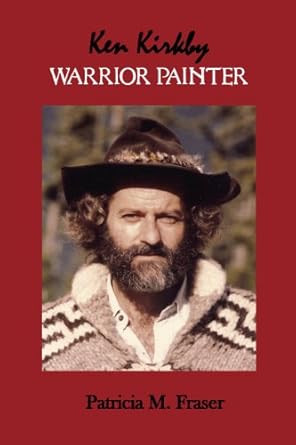
Ken Kirkby, A Painter’s Quest for Canada

excerpt

trying to meet you for years,” he said. Gruber carved decoys, many of
which had made their way into Ken’s extensive collection. “Our paths
have crossed many times,” he said. “But somehow we’ve never met. Now,
unfortunately, we have to meet under circumstances that aren’t the best. I
work for a credit company, and I have to cancel and pick up your gas card.
I’m awfully sorry to do this.”
“That’s fine,” Ken said. “You’re just doing your job. Come over now.”
They talked, while consuming an entire bottle of Scotch, and became
friends for life. Ron and his wife lived in a big house near Jericho Beach,
that had separate living quarters on the ground floor. When Ken told him
he had just lost his house, Ron suggested he move into their ground floor
suite, and a few days later, Ken loaded his possessions into his truck and
drove to Jericho Beach.
Revenue Canada sent a letter demanding a large sum of money in back
taxes on his real estate investments. Because he had never taken the money,
but only reinvested it, it had never been taxed. Ken put the letter on his
bureau. Another letter arrived and then another, until he had accumulated
seventeen progressively threatening tax notices. The final one informed
him he was being sued. Ken took the notices to his accountant who was as
puzzled as Ken. Each one demanded a different sum of money.
When they went to court, the lawyer for Revenue Canada made his
statement. The judge turned to Ken. “Guilty or not guilty?”
“Not guilty,” Ken said. “Impossibly and completely not guilty.”
“How so?”
“Your honour, if I may be allowed to approach the bench and present
you with the situation in writing. But, before I do that, may I ask you a
question in order to help clarify the situation?”
“What if one were walking down the street,” he asked, “and came across
a car lot, and spotted a car he fancied, and wanted to buy it, and the salesman
didn’t know how much it cost? And what if he went to his sales manager
and the manager, also, didn’t know how much it cost? And what if
he went to the owner of the car lot and the owner didn’t know how much
the car cost – would one be able to conclude a satisfactory transaction?”
“Clearly not,” the judge said.
“This would appear to be the same situation,” Ken said, handing the
demand letters to the judge. “There are seventeen different notices here,
which are completely confusing. There is no way, even according to the
accountants I am acquainted with, to make head or tail of it. Every single
one has a different figure on it: that makes no sense at all.”
The judge studied the demands, his frown deepening.
“As far as I’m concerned, I don’t owe the money,” Ken said.
“I think you’re absolutely correct,” the judge said. “This is disgraceful.”
And he threw the case out of court.

https://www.amazon.com/dp/0981073573

Arrows

excerpt

She could barely restrain herself from making a second
public accusation.
“You might get the answer to your question if you asked our
friend, Gregorio,” I replied, looking at Gregorio instead of Josefa.
Gregorio immediately understood. He grabbed Josefa by the arm
to forcibly remove her. I stood rooted to the ground, hoping he
would drag her away and that could be the end of it. But Josefa
remained feisty and broke away from him, running to me with a
pained expression. She leaned forward and whispered devilishly in
my ear, so that only I could hear. “I know what happened at the
river,” she said. “I know everything. I know you let her touch you!”
I jerked back from her, as though she had slapped me in the face.
The servant, she had seen me, and Josefa could barely contain the
power she had over me. There was no point in trying to deny
anything. I walked away, horrified by Josefa’s misplaced jealousy,
and dumbfounded by my inability to eradicate her secret
knowledge.
Right then, I decided I did not want to learn whether Apacuana
had bitten Josefa or not. There was a part of me that hoped she had.

In the morning, when Losada was notified of the incident, he
preferred to dismiss it as mere female hysteria rather than discern
which party was responsible. It was the prudent decision: to
concentrate on completing his negotiations with the cacique Chacao.
After mass, Losada ordered the captives brought to him and untied.
“We want to be your friends. You see we have not harmed you,”
Losada told Chacao. “We can decide to do this in peace, or we can do
it in war. We are powerful. To show you my goodwill, I give you all
your people back.”
Chacao was a middle-aged man with deep lines running down
the sides of his nose to his mouth in a permanent scowl. He did not
answer, just stood there, hands folded in front of him. It was
important for him not to appear grateful for Losada’s benevolence.

https://www.amazon.com/dp/0981073522

Still Waters

excerpt

nterior stunned her, and she felt a twinge of guilt. This must be terribly
expensive. Why had Cam chosen such a place? To impress her?
But he appeared at ease in their surroundings, was recognized by
both the maitre’de and the wine steward, and had obviously been
here often. Determined to enjoy the evening and the company of
the man who had lavished attention on her since the moment he
had appeared at the door of her apartment, she settled back in the
delightfully comfortable chair and relaxed.
Until the wine was brought and their order taken, they made small
talk about the hospital, his parents and her family in Emblem. Then
Cam smiled and raised his glass.
“To our meeting again, and to our future meetings. Together we’ll
set the Holy Cross on fire.”
He touched his glass to hers, then put it down and looked at her
soberly. “I want to ask you something – at the risk of having you tell
me to mind my own business.”
“Ask away.” She knew what was coming, but her spirits were too
high tonight to be dashed by the mention of Morley’s name.
“Are you … that is, are you still seeing Morley?”
Tyne raised her glass to her lips, and looked steadily into Cam’s
eyes. “No,” she said.
“Oh.”
He appeared baffled by her brief, straightforward answer as if he
had expected her to simper and evade his question. Well, she was
through simpering over Morley Cresswell. He had dumped her, and
that was that … all in the past … over … done. And why should she
care? She did not need a stubborn, pig-headed, unsympathetic farmer
in her life. Was she not here, in this posh restaurant, being wined
and dined by the handsomest intern the Holy Cross had ever had the
honour of admitting to its program? And was he not looking at her
with the fondest admiration? So she did not need Morley Cresswell.
Goodbye, good riddance.
Tyne put her glass on the table with a thump. And to her horror
and distress she burst into tears.

https://www.amazon.com/dp/1926763068

Savages and Beasts

excerpt

“Yes, I do. I’ve been in this position for almost five years
and since my first month, one November night, around nine
o’clock I was paid a visit by the Head Master of this facility,
Father Jerome, who, that night for the first time but not the last
violated me in the most disgusting way; He has been doing this
occasionally, whenever he would feel up to it, no questions asked
no permissions granted…”
“Father Jerome” Anton talked to himself, “somehow the
impression I got for the man, the first time I met him, was that
he would never take no for an answer…”
Mary turned a little so her eyes would dive deep in Anton’s
and smiled at him. Her smile seemed forced, stressed smile, yet it
was her smiling lips that Anton looked at and enjoyed their shape
and promising tomorrow. She took his hand before she continued.
“Yes Sister Gladys and Father Jerome are lovers, for a long
time, I’d say from the day of his arrival here, they seem to match
in many different ways and the way our rooms are lined upstairs,
you’d notice when you come for some reason upstairs and spend
time you’ll realize that her room is next to Sister Helen’s and next
to hers is mine, all the men’s rooms are on the opposite side of
the upstairs hallway with Father Jerome’s in the middle. He’d
just walk out of his and within ten or so feet he accesses Sister
Gladys’ room or mine.”
She stopped and took a breath, the freshness of the August
day just outside the truck window and the freshness of the slow
flowing water of the Thompson River blew certain moist on her
face moistening it; she pulled Anton closer to her and kissed him.
“Sister Gladys followed Father Jerome each time he paid a
visit to me and since she saw me as a competitor who I never have
been nor would I ever want to become, in fact each time Father
Jerome came to my room, he plainly and simply raped me,

https://www.amazon.com/dp/1926763602

In Turbulent Times

excerpt

Liam Dooley was thirty-eight, going on thirty-nine. His fair, wavy hair was receding alarmingly at the temples. He believed a baldness was spreading at the back of his head also, like a threadbare elbow in an old jacket, but he could not see for sure in the mirror and he would have been embarrassed to ask. There was no one he could have asked in any case without feeling foolish. His parents were dead; his sister, after her twenty-first birthday, had moved to Belfast to marry the father of her daughter; and Liam lived alone in two rooms, a kitchen and a living-bedroom that the Church had built onto the back of the new school as accommodation for the teacher, but which could be converted to additional classrooms when the growing number of pupils made the extension necessary. Liam’s baldness and his forties were both approaching rapidly. Both inexorable. He could always have lied about his age to strangers who did not know him but he could not pass himself off as twenty-eight or twenty-nine when his hairline was almost as far back as his ears and threatening to meet up with the circle of skin he felt was spreading at his crown. He had to face facts. Liam Dooley’s youth was irretrievably lost. Lost, not squandered. Liam was no profligate. He was no philanderer. His intimacy with women extended only to walking one or two of them home from church. Once he went as far as holding Molly Noonan’s hand as they strolled home from a choir practice but he could not bring himself to embrace her, nor to give her a kiss as he left her at her door. He wanted to. He wanted to very much. But he was timorous and hesitant. Fearful of rejection, he held back. Molly did not ask him in for tea. Nor did she ever walk home with him again. Sean O’Sullivan, a tenor with large, yellowing teeth, escorted her home after that. Then Molly got pregnant, and she and Sean ran away to Belfast and were never seen again.
Liam often thought of Molly Noonan, of the pert looks she flicked his way, of the teasing scent from her red hair as he stood behind her in the choir, of the smiles she gave him when he entered Lizzie Martin’s shop where she worked. He remembered the late spring evening when they had last walked home together. They had paused where Killeenagh Burn trips down

https://www.amazon.com/dp/1926763270

Poodie James

excerpt

He spoke at service club meetings. He lectured at
the college. He played golf as he always had, seldom and badly. It
was a way of socializing; he detested the game.
Sam restrained himself from meddling in the affairs of Winter
and Franklin; he promised his partner and his wife that he would
keep hands off the firm. Despite his efforts to stay busy, the boredom
of retirement began to overtake him. Pete Torgerson’s predecessor
as mayor asked Sam to fill the unexpired term of a full-time
municipal court judge who died. The term had less than a year to
run. When Sam told her about it, Liza was reluctant and then, the
more she thought about it, relieved. Sam accepted the judgeship.
On the bench and in chambers, he discovered in himself gravity
and patience, qualities that during his years of arguing before
judges he never imagined he had. He enjoyed the work. Before the
term ended, he announced himself a candidate for a superior court
seat. The bar association endorsed him. He won easily and was
nearing the end of his second term.
There was nothing official about it, but Sam Winter had
become a sort of guardian to Poodie. In 1934 when the bank foreclosed
on the Thorps, Jeremy Stone asked him to come up with a
legal guarantee that no one would throw Poodie off the property.
On Sam’s advice, the bank gave Poodie a life estate in the cabin.
That’s where he was now, reading, no doubt, Sam thought. The
little man came to the door in his shorts and sandals, grinning,
holding Breasted’s History of Egypt, a book the judge had always
meant to get around to.
“Listen, Poodie” Sam began.
Poodie’s grin expanded. He cupped his hand behind his ear and
cocked his head, eyes intent on Sam’s face.
“Oh, for heaven’s sake. Sorry, Poodie. I mean, we have to discuss
something. It’s about the mayor.”
The grin diminished. Poodie spoke a couple of sentences. Sam
hunched his shoulders and spread his hands.
“Better get your pad and pencil,” he said.
Poodie invited the judge inside.

https://www.amazon.com/dp/B08W7SHCMV