Then remembering his encounter with Frankie, he added, “Oh, and just to remind you about Wheaton, we’ve been picking up steadily there too, as you might have noticed. That’s the next one, I’m sure of it. Don’t let it go without getting in.” “I have my eyes on it, Eteo. Thanks. You’ve always followed Frankie, I know.” “Nothing but success with him, John, you know that.” “Too true there,” John agreed. “I’ll clue in some people I know to it.” “Everyone who gets in early will make a good profit if they play it right. I wouldn’t be surprised to see it in multiple dollars in a year or so,” Eteo said. “That’s my gut feeling.” “I’ll remember this, Eteo,” John replied, and with that he excused himself to walk to the washroom. Eteo headed back to his office, but before he reached it, Bradley Connors stopped him in the hallway. “I didn’t see you at the dog and pony yesterday,” Bradley said. “I had another meeting, but I sent Logan in my place. He has already briefed me on it,” Eteo lied. “I saw your son, but your presence would have been appreciated. I wanted your input on this new company.” “And as soon as I’ve studied the prospectus, you’ll have it,” Eteo promised. “By the way, stay tuned to Wheaton, Frankie’s new deal. I can only see it climbing.” “I’ve heard that from others as well. Thank you, Eteo,” he said and strolled off, looking pleased with himself. Eteo hadn’t been back in his office for more than a minute when Mario Messini called. “Want to grab a bite later?” he asked. “My treat.” “Sure,” Eteo replied. “What time?” Eteo tried to sound nonchalant, but he was surprised. “Da Carlo’s, noonish?” “See you there at noon,” Eteo confirmed, then he added, “Just us or more?” “Just us Eteo, like old times,” Mario said and cracked a laugh. At exactly twelve o’clock Eteo walked into Da Carlo’s. There was no sign of Mario, so he took a table and ordered a glass of red wine.
The brothers replied: “Ad deum qui laetificat juventutem meam.” To God, Who giveth joy to my youth. Brown Bear strolled alone to the bluff overlooking the bay. High above green waters and the multicoloured maples and birch on the far islands, he saw the first arrowheads of honking geese. Three generations of large white birds announced the coming snow and stirred the arrowhead of pain in Brown Bear’s heart. “My little Namid, do you fly with Grandmother Snow Goose to the land of warm breezes? Or does your spirit dance among your sister stars? My beautiful daughter, your father’s heart still boils with anger for those who took you from your home and snatched away your mother’s joy. It’s time, I know, my little Star Dancer, to take your bundle to the resting place of our ancestors. But we cannot take you there until your brother, Running Deer, and I make peace in our hearts, or else our anger will be carried with your bones. We will not be long, my little one. Fly safely on. We will not be long.” Though Brown Bear, Corn Mother and Running Deer had supported one another as a bereaved family, Brown Bear needed to renew his own energy and that of his family, within a village healing circle. As Sachem, White Eagle would organize a cleansing sweat lodge, erected new for the occasion. The sweat lodge would be built close to the stream, dammed to create a cooling pool. This work and the organizing of a healing feast would be done by the women of the tribe. All those who wished to join the circle knew they must make their intentions known to White Eagle well ahead of time and prepare for the ceremony with fasting and sitting apart in the forest. Brown Bear invited his friend White Bear, and Running Deer invited Mountain Thrush. Kiche, Sky Spirit, also was invited out of respect for his position among the newcomers. But Father Finten declined the invitation when he learned to his horror the ceremony would take place in pagan nudity. He forbade Brother Rordan to attend, but Mountain Thrush chose not to obey his priest’s command. Although she never attended the prayers of her companion Brothers, Ula felt drawn to the Native spirituality and asked if she could be included. She wanted to be closer to Corn Mother who had been so good to her when she was ill. Ula asked White Eagle’s permission to be part of the healing circle. Bjorn and Rordan knew that they represented the evil men who had brought pain to Brown Bear and his family and to Grey Wolf for the loss of his ear and the pride of his first kill. Now they’d listen and share with respect and truth and love, and help in the healing of their new brothers and sisters. In the days leading up to the healing circle, Bjorn, Rordan and Ula spent full days sitting beneath single trees in the forest until they each came to know the individual characteristics of their tree and how it was different from every other one in the forest. The day before the circle, White Bear, Mountain Thrush, and Una, were honoured with an invitation to the sweat lodge. Drums announced the sweat lodge healing ceremony. The circular lodge, big enough for thirty or more people, was built low into the ground with a framework of twelve sturdy saplings and covered with woven reed mats and fallen leaves. The tiny door, also covered with a mat, faced east, the source of life, power and wisdom.
“Do you think Nonno and Nonna will let me borrow the… ukelele sometimes?” “I think so, yes. But you’ll have to ask them.” When he talks with his grandparents the next morning, Rick can feel that his question has made them sad. Something that doesn’t need to be said passes between them. Then Nonno Arsenio puts his thick, strong arm around Rick’s shoulders. “We have give you Enrico’s name, caro. He would be glad you want to make music like him. Many years we save it, to keep him here, with us, but now we see, also, why. We don’t know all that time, but it was for you, too, that we save it. Maybe you play for us when you learn. Tomaso can teach you.” For the rest of the summer, for a few hours almost every day, he sits with his father in the big front room, learning where to put his fingers, the chords, and the keys. In the fall, he takes it back with him to the city. Year after year, through the long hot summers, cars come in from the city and park on the grass outside the fieldstone gateposts. Guests with smiling faces bring in their roasts and flowers and bottles of wine. There are hugs and handshakes, kisses, chatter and raillery and laughter. In the shade of the swamp willow that leans from a corner of the guest bungalow, long trellis tables are set up and covered with white cloth. People in shirt sleeves and suit-pants, in summer dresses and bathing suits with pink, sun-warmed faces renew old intimacies, drink pineapple and cream soda punch or red wine spritzers with ice from frosty, sweating pitchers cruised by flies, smoking, exchanging gossipy tidbits, arguing politics or points of law, flirting outrageously, trading friendly insults, sharing stories and the latest jokes. Theresa, large and gregarious, cooks in the outdoor kitchen, or talks to everyone at once as she pours narrow glasses of homemade Strega, asking after the numerous god-children she mid-wifed into the world, making real estate deals; and Arsenio, round faced, red with exertion and sheer enjoyment, picks lettuce, tomatoes, green peppers, cicoria, dandelion leaves, cucumbers, and onions for the evening salad. After the children are in bed, those who will stay overnight say good bye to those who are leaving and everyone moves to the arbour of grape leaves near the peach and cherry trees behind the big house.
Dennis was a top student, the school rep at the Science Fair. Afternoons he skinned cats. – Whatcha watching? – Show about bugs, replied young Ronnie. Fucking stupid. Dennis whispered, Got any smoke? Mrs. Stinson appeared, a towel around her head. Beads of hair colouring sluiced across her forehead. – Burt still not going to Aunt Peggy’s? she asked. The only way the Stinsons could have known about Burt’s recalcitrance was if someone had told them. Someone like Mom. Times like that I’d get these pictures in my head. I could see Al Stinson disguising his voice and mumbling threats into a telephone, the three conspirators having a good laugh afterwards. My brother knew about my visions. He figured I had psychic powers. Aunt Peggy was waiting for us at the bus station. With her was Bud, the latest boyfriend, and Mark, our cousin. Bud walked bull-legged and sucked on a toothpick. Mark was an awkward 12-year-old with eyes the colour of blue marbles. Aunt Peggy said he wore his cub uniform everywhere. – Are you a Sixer yet? asked Burt. Before developing other interests, my brother had been a pack leader himself. – I need one more badge, Mark said. Knots. The five of us squeezed into the cab of Bud’s pickup. Mark and his dripping Popsicle sat on my lap. Bud said, Don’t blink, fellas, you’ll miss the highlights. The town of Coppermine was divided by the Similkameen River, a marauding deluge of glacier-cold aqua roaring through a steep gorge. Mountains loomed on all sides, leaving the few thousand residents in shade for all but a couple of hours a day. The mountains also blocked TV reception. A bridge joined the wealthier west side of town with the poorer east. The narrow wooden span was a popular meeting spot for teens. A resentful congregation dissolved at our crossing. – That road there, said Aunt Peggy, indicating a gap in the trees, leads to the Cherry Creek Indian Reserve. They say all this land belongs to them.
He laughs and turns to look the other way. They are walking to her car, the same old Chevy Impala; it must be at least twenty years old by now. He remembers her having that car for a long time. “You still drive this Impala? I’m amazed it’s still running; and, yes, to come back to the subject of retirement, I’m thinking of retiring next year. And yes, I can see myself without the service.” “What are you going to do? Most people, after so many years with an organization, go downhill as soon as they retire, because they don’t know what to do with themselves. What are you going to do, Bevan?” “I haven’t thought about that yet, Evelyn. Perhaps I’ll come this way and retire with you in your hermitage and be as isolated as you for the rest of my life.” He makes fun of her. She starts the car and drives out of the parking lot; it’s a busy evening as most people have finished their work week and are headed home for the weekend. “You would be welcome to come and stay with us for as long as you like; but I know you, you like to be with lots of people. You could never live isolated in a hermitage, as you call it.” He turns to her. “Sometimes, one can feel isolated even among people, my dear Evelyn, particularly in the midst of lots of people, trust me.” Evelyn doesn’t respond as she concentrates on driving the busy streets of San Francisco. It takes forty minutes to get to her house, and they find William half asleep in his chair, watching TV. Evelyn shouts at him, “William, for God’s sake, you’re asleep, at six in the evening.” William gets up and shakes Bevan’s hand. “Hello, Bevan, what brings you this way?” “Hello, William.”
Talal and Hakim take the bags and go inside. The house smells stuffy from being closed up for so many days. The flowers in the pots are dry and Emily takes the watering can to freshen them up as she talks to Jennifer about her trip. It is, of course, hard for anyone to understand by just listening. “You’d have to go there to understand what it’s like, sweetheart; it’s difficult to grasp the way they live, which is so different from the way we do things here. Life goes on for them as it does for us. They’re people with dreams and…
Caitlin was clutching at straws and she knew it. In her heart of hearts she knew that ten-weeks-old Rowan Hanlon had been left to their care. This conclusion was reinforced within a couple of hours when Michael returned from his walk to the telephone kiosk. ‘The Hanlons’ telephone has been disconnected,’ he announced. ‘It seems that they’ve gone.’ ‘And left us with their baby,’ Caitlin added. ‘What are we going to do, Michael?’ ‘What can we do? We either adopt and keep him, or put him up for someone else to adopt.’ Michael was feeling nervous and guilty. ‘We always wanted a boy. Maybe we should keep him.’ Caitlin looked at the sleeping baby, and her heart warmed to him in a way it never did to her daughter Nora. ‘I’m fifty-four, Michael. Do I want to start rearing a baby again at my age?’ ‘I don’t know, Caitlin. That’s for you to decide.’ A week later Michael came in from the fields for his dinner. The baby was asleep in a large basket in front of the kitchen range, and Caitlin sat in the armchair beside it. Michael crossed the room and kissed her on the cheek. ‘What have you got there?’ he asked. ‘A letter?’ ‘This came this morning. It’s addressed to you.’ Caitlin opened all the post that came to the house, no matter to which one of them it was addressed. ‘The envelope is postmarked Baile Átha Cliath, and my first thought was that Flynn Casey had gone back to Dublin. But it’s not a letter; it’s Rowan’s birth certificate.’ ‘From Robert and Connie.’ ‘But there’s no letter. Just the birth certificate.’ Caitlin looked up at Michael who was standing before her. ‘Michael, you are named as this baby’s father. Look.’ She handed the certificate to her husband. ‘At first I thought, No this can’t be true. Then I remembered that week last May when Connie stayed at the cottage on her own. You were having sex with her then, weren’t you?’ Michael shuffled uneasily, staring at his own name as the father of Rowan Michael. ‘May to February is nine months, Michael.’ Caitlin’s voice was calm and controlled. ‘Aren’t you going to say anything?’ Michael at last looked at Caitlin. ‘I’m sorry, Caitlin. I’m truly sorry. But ….’ ‘But you just couldn’t resist her. Isn’t that it? You just couldn’t resist her.’
The Wolf George left Vratsa behind him, and after he walked for three hours, he came close to the Balkan Mountain range. He kept on going, knowing that with every step he took, he was coming closer to his destination. This was a thought that truly calmed him, and without any unexpected incident, his day passed as he covered the distance, he believed he had to cover every day. He followed Highway 15, which the next evening would bring him around the next big city of Botevgrad, 55 south of Vratsa. But for now, he was walking uphill and soon had to go off the road to find a place to spend the night. Upon leaving the road, he climbed 100 meters, thinking it would take him another full day of walking to pass the mountains. He also knew that once he passed them, he would follow the valley southward until he came to the Struma River, called the Strimonas River in Hellas. The Struma River would be his landmark. He noticed the trees around him weren’t too high nor too dense. He stopped at a little plateau and gazed around the surrounding area. The open area provided him with a good view of everything. He walked further and found a spot between two trees and a big boulder on the far side. That spot welcomed him as his place for the night. He put his backpack against the boulder and gathered a bunch of leaves from a tree, which he used to make a makeshift bed onto which he laid his sleeping bag. He gathered a few pieces of wood and created a circle of a fire pit with a few rocks. He arranged the firewood and lit it with the help of some toilet paper. In a minute, his fire was ablaze.
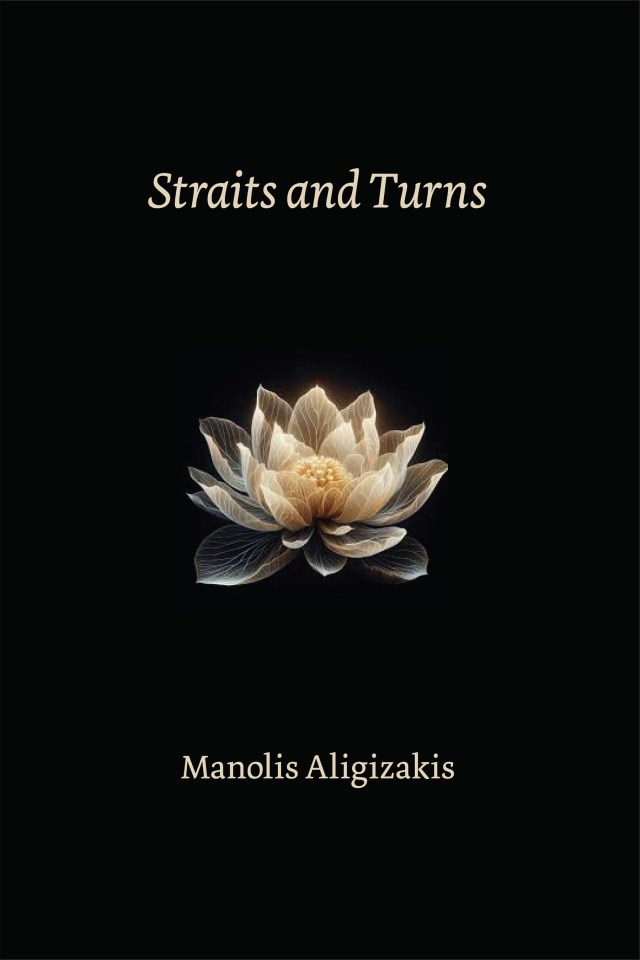
Pip: Manolis Aligizakis runs a site where the ancient and the urgent share the same page — Cavafy and civil war, hobos and murder investigations, all in the same week.
Mara: vequinox has been busy across a wide range of territory — modern Greek poetry, political conflict and social upheaval, and narrative fiction with some sharply drawn characters at the center of it all. Let's start with the poetry.
Greek Voices, Ancient and Modern
Pip: The poetry posts here span centuries of Greek sensibility — from Cavafy's cool historical ironies to contemporary voices wrestling with longing, identity, and the weight of the body itself.
Mara: The Cavafy post sets the tone. Translating the poem "In 200 B.C.," it ends with a pivot that reframes the whole Macedonian campaign: "And from this marvellous Panhellenic campaign, the victorious, the splendorous, the most famous, glorified, as no other has been glorified, the incomparable: we were born."
Pip: So the Spartans sitting it out becomes almost beside the point — the world that emerged from their absence is the real subject.
Mara: Exactly the move Cavafy makes. The Yannis Ritsos posts — two of them, from Volume VI — work very differently, in tight, surreal domestic images: a severed antler left by a mirror, an owl made of sheet metal perched quietly on a roof.
Pip: Ritsos does a lot with a very cold room.
Mara: The Livaditis post, "For Maria," takes grief further: "as I stretched my arm to find your hand, it was as if I stole bread from the hands of the hungry." The Titos Patrikios piece, "Obstacles," turns inward — the speaker raising walls not to repel but to test how far endurance can reach. Katerina Anghelaki Rooke's "Stowaway in a Dream" and the Kariotakis-Polydouri post, "Lost," both circle longing and absence. The Fostieris, Livaditis, Introspection, Hours of the Stars, Orange, Medusa, and Neo-Hellene Anthology posts fill out a week's worth of translated voices, each one landing a different emotional register.
Pip: A lot of that longing has a political undercurrent — which is where the next segment lives.
Conflict, Division, and the Cost of Conviction
Pip: Several posts this week place characters inside political fracture — moments where ideology hardens into something people are willing to die, or kill, for.
Mara: The novel excerpt from Redemption captures it in texture rather than argument. Two characters are hunting near an olive grove when the mood shifts: "Hermes bent down and reached for the fluttering bird; he could see the huge pain in its eyes. Suddenly, the strange shudder overtook his body again, like when he was aboard the ship."
Pip: A man who can shoot without hesitating suddenly can't. That's doing a lot of quiet work.
Mara: The Unquiet Land goes louder — a pub argument about Irish partition, Lloyd George, Carson, and Sinn Fein, where Flynn Casey and Jim Patterson talk themselves toward the edge of civil war. The Troglodytes poem frames the same pattern more abstractly: institutional power dressed in sanctity, "Four Golden Gates to Heaven still stand firm while dividing into castes, races, and creeds." Ugga compresses it to almost nothing — half the planet on the line of fire, white doves, international agreements, and a dead avatar. Twelve Narratives of the Gypsy asks where conviction actually leads: "Strike Chimera mercilessly, life is just a dream."
Pip: From a pub in Ireland to a collapsed avatar in seventeen lines — the scale changes, the problem doesn't. Which brings us to the fiction, where the conflict gets personal.
Character Under Pressure
Pip: The fiction excerpts this week are less about plot than about the moment a character's interior life collides with what the world expects of them.
Mara: Small Change is the clearest example. Rico comes home to an empty house, finds a note, and sits alone in the dark rather than cross the street. When Marianna finds him, she asks what's wrong, and the excerpt gives us this: "He goes to the piano bench and opens it. He takes out the papers he has worked on and holds them up to her. Suddenly he feels very small, and scared and shy."
Pip: A kid showing someone his work in the dark — that's the whole thing, right there.
Mara: What the excerpt does well is hold the reader inside Rico's hesitation without explaining it. Poodie James works a different register entirely — a public hearing where Engine Fred defends a hobo against a bully's insinuation. He tells the council: "It is so not because he risked his life to save someone. It is so because under circumstances that would defeat most of us, he lives his life with independence, dignity and joy."
Pip: A defense of dignity delivered at a lectern, which is somehow more moving than it has any right to be.
Mara: Savages and Beasts stays procedural — RCMP officers questioning a caretaker and a Cretan cook about a murder, a missing kitchen knife surfacing as the key detail. Fury of the Wind puts Sarah in the middle of a crowd enjoying her distress, with Will Andrews forcing his way through to help her. Swamped follows Eteo walking English Bay, his thoughts moving between a drilling project, his parents in Crete, and Vietnamese fishers working nets in the shallows — immigration and displacement held in a single afternoon walk. And Cloe and Alexandra delivers the sharpest scene of the week: Antigony standing before six judges, hearing none of their words, then offering them her severed breast and announcing her name.
Pip: Antigony gets the last word, which feels right.
Mara: What ties the week together is that question of endurance — whether it's Cavafy's Alexandrians, Flynn Casey's republicans, or Rico in the dark with his papers.
Pip: Everyone's deciding how much of themselves to show, and to whom. More of that next time.
“I came here to say what I know about hobos.You have been told that we mean no harm. I believe that we cause none.” Engine Fred paused to look at Stout. “No more harm than most people do, and less than some.” He turned toward Torgerson and halted again. The room was suspended in silence. “But now, this hearing about hobos turns into an attack on the best, the bravest man I have known. He came to help after the train ran off the tracks near the hobo jungle. If he hadn’t, I could not have got the engineer out of the cab. I probably would have been blown up trying. Mr. Stout says that Poodie James is my accomplice. He says that Mr. James and I caused the train wreck so that we could make ourselves look good. That is offensive, Mr. Stout. It is also slanderous.” The fat on Stout’s face quivered as he ratcheted his head in Torgerson’s directon and back to Engine Fred. “’If,’ I said. That’s what I said, ‘If.’ I was only raising a possibility.” Stout’s voice had lost some of its vigor. Engine Fred took a step in Stout’s direction. “That is the defense of a bully and a coward. You made an accusation, Mr. Stout.” He looked at Torgerson. “It did not occur to you that the hobo or his accomplice would defend against it.” He’s even better than I remembered, Sam Winter thought. “Mr. Clarkson,” Spear’s voice cut through the tension, “under the hearing rules, you may make a statement and answer questions. You may not engage in debate.” “Mr. Spear,” Engine Fred said, with the trace of a smile, “you’re trying to be fair, of course. I’ll observe the rule.” He stepped back to the lectern. “I told the council that Poodie James is the bravest man I have known. That is so not because he risked his life to save someone. It is so because under circumstances that would defeat most of us, he lives his life with independence, dignity and joy. He does not accept charity and he does not seek institutional help. He makes his own way, gathering and selling discarded newspapers and bottles.
…dedicated themselves to the benefit of the people’s lives. Ah, my poor motherland…” “Yes, I know. But we’d better go now.” “Yes, let’s go. We might take the other road over the small marsh, and hopefully we could come across some ducks, then we could go by my father’s greenhouse and see what he has accomplished. Sounds okay?” “Yes, let’s get going then.” They followed the road to the marsh. There were a few dark clouds on the north horizon, clouds that lingered in the sky, indecisive clouds, unsure of where they’d like to run; there was light wind blowing from the north, and the weather could change very quickly. A fierce storm could come from the north, which will drench everything in a matter of minutes. “We’d better be quick, Uncle. I don’t like the looks of those clouds.” “I don’t think this weather is going to change any time soon, Son. Why are you so concerned?” But his nephew repeated, “We must be quick, my uncle. I don’t like these clouds.” As they entered the olive grove, Hermes caught sight of a wild dove at the top of a tree. He aimed and shot, quickly and with confidence: he succeeded. He reloaded and ran to pick up the bird, which was still fluttering its wings on the ground. The dog reached the bird first. He approached the bird to pick it up with his mouth, but when he came close to it, the bird fluttered and scared the dog away, barking and wagging his tail. Hermes bent down and reached for the fluttering bird; he could see the huge pain in its eyes. Suddenly, the strange shudder overtook his body again, like when he was aboard the ship. “What is it?” he wondered, and suddenly, he didn’t feel like hunting anymore. The wind started blowing stronger now, and Hermes convinced Demetre that they should head to his father’s greenhouse.