Water in the Wilderness

excerpt

in the far corner of the bed. Her breath spent, Rachael grew still, and Lyssa released her wrists. Without a word she turned away, walked quietly around the bed and, falling to the floor, gathered the doll into her arms. There she sat and rocked back and forth until both cousins quieted and lay still.
Her grief too deep for tears, Rachael lay down on the cold floor. And with the mutilated doll clasped tightly against her chest, she silently made her plans.
“It’s been a good Christmas, sweetie,” Tyne said as she snuggled against Morley on their way home from his parents’ farm. “Our first one as an old married couple. Imagine that.”
Morley chuckled and took his right hand off the steering wheel to put his arm around her shoulders. “Who’s old? Do you feel old?”
Tyne smiled in the darkness. “Not with you around, husband.”
For several minutes they drove in silence, a deep peace enveloping Tyne as she relived the highlights of the day. Her first Christmas off duty for several years was in itself cause enough for rejoicing. But the best part had been her dad’s hospitality towards Morley. She had first noticed his change in attitude when the family had gathered at the farm for dinner in the fall, and she silently thanked God for bringing it about. Jeff Milligan had sat with Morley and Jeremy in the living room on Maple Avenue today, and willingly joined in the conversation.
In the kitchen, she had been helping her mother and Aunt Millie clean up the remains of breakfast and begin preparations for dinner. She smiled now, remembering how her aunt, dishtowel in hand, had stood by the door to the living room and listened for a few moments to the amiable conversation between the three men. Returning to the counter, Millie had picked up a plate and said to her sister-in-law, “I don’t know what you’re putting in my brother’s tea, Emily, but whatever it is, please keep on doing it.”
Tyne’s mother had stifled a laugh, and said in her usual reserved way, “Now, now, Millie ….”

https://www.amazon.com/dp/192676319X

Swamped

excerpt


Today is one of those times. After school, the two sides gather in
the school yard and make all the customary arrangements: putting
goal “posts” in place, deciding who will play what positions, and
drawing straws to see who has the ball first. Then the game commences.
On this day, they play for half an hour and are tied two goals
apiece before all hell breaks loose when Nicolas scores a goal the
other side calls “out,” and Nicolas and his team insist it was a fair goal
and the other team shouts in unison, “Asshole,” which is all the trigger
Nicolas needs to land a couple of good blows with his fists on the two
nearest kids on the other team, and then they all take part in their ritual and fight, and not even a sudden shower of rain can stop the
upper village kids fighting their age mates from the lower village until
three or four from each side have bleeding noses and bruised arms
and faces. Nicolas of course is the keenest fighter on the upper village
side, and he manages to inflict most of the damage on the enemy
until everyone has had enough of fighting and the two teams go their
separate ways
They may be tired of fighting, but their blood is still boiling, and
this is why, when far away from the school grounds, the upper village
kids turn at the side of the hill, from where they cannot be seen from
the school anymore, take off their shoes and socks, lie down on the
wet soil, and give the lower village kids their open hands and toes.
This is their fiercest act of defiance. It is the height of ridicule in this
part of the world to be shown the open palm of another and especially
when even the toes and soles of the feet take part in the insult.
Afterwards, in their respective houses, the children from both
sides have to contend with their mothers’ angry questions: “what has
happened to you?” and “who have you been fighting?” and “why have
you got into another fight?” and “how many times have I told you
not to do this?” These are questions they have all heard many times
but that never stop them from repeating their ritual.
On another day the boys go hunting, all geared up and ready. It
is the middle of July, as hot on Crete as it is every July, and they leave

https://www.amazon.com/dp/B08WP3LMPX

Blood, Feathers and Holy Men

excerpt

Finten took the potion, looked at it and handed it back without
even tasting.
“What is this vile green stuff? It’s going to make me retch again.”
“It’s allium and mint. Drink it. You’ll feel better.”
“Garlic juice! If it kills me, I’ll be relieved.”
Finten closed his eyes and quickly drained the cup. He took a deep breath, then
another. Slowly, the nausea passed.
“Ah, my dear, good friend. Thank you. Thank you. Bless you, Brother. Now look
after your patient, Father Gofraidh.”
Rordan moved toward the old man but Gofraidh motioned him away. Rordan
sat and closed his eyes to the impending headache that always came in stressful
situations.
As the sky grew dark, the wind intensified to gale force. The sea roiled and heaved.
Mountains of angry water tossed the small craft dizzily through the air to the top of
a white-capped wave.
Brother Ailan cried out above the howling wind, “Holy Mother of God.”
Father Finten completed the prayer, “Ora pro nobis.” A reflex bred out of habit.
“Lord, save us,” the usually jovial Ailan whispered as the cauldron shifted, the lid
popped off, and the hapless cook grabbed to rescue a chunk of peat. “Ouch! Damn!”
The tiny craft slipped back, down, down, down. A fountain of icy water washed
over the six miserable monks, huddled together, holding on to the shifting struts.
Leather bulged and snapped against bleeding fingers.
Brother Ailan struggled to unstop a bag of whale oil to pour the contents on the
frothy waves. The bag slipped from his grasp. Putrid smelling oil ran over his feet
into the bottom of the boat and sloshed over Rordan’s and Finten’s feet. “Merda!”
Shit! Rordan swore. Father Finten didn’t even look up.
Once more, Ailan lifted the bag over the side. A wave crashed in, spreading more
oil in the currach than on the waters. While he struggled to return the remaining
whale oil to its storage under the floorboards, Brother Ailan watched a wall of water
crash in to knock the lid from his peat cauldron once more and swamp the smouldering
contents with a mighty hiss.
The shape of the boat seemed to change with each twist and turn. Like a struggling
sheep nipped in shearing, the currach pranced, kicked, and butted with creaks
and groans. The wind howled like demons in agony.
Each time a wave broke against the bow, a torrent of spray swamped the boat. The
Brothers bailed for their lives with buckets and cooking pots.
Father Gofraidh lay half submerged by water in the bottom of the currach. The
old man held a crucifix firmly in his left hand while his right held desperately to the
seat above him.
Mountains of water marched, threatened, marched on. The wind tore the tops
off the waves. Sleet drove horizontally, caking hair and clothing in dripping slush.
Brother Rordan, to stem his own fear, chanted, shakily at first then with increasing
gusto,“Salve, Regina, Mater misericordiae.” Hail, holy Queen, Mother of Mercy.
His voice rose above the wind and waves as though the angels sang. The wind paused
to listen. For an instant, there was calm. Then, a mountain of dark green water rose
above the tiny craft and the miserable mortals were about to be flattened by one giant
slap. Miraculously, the currach glided slowly up the sheer wall.

https://www.amazon.com/dp/1926763106

The Unquiet Land

excerpt

night beyond the window. But tonight was different. Tonight the heavy, unmoving air grew stagnant; it weighed upon the room unstirred by old Finn’s gusty tales. Tonight the old sailor’s verbal gales had died to barely audible sighs.
Finn appeared to be unaware of the deepening depression that had settled over the homecoming party. His mind was on the day many years ago when he first saw Padraig: a skinny boy in short pants, writhing on the cobbles of a market square, foaming at the mouth like a rabid dog. Never would he forget the sight. The crowd pushed back, staring in ignorance and horror at the boy’s convulsions. Two mongrel pups snapped at his legs and arms, and a sheepdog snarled and barked, its vicious teeth bared as if ready to rush in and chomp them into the boy’s neck.
“The whelp with the trousers isn’t putting up much of a fight,” someone said, and the crowd started to laugh. Ignorance and horror relaxed into mirth.
“I wonder what he’d do with a bitch in heat,” said another.
Finn waded through the crowd as through a field of barley, pushing the people aside in anger. He burst into the clearing where the boy was lying still now, his face in the muck that covered the cobbles of The Square. Finn kicked the sheepdog hard; it ran off into the crowd with a howl of pain. The pups pranced around him, yelping still, as Finn knelt down, rolled the boy over and picked him up in his arms.
“I spit on you all,” he shouted to the crowd and carried the boy away down the sloping street to where his fishing boat was tied in the harbour.
Now the Devil’s child, his own adopted son, was home again, a priest.
“I hoped to make a man of you, Padraig.” Finn was rising out of his reverie. “And I made a monk. Well, I suppose that’s not a bad accomplishment, considering what I had to work with. Come now, gentlemen, let’s not look as if we’re at a Presbyterian wake. Let’s drink. Let’s eat.” He turned towards the door that led into the kitchen. “Caitie! Jinnie! Bring us some supper. We’re half a dozen hungry men in here.”
Supper revived the company. Even Clifford forgot his headache and his queasy stomach. He enjoyed the food, the conversation, the dark red wine that everyone started drinking again in large measures. The more they drank, the more convivial they became. Only Finn MacLir seemed more subdued than usual.
“We had many more people here to welcome you last night, Padraig.” Slattery’s purple face was taking on a crimson cast like a spectacular sunset.

https://www.amazon.com/dp/1926763203

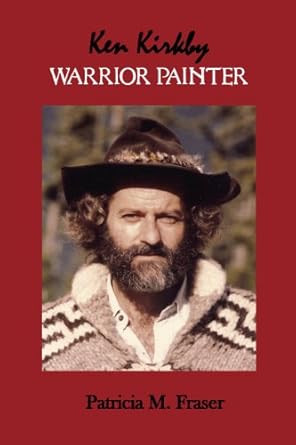
Ken Kirkby, A Painter’s Quest for Canada

excerpt

The day before the exhibit, he helped hang the paintings;
only one in each room of the gallery. Opening night resembled a Hollywood
premier. People gathered in the street and, when a chauffeur
driven limousine drew up to the curb, the media descended. Ken parted
the crowd and opened the door, guiding the Duchess into the gallery. The
crowd inside fell back as though God himself had made an entrance.
Ken led her through the rooms, telling the stories of the Canadian
North. She nodded, smiled, listened attentively, and left as quickly as she
had come. Forty-five minutes later every painting wore a sold sticker.
Ken extended his stay, in order to accept all the invitations he was besieged
with. He had been in Madrid for six weeks, when his father called.
“You must come home right away.”
“What happened?”
“Just, come home immediately. It looks like the trust company has
gone under.”
He flew home the next day and took a cab directly to his father’s apartment,
where he found him more agitated than Ken had ever known him
to be. “This is real trouble,” he said. “We tried to get into the office and it’s
locked – the locks have been changed and nobody is there.”
In his own office, he discovered several key files missing. He arranged
a meeting with other clients of the trust company. There were rumours.
Some said the company principal had moved to the Fraser Valley, where
he had set up an Arabian horse farm and purchased a Rolls-Royce. Others
said he had simply vanished without a trace.
Ken called the RCMP commercial crime division and drove to the station
with his father. The officer explained that the department was aware
of the issue. “It’s a complicated mess,” he said. “We’re going to have to
investigate you and your activities, the same as everyone else.”
The police found many of the missing files but not a trace of the company
president and CEO. Rumours continued to circulate. One claimed
that the head of the trust company had had nothing to do with the missing
funds. It was Ken Kirkby. He was crazy, and smart, and out of the
country when disaster struck. He was the one who had masterminded the
plot. The media ran with it and reporters parked their cars and vans in
front of his house waiting for one glimpse – to take just one picture with a
telephoto lens. Two professional hockey players, convinced that Ken had
taken their money, filed a lawsuit. The judge threw it out of court. Ken
threw himself into the investigation, working with the police day after
day to piece together what had happened.
The RCMP interviewed the victims of the fraud and examined the
documents. Sorting through his own papers became a full time job, and
there were many times he gave up all hope of making sense of them.
His greater despair was the loss of his friends.

https://www.amazon.com/dp/0981073573

The Circle

excerpt

He sits down and looks around the office; the lieutenant catches his eye and
says, “Well, it’s as functional as any other, I suppose.”
The Admiral smiles thinking of his own office, which is very similar.
“Yes, I suppose so, lieutenant. Well, tell me what we know so far; do you have
an autopsy report?”
“Yes, it arrived a little earlier,” Bonetti gives him the written report of the
autopsy.
The Admiral reads the half-page brief and hands it back to the officer.
“It appears to be a clear-cut case, I suppose. Anything else on your mind,
lieutenant?”
“It’s strange that, when we got the phone records from the house, we
determined the widow had made a few calls when she discovered the body. The
first call was to a lover, then to the daughter, then to us third. Then to her
girlfriend.”
“To a lover? There is another man in the picture? I never expected that from
Emily. Are you sure?”
The lieutenant looks him in the eye and says, “No doubt, Admiral. She calls
him “sweetheart” and he says to her, “I’ll be there shortly.” I have seen this
scenario many times, however we cannot place him at the crime scene at the time
of death. The evidence is crystal clear, ballistics, prints, etc.”
“That means the third person has no involvement, I presume,” the Admiral
says. “Who is he, anyway?”
“A person named Talal Ahem, an Iraqi chemist, presently unemployed.”
“I have met this man, Talal Ahem. He is a friend of Hakim Mahdi,
boyfriend of the deceased’s daughter?”
“Yes, Admiral. He was the one with the limo, when I got there.”
“Yes, I know him as well. He’s the nephew of Ibrahim Mahdi, an Iraqi
billionaire, here for cancer treatment. I wouldn’t think these two boys would
have anything to do with this,” he admits to himself aloud.
“Well, it seems you know these people. Now I have something else for you,
Admiral, and this is most strange. When I conducted my examination at the
scene, I noticed signs of tears on the cheeks of the deceased; the medical
examiner confirmed it. The examiner says this man was in a blissful state of
mind when he took his own life. I find that very difficult to follow. Yet the
autopsy confirms that; as you read in the report they found traces of serotonin in
his bloodstream. On the other hand, there was plenty of adrenaline in his
bloodstream also, which means this man had been quite unhappy and angry
before coming to the state of blissfulness, as the examiner put it.”

https://www.amazon.com/dp/0978186524

In Turbulent Times

excerpt

‘Not capable enough, Clifford. Caitlin needs a doctor. Mother Ross says so herself. She’s worried. Mrs Starkey says she’ll give you anything you need from the doctor’s surgery.’
‘No, it’s all right,’ said Clifford. ‘I have everything I’m likely to need here.’ He dithered. Then he drew a deep breath and said, ‘Very well, Michael, I’ll come right away. Let me get my stuff together and put my rain-gear on.’
He climbed back upstairs to his room.
Hurry, Clifford, hurry, hurry, Michael kept saying to himself. For God’s sake, hurry.
At last Clifford came down again, buttoning his raincoat. He carried a black bag in one hand. He shouted down the hall, ‘Timmins, we’re leaving. I’ll be back in an hour or two. Don’t lock the gates.’ Then he turned to Michael and said with a levity lost on the distraught father-to-be, ‘Now, let’s be off to the rescue of this fair damsel in distress.’
He followed Michael to the main road and climbed into the trap. The shafts tipped up, the harness jingled and creaked, the pony snorted and tossed its wet head. Michael jerked the reins a couple of times and shouted. He turned the pony and trap around, and off they went, slowly at first, until the pony found its stride.
God, what a miserable night to be born, Clifford thought. He was nervous. He had already delivered three babies, but they were easy, straightforward births, the first two under supervision. This one sounded difficult. A breech birth at least. Perhaps a Caesarean. He would rather have kept clear of this ordeal but found it impossible to refuse. He had a reputation in the village where many already regarded him as the best new doctor in Belfast. The village was proud of him. This birth would enhance his reputation or shatter it like a dropped mirror. Clifford was worried in case it might go badly. As the rain-beaten cart bounced and swayed towards the MacLir house, Clifford frantically recalled everything he ought to know about breech births and Caesarean sections. By the time he and Michael arrived in the yard behind the house Clifford was confident he could handle any complication. His reputation was assured. It was not the village that was looking on, he thought with typical self-importance, it was the world.
As he rushed across the farmyard to the back door, Clifford slipped on a wet, muddy cobblestone and almost fell. He only just reached the door in time to check his forward fall with his free outstretched hand. That frightened him. Tonight he could not afford to be clumsy.

https://www.amazon.com/dp/1926763270

Poodie James

excerpt

heat of friction on his backside, and his spine raked over the door
jamb. He tried to raise up, but they jerked him backward down the
step and onto the ground. The clubbing began. He wrapped his
arms around his head and tucked into a ball.Two of them straightened
his body by pulling his hands and feet while the biggest man
alternated kicks with blows from a length of wood. The clubs and
boots battered his arms and legs, his torso, his shoulders. The pain
was like fire on his skin. The ache went to the center of his bones.
They let him go, then knocked him off his feet when he got up,
laughing at his contortions when he twisted and thrashed to evade
their clubs.They were killing him, he thought.He was going to die.
Suddenly, the big man was on his back and Engine Fred was on
top of him with a forearm bearing down on his windpipe. Poodie
sat up and saw the other two running down the lane. His head
throbbed. Three more hobos came down along the path from the
jungle. The man on the ground got an arm free, knocked Engine
Fred off balance and was up and running away. He disappeared
into the orchard, headed toward the river. Two of the hobos ran
after him, but came back shaking their heads. It all happened in the
space of a few minutes. The Thorps slept through it, but Engine
Fred told Poodie that he heard a scream. Poodie didn’t know that
he was capable of screaming.
Dan Thorp called the police the next morning. By then, the
hobos had hopped a freight. Poodie could not identify the thugs.
The bruises on his face and body took weeks to heal. Thorp put a
lock on the cabin door. The attack was the worst thing that had
happened to Poodie since his mother died. He lived it over in his
dreams night after night for months. Years later, he still awakened
in fear that the men would come back.
Alice Moore looked up to see Poodie James’s face floating just
above surface of the checkout desk, a stack of books next to it. She
had never seen that face without a smile. She looked at the books;
Howard Carter’s The Discovery of the Tomb of Tutankhamen, three
books about whales, a collection of de Maupassant stories.

https://www.amazon.com/dp/B08W7SHCMV

Arrows

excerpt

amazement, our eyes locked often, for my face was in darkness and
my eyes half-closed. She somehow sensed my gaze. My heart
rushed a little every time, as if some strange and invigorating
connection had established itself between us.
The men had been tied around a tree, including the boy who
had fought to free Apacuana. I wondered who he was, likely her
brother.
Losada, along with Gregorio and Pánfilo, had entertained himself
in pacifying the Indian boy, but the youth’s courageous rejection of
every kindness didn’t amuse Losada long, and he had ordered him
tied up with the men.
My head throbbed. I was feverish again. I lay with my back to
the fire, concentrating on the frogs and crickets singing their night
song, hoping their music could distract me from my growing
queasiness. The fire crackled as sap pockets exploded, sending
fiery dots into the sky.
The moon was full, though there were some clouds. I was still
learning to read the signs of the sky in this new land. The rainy time
had just begun, and I was surprised at how suddenly the water
poured from the heavens and, just as suddenly, stopped and the
skies cleared.
My head felt ready to burst. I put a hand to my head. A moan of
agony and desperation stuck in my throat, and I sat up, closing my
eyes and swaying with dizziness. My breathing had gone from
heavy and deep to shallow and fast.
I crawled on all fours to the nearest tree and puked bile that made
me shudder with its bitterness. I had nothing in my stomach in the
way of food. A temporary moment of relief came over me, and I sat
with my back against the trunk, blinking owlishly, until I
remembered Apacuana again. What would become of her?
A head popped up in front of me, silhouetted against the fire. It
was Tamanoa. “What is the matter?” he asked. “You are sick again!”
“I’ll be all right in the morning. Don’t worry, I know these pains. I
get them occasionally.”
“What pains? Where does it hurt?”

https://www.amazon.com/dp/0981073522

Jazz with Ella

excerpt

It was to one of these, the park on Mamaev Hill, scene of a prolonged battle, that the combined tour group, accompanied by Natasha, arrived by bus. This time Natasha was quiet; there was no need for her to whip up enthusiasm. The spectacle of Mother Russia—a behemoth of a statue brandishing her sword and poised on the hill overlooking the city—excited the visitors.
“That’s got to be taller than the Statue of Liberty,” exclaimed one of the Americans to Jennifer as they shuffled along with crowds of Russians winding their way through a memorial park up to the statue’s base. “It’s really impressive.”
She smiled. “It’s a commemoration of a siege that no one here has forgotten; nothing could be too big or too dramatic for that.” So far the Americans had not admitted that anything about the Soviet Union was bigger or better than the good old US of A. This was a first, she reflected.
“Where are you from?” the man asked her, and when she replied, he nodded. “Y’know, that’s near Seattle where I’m from,” he said. “I’m Bert, by the way.” He extended his hand and Jennifer introduced herself. “You Canadians know all about Russia, don’t you?” Although she began to protest, he continued. “See, we weren’t told much before we came. I don’t know if you’ve heard of the cold war… yes? Well, it’s pretty hard to visit this country right now without everyone at home thinking we’re reds. We’re probably being investigated by the CIA for even coming here.”
“Wow, that’s frightening,” Jennifer said, amused at his naïveté—an attitude she might have shared just a few short weeks ago. Little does he know that he’s probably being investigated by the KGB at the same time.
“You know, the people in our group just want to find out more about the real Russia,” Bert went on. “We don’t want to believe everything we read in the papers about the ‘evil commies.’ You think that way too, don’tcha?” Jennifer nodded agreement.
“This is all real swell,” he continued, marvelling at the faces of warriors etched in marble around him. The slowly moving line of visitors advanced up the hill towards the statue and then indoors into a tomb-like memorial chamber at the top of the hill. Once inside, an illuminated path spiralled downward around the chamber, and they gazed at the names of the fallen soldiers and citizens inscribed on every available inch of the walls. Jennifer noticed that Bert had tears in his eyes.
“It’s very moving,” he told her. “All these people…” He shook his head. “It makes you think about the ugliness of war.

https://www.amazon.com/dp/1926763246