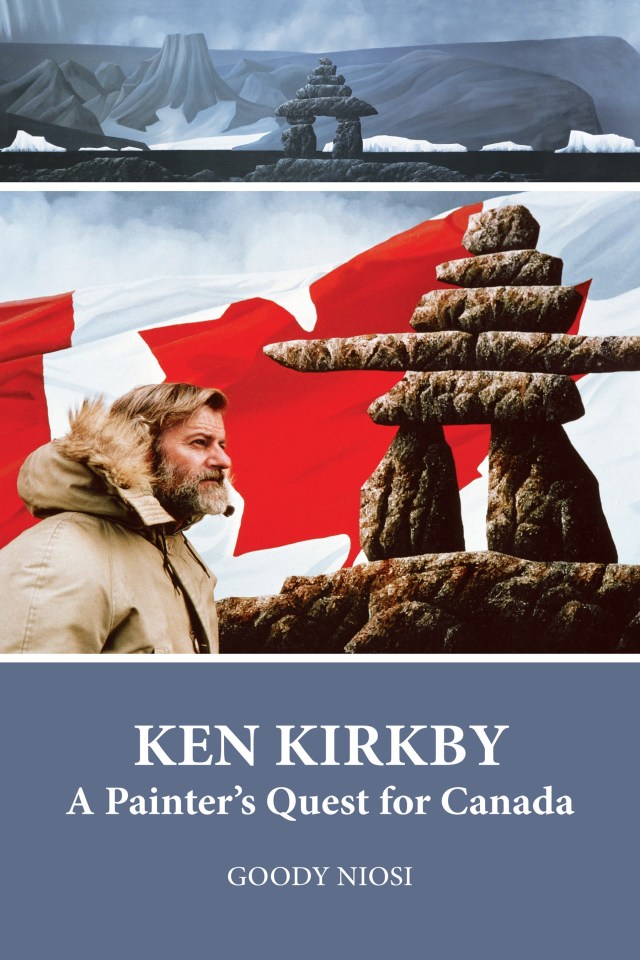
Ken Kirkby, A Painter’s Quest for Canada

excerpt

The media continued to be fascinated by him, the way an audience is
mesmerized by a performer who embarrasses himself inadvertently, on
a talk show. Ken had stepped so far outside the boundaries, had put on
a show so over the top, right down to the Inuksuit painted on the streets,
that the media haunted his studio just to see what would happen next. Ken
continued to feed them quotable lines that seemed to come effortlessly to
his lips, but that he had, in fact, been practising for months and years.
But, tidbits wouldn’t feed them forever. Eventually they would want to
stop nibbling and indulge in another meal – and the next banquet would
have to be bigger and better than the last.
He met Salvador Grimaldi for lunch again at Boccacio Restaurant, in the
Columbus Centre, and once again the architect came bounding into the
room, perfectly dressed in understated, expensive clothing, his eyes sparkling,
and his smile spreading goodwill around the room. Ken had a plan.
He told him that his next project had to be an even larger success than
the last, and described the two immense paintings he was currently working
on: one was a sixteen by sixteen foot canvas, featuring an Inukshuk set
against an enormous white cloud, that was intended for the Reichmanns.
Why the Reichmanns? Salvador asked.
“They are a very prominent family which the media and the public
have become very interested in,” Ken said. “They’re secretive and almost
impossible to approach. I’ve been studying them, and the information is
very sparse. I know they spent time in Valencia after leaving Eastern Europe,
and then they spent time in Morocco, and then from Morocco they
moved to Toronto: they started a tile business that immediately turned
into a raging success. Then, they went into high-end real estate development,
in which they have achieved even greater success. They are an
intriguing family – and just what I need. I need a Lorenzo de Medici.”
“I want to get to a place where other people cannot go. I want to sell
a painting to a man who doesn’t buy paintings and see it hung in the
foyer of the tallest building in the British Commonwealth – and have that
become a media event – even though they don’t like the media, that is
what I am after. What do you know about the Reichmanns that you feel
comfortable passing on to me? I get the idea you’re pretty close to them.”
Salvador allowed that he was close to Albert Reichmann, who preferred
to be called Mr. Albert. He had done his corporate landscaping and was
currently working on his personal property. “He’s a prince,” Salvador said.
“A merchant prince. He is a man of many talents, and I find it interesting
that you would have, instinctively, known that.’
Ken took Salvador to the studio to see the Reichmann and Yellowknife
Airport paintings, in progress. When he unlocked the door and switched
on the bank of lights, Salvador froze. The larger painting was nearing
completion while the other was only half finished.

https://draft2digital.com/book/3562830

https://www.amazon.com/dp/0981073573

Poodie James

excerpt

town and the prospects. He listened carefully to the details of the
planning. The enthusiasm of his own replies still rang in Jeremy’s
mind.
“Dad, the state is only 13 years old. There’s opportunity everywhere.
East of the mountains, they’re bringing water to the land.
It’s going to bloom and it’s going to make people rich. It’s in the
center of the state, on the river, on the railroad that runs east and
west. They’re already shipping apples to Chicago and back east.
They’ll need a good newspaper. A paper can make a difference in
how that valley develops. The man who owns that paper will be an
influence.”
“And Winifred? Is it right to take your young wife away from all
she’s known, into a wilderness?”
“It is not a wilderness.” Jeremy reached into his breast pocket for
a post card and handed it to his father. Zeb Stone studied the
scene: A few buildings, a handful of carriages, a line of poles, the
blurred image of a man striding across a dirt street that stretched
into an infinity of sagebrush and bare hills. He looked up and contemplated
the club’s spread of gardens, fairways and trees. Jeremy
was determined to go west with or without his father’s approval,
but he ached for the endorsement. The perspiration and the dread
accumulated as he waited. The severity of the look his father
turned on him, his relief when a trace of a smile appeared and his
father offered to help with finances; it was all as clear as the day it
happened.
“As it is, sir, I’m going to use your money” Jeremy told him. “I
haven’t touched the trust fund since I turned 21. I’ll take money
from that and my savings and, if need be, Win will chip in from her
inheritance. We want to do this on our own.”
“If you ever decide to go back into banking, tell me,” Zeb Stone
said. “A growing town will need a good bank.”
Jeremy never dreamed that 25 years later he would turn his
newspaper over to his wife and plunge fully into banking. Winifred
had turned out to be as good a publisher as he was, and a better,
tougher editor. He had stayed out of the paper’s business since

https://draft2digital.com/book/3562868

https://www.amazon.com/dp/B08W7SHCMV

In the Quiet After Slaughter

excerpt

But their censure didn’t weaken her resolve. She savoured my
father’s embarrassment — and cursed his having been conceived
every step of the way home.
He drank with old navy buddies at one of the Canadian Legion
branches and foolishly denied doing so. He attempted to disguise
the alcohol on his breath with Halls Cough Drops. Tobacco fumes
clung to his clothes like an invisible lint. Sometimes my mother
alleged the scent of woman.
On occasion, it was true, my father would take off for a few days
—to where, no one knows. Going absent without leave guaranteed
an intensified resumption of their conflict at some future date. The
air in our house crackled in anticipation of the rematch.
Once, to regain entry, he claimed to have gone angling with
friends.Mymother circled him warily, a dog sniffing a fire hydrant.
– Lying bastard!
Punishment often entailed his eviction from their bedroom. Banishment
could stretch from three days to three months, depending.
He appeared relieved to be sentenced to an air mattress on the living-
room floor. Because mybrother Burt and I often took myfather’s
side, it was self-serve in the kitchen until a truce was reached. Our
body weights fluctuated accordingly.
I viewed my father’s carousing like this: he was born during the
First World War and orphaned in the Depression. He spent the best
part of his 20s fighting the Second World War. I reckoned the occasional
disappearance was his way of making up for lost time.
People sometimes remarked that my parents seemed to have little
in common. This may have been the case. But there had to be a reason
they were able to cohabit for as long as they did. I think they
were joined together, as many unions are, by the sum of their unfulfilled
expectations, and because as the years passed, options
decreased and habits fossilized.
My parents, you see, were either in love or at war. Rancour
seemed an aphrodisiac. There was no Switzerland, no neutral
ground. It was the one thing they seemed to agree on: the enemy of
love is indifference.
My mother, in anticipation of their evening fete, had passed the afternoon
tethered to the dresser. Her features had been transformed by …

https://draft2digital.com/book/3562874

https://www.amazon.com/dp/B00731WSPE

Jazz with Ella

excerpt

“What do you mean by that?”
“Look, it doesn’t have your name on it.” She had the sensation of the floor moving away from her and decided to run for the door while her dignity was still intact.
Back in her cabin tears overwhelmed her. You give me hope. She missed Volodya more than ever. She sat on the bed and smoothed the crumpled paper, studying it, trying to understand what Chopyk had meant. True, it was not addressed to her but had been sent in care of Natasha Kuchkov as tour guide. A number followed—presumably that represented the bureaucratic Intourist agency’s official designation for the tour. If it had not been intended for her, then who? Did he really send it? Volodya was a very common name—and there was no last name. So how did Natasha know whom to check? And how did Natasha know the telegram was meant for her?
Her class that afternoon was conducted in a pall of discomfort. Most of the students had overheard the dispute in the dining room without knowing exactly what had transpired. She thought of having Paul lead the class instead of her but she couldn’t find him anywhere. The mood stayed with her through the formal dinner that evening, well into the hour of entertainment—several of the students had learned Russian poems or ditties and were amusing the Americans by reciting the translations—and it lasted on into the evening.
As she lay awake, she began to have doubts about her behaviour. Maybe Chopyk was only being a good guy, after all—meddlesome but showing genuine concern. Maybe Volodya was a dead loss. After some agonizing, she realized that Volodya must know Natasha. Of course. He must have known her when he had worked for Intourist. She had even said she was from Leningrad. They would have been colleagues. That would explain a lot. So maybe Natasha had known about Volodya and her all along. Could he have wanted Natasha to see the telegram—maybe to let her know that he was attempting to leave the country? Could it be that Natasha was helping? As Jennifer rolled on to her back in the cabin berth she felt the increased pressure from Volodya as if it were some live thing pressing on her chest. What a day! Even the strange comment from Hank in the hallway that morning. It all fit into the stew. She fervently hoped that sleep would give her some respite from her muddled thoughts.

https://draft2digital.com/book/3562892

https://www.amazon.com/dp/1926763246

Swamped

excerpt

Eteocles in grade two and Nicolas in grade four. It doesn’t
take them long to gang up with other kids, but because they are newcomers,
some of the other children start picking on Eteocles, choosing
him because he is the smaller of the two. Sometimes they push
him against a wall or block from going down the stairs before others.
Sometimes they try to intimidate him with threats. This goes on until
Nicolas discovers what is happening, and after he finds out who the
ringleader is, he rewards him with a few good punches on the stomach
and head. These make the third grader start howling, and Nicolas
ends up in the principal’s office and is suspended from school for two
days. It is his first suspension, but more will follow as the days and
years go by.
Within only a couple of weeks, the two brothers have done all
their exploration of the immediate area, made new friends in the
neighborhood, and become familiar with all the surroundings. They
like their new neighbourhood, but especially the water pump they
call touloumpa. Eteocles loves to work its lever and draw water from
the depths of the earth. He loves the freshness of the cool well water
and with some practice gets good at working the lever with one arm
while drinking the refreshing water out of the palm of his other hand.
Another favorite spot is by the two big trees about a hundred meters
from their house where all the boys and girls of the neighborhood
play their favorite characters, Tarzan and Jane, Gaour, and Tatambou,
and all the other heroes, the detectives, the resistance fighters during
the German occupation, all the daring characters they know so well
from their comic books.
Every Sunday afternoon their parents take the boys down to the
promenade by the Gulf of Salonica where they walk from west to
east, usually stopping near the White Tower where their dad buys
them ice cream during the hot summer days or roasted chestnuts
during the cold days of autumn and winter. This is the only entertainment
they can afford, but the boys love it every time, even if the
scenery is always the same and the long walk tires them out especially
on the uphill walk back to their suburb of Sikies.
Today, like any other Sunday, after they attend mass at the local
church and have their noon meal at home, their mom tells them …

https://www.amazon.com/dp/B08WP3LMPX

https://draft2digital.com/book/3562976

Blood, Feathers and Holy Men

excerpt

Fire and Ice
For several days, the ship lay on a becalmed sea. While Finten and Ailan sat discussing
their worst fears – their slavery, the long cold winters, and uncertainties of the
future – bubbles began bursting on the water surface, becoming more and more
intense as the ship drifted slowly landward. When several fish popped up to float
dead on the water, one of the men reached over the side to retrieve a floating cod. He
remarked that the sea felt amazingly warm. Two other crew members reached into
the water and pulled out a small halibut. Everyone gathered around in amazement.
As more Norsemen plucked up floating fish, the meat fell apart in their hands
and onto the deck. When the first man remarked the fish he’d pulled up smelled
fresh-cooked, he pushed back the scaly skin and took a tiny nibble then another
and announced that it tasted good. Another sniffed then took a nibble while others
watched. Those who had dared to taste ate on and other Norsemen reached over the
sides for fish and laughed as they ate.
The Brothers joined the crew at the ship’s rail but by then hissing hot air burst
close to the prow and pulsating plumes of sediment, the colour of egg yoke, rose to
the surface and surged all around the ship. Clouds of yellow steam filled the air with
the smell of sulphur, making breathing difficult. Then a slow-moving cloud of white
smoke enveloped the ship and droplets of rain burned exposed skin, causing blisters.
The men dropped their fish and ran to the prow in a panic.
Finten’s worst fears had been realized. He knew they had finally travelled too
far and were now on the edge of hell. Soon pagans and Christians alike would be
plunged into the fiery depth. Once more he prayed aloud the psalm of death and his
Brothers joined in: “Out of the depth I cry to you, O Lord. Lord, hear my prayer.”
Captain Hjálmar shouted for calm. “And shut that infernal babbling. You papish
thralls are worse than a bunch of old women. How can I think with all that commotion?”
After about an hour of increasing turmoil in the water, the ship lurched, as a firebreathing
monster rumbled, spurting hot ash into the air. A wave formed, seemingly
out of nowhere, and pushed the Nordic knarr from the seething mountain, which
now burst and heaved its way above the boiling water. Freki ran to his captain. “I
knew it. I knew it. Now we’re all going to die in fire and water.” Everyone on board
cried out to different gods in fear and trembling. Only Captain Hjálmar appeared to
maintain his calm until he bellowed, “Quiet! Pay attention.”
Still Freki jumped up and down pulling at the captain’s cloak and shrieking. Hjálmar
pushed Freki aside and shouted above the din, calling for buckets of seawater
to douse the hot coals smouldering among the panicked sheep. The sky filled
with black clouds. A staccato of thunder and lightning sounded like Thor’s hammer
to the terrified Norsemen, while a monstrous wind roared out of nowhere to send

https://www.amazon.com/dp/1926763106

Ken Kirkby, A Painter’s Quest for Canada

excerpt

same feeling about you as I had about where that puck would be.”
“I want to help you,” he said one day over lunch.
“I’d appreciate all the help I can get,” Ken said. “There hasn’t been a
helluva a lot of it at this point.”
“Yes, so I gather.”
Virgil Pires, a tall Portuguese man, became another frequent visitor.
“You come from my country,” he said when he introduced himself.
“You’re almost Portuguese. I love what is in the papers and on TV. You
talk about my country with so much love.
“I wasn’t born in Portugal,” Ken said. “But I think that part of my soul
is Portuguese.”
The collection of paintings for the show grew, most of them featuring
an Inukshuk standing sentinel over the stark Arctic landscape. Irving and
Virgil visited almost daily, moving the paintings around, discussing the
merits of each one, and arguing about who should purchase which. Virgil
liked to say proudly, “He’s Portuguese, you know.”
Irving argued, “Portuguese, my ass. He’s no more Portuguese than
I am. He’s a mongrel – Danish, Irish, Spanish, French, Italian, Jewish
grandmothers, Christian grandfathers – grew up in Portugal – I tell you,
he’s a mongrel!”
“Oh no!” Virgil protested. “This is brilliant! This is magnificent! It was
written in heaven! This man has a place in heaven!”
Ken painted, working in a world he was entering for the first time.
These visions of the Arctic had been bottled up inside him for years, and
a great dam had burst open, spilling out a Niagara of creativity. The faster
he painted, the more powerful the pictures.
The week before the show, Irving and Virgil began to choose the paintings
they wanted, arguing good-naturedly over several of them. “You
can’t have them all,” Ken said. “You can only have twenty paintings!”
“Between us or each?” Virgil asked.
Were they serious? Ken wondered, beginning to feel excited. “Each,”
Ken said.
He had completed ninety-six canvases. Virgil and Irving fell on them
with the glee of schoolboys who had just been told they could choose a
dozen of any sort of candy in the store. They argued, talked, and wrangled
possessively over one or two of the larger paintings, until each had a
pile of twenty. “How much?” they wanted to know.
Ken forced his voice to remain calm. He studied each painting and methodically
wrote the price on a slip of paper. The forty canvases totalled
eighty-five thousand dollars.
Neither man flinched. Instead, they insisted on a celebration, and over
a bottle of good wine, Ken explained that their paintings would be part of
the exhibit – and he recalled one of Alex Fraser’s pieces of advice.

https://www.amazon.com/dp/0981073573

https://draft2digital.com/book/3562830

The Unquiet Land

excerpt

She used to stick up for Nora like an older brother. Fearless, she was. What a girl.”
Finn’s voice trailed away, but the wistful look remained. He was recalling scenes from long ago. “I was working on the boat one summer afternoon. Hot as an oven, I remember. Had been for several days. The children were playing on the harbour. Half a dozen of them. Boys and girls. They must have been ten or eleven years-old at the time. Clifford Hamilton was there. He was a bumptious young fellow even then. He started teasing Nora. I don’t know what he was saying because I was too far away. But you know Nora. Always sensitive, easily embarrassed. Whatever young Clifford said, Nora took it ill. It obviously upset her. That got Caitlin’s back up. Man alive, she lit into Clifford like a she-cat. Next we knew, Clifford was over the edge and into the water.” Finn chuckled. “It happened so quickly no one could do anything to prevent it. I saw it coming and I shouted, but I was too late. Even if they heard me, which I doubt. And Caitlin just stood up there on the lip of the harbour, hands on her hips, and continued shouting at poor Clifford who was swimming to the ladder to get out.”
“The tide was in then,” Padraig said.
“By good fortune it was.” Finn said. “Clifford would have been in one hell of a mess if it hadn’t been.”
Then the old man fixed his pale grey eyes on Padraig’s emaciated face for a few moments of silent but stringent admonition. “I hope you’ll leave Caitlin alone, Padraig. I hope you won’t try to force her to conform to your impossible Christian practices. Keep that nonsense for the saintly Nora. Caitlin’s different. She has pride in herself, and I want her to keep it. I want her to know that her accomplishments—and they are many—are her own, her very own. I would hate her to go through life thinking that she owed them to a non-existent god, that they were the hand-outs of divine charity. What pride can anyone derive from that? So leave Caitlin alone. Do you hear me?”
Padraig remained silent. He returned Finn’s unwavering gaze with a look of obdurate purpose. The two men sat in this dualistic pose for several seconds.
“So that’s how it is,” Finn said at last.
Still Padraig did not answer. He looked away from Finn with harrowing sadness and regret, his glance settling on the pale porcelain of the Victory of Samothrace.
“Damn you, Padraig,” Finn said with feeling but without raising his

https://draft2digital.com/book/3562888

https://www.amazon.com/dp/1926763203

Ken Kirkby, Warrior Painter

excerpt

To have the warmth and companionship fade away now that he had time
to devote to her in the pursuit of her dreams seemed to be nothing short of
cruel. Whatever it took to appease Karen would be done.
~~
Now, in Bowser, Ken was faced with the sudden realisation that he had
been living life on autopilot. It was a severe jolt for the man who prided
himself on being attentive at all times to what was going on, both within
himself and in the world surrounding him. As a quicksilver dawn slipped
above the scattering of islands offshore, Ken made a fresh pot of coffee and
realized he’d made a breakthrough. It had been a long night coming to grips
with the situation. Self-awareness was a fundamental state of mind for him,
but as he replayed the recent years, he could identify countless occurrences
that had ultimately reduced him to this astonishing loss of control.
His elusive mind was stubborn in its refusal to follow an orderly chain
of thoughts, and he became aware that for months, perhaps even years,
his overloaded brain had taken refuge in the distractions provided by an
intelligent mind. No matter how vigorously he attempted to discipline it to
the process, it slid sideways into something less conflicting.
The act of thinking had become busy work, necessary in order to avoid
the bleak despair that filled him, most especially intensified when Karen had
withdrawn. But he now recognised it was an escape mechanism that needed
to be meticulously managed. For the first time in a long while, he was
looking with a clear eye at the core of his anguish rather than retreating from
it. Gradually he was being filled with certainty that, with this awakening, he
was exactly where he should be.
My real job now was to be painstaking in programming my healing,
much as I did in Portugal when my dad turned the problem of beating
my recurring childhood illness over to me.
Ken was frequently ill in his early years. Although no medical expense
was spared, the ailment remained unnamed. He had grown weaker, thinner
and yet more tired following relocation from Britain to Spain. However,
in his mother’s Spanish culture, weakness—whether physical or mental—
was never to be acknowledged. It was only after the family rejoined Ken’s
dad in Parede, Portugal that the six-year-old was permitted to articulate…

https://www.amazon.com/dp/B00CB8W4CG

https://draft2digital.com/book/3562902

Jazz with Ella

excerpt

VOLGA RIVER, JULY 17, 1974
“She’s madder than a hornet, and she’s calling for your blood,” teased Marty. He ducked out of Hank’s way. It was lunch time on the morning after Hank had found Lona’s mysterious black book. “I guess she tortured your waitress friend until she confessed.”
“I’ll go find her,” Hank muttered. “I don’t want Chopyk or Jennifer to find out. Don’t say anything, okay?”
He didn’t have far to look. They smacked into one another at the door to the dining room.
“You…creep,” Lona growled at Hank, her usual Cheshire cat smile missing. “Now, give me back my book!”
He couldn’t resist one last stand. “Uh…whatcha talking about?” She was about to raise her voice again, when he hustled her down the hall, one hand firmly on her back, until they were out of earshot of the passengers.
“Okay, so I took it. It was a stupid thing to do, but I wanted to know why you’re on this trip—and don’t give me that line about being a student.”
Lona drew herself up to her full height and bristled like an alley cat prepared to do battle. She thrust out her hand imperiously. “It’s none of your business, you thief. I want my book back right now!”
Hank knew when he was licked. “I just …heck, I’d still like to know. I’ll get it for you.” He walked her to his cabin, and she waited at the door, tapping her toe, until he placed the worn black book in her hand. “Come on, Lona. I just wanted to get to know you. Maybe we could still be friends.”
In fact, the book had been a big disappointment—besides a list of Russian names and addresses there were only a few other notes on icons

https://draft2digital.com/book/3562892

https://www.amazon.com/dp/1926763246