Cretan Canadian Poet, Author, Translator, Publisher
Author: vequinox
BIOGRAPHY
Manolis (Emmanuel Aligizakis) is a Greek-Canadian poet and author. He was recently appointed an honorary instructor and fellow of the International Arts Academy, and awarded a Master’s for the Arts in Literature. He is recognized for his ability to convey images and thoughts in a rich and evocative way that tugs at something deep within the reader. Born in the village of Kolibari on the island of Crete in 1947, he moved with his family at a young age to Thessaloniki and then to Athens, where he received his Bachelor of Arts in Political Sciences from the Panteion University of Athens. After graduation, he served in the armed forces for two years and emigrated to Vancouver in 1973, where he worked as an iron worker, train labourer, taxi driver, and stock broker, and studied English Literature at Simon Fraser University. He has written three novels and numerous collections of poetry, which are steadily being released as published works. His articles, poems and short stories in both Greek and English have appeared in various magazines and newspapers in Canada, United States, Sweden, Hungary, Slovakia, Romania, Australia, and Greece. His poetry has been translated into Spanish, Romanian, Swedish, German, Hungarian languages and has been published in book form or in magazines in various countries. He now lives in White Rock, where he spends his time writing, gardening, traveling, and heading Libros Libertad, an unorthodox and independent publishing company which he founded in 2006 with the mission of publishing literary books. His translation book “George Seferis-Collected Poems” was shortlisted for the Greek National Literary Awards the highest literary recognition of Greece.
Distinguished Awards
Winner of the Dr. Asha Bhargava Memorial Award, Writers International Network Canada, 2014
“George Seferis-Collected Poems” translated by Manolis, shortlisted for the Greek National Literary Awards, translation category.
1st International Poetry Prize for his translation of “George Seferis-Collected Poems”, 2013
Master of the Arts in Literature, International Arts Academy, 2013
1st Prize for poetry, 7th Volos poetry Competition, 2012
Honorary instructor and fellow, International Arts Academy, 2012
2nd Prize for short story, Interartia festival, 2012
2nd Prize for Poetry, Interartia Festival, 2012
2nd Prize for poetry, Interartia Festival, 2011
3rd prize for short stories, Interartia Festival, 2011
Books by Manolis
Autumn Leaves, poetry, Ekstasis Editions, 2014
Übermensch/Υπεράνθρωπος, poetry, Ekstasis Editions, 2013
Mythography, paintings and poetry, Libros Libertad, 2012
Nostos and Algos, poetry, Ekstasis Editions, 2012
Vortex, poetry, Libros Libertad, 2011
The Circle, novel, Libros Libertad, 2011
Vernal Equinox, poetry, Ekstasis Editions, 2011
Opera Bufa, poetry, Libros Libertad, 2010
Vespers, poetry by Manolis paintings by Ken Kirkby, Libros Libertad, 2010
Triptych, poetry, Ekstasis Editions, 2010
Nuances, poetry, Ekstasis Editions, 2009
Rendition, poetry, Libros Libertad, 2009
Impulses, poetry, Libros Libertad, 2009
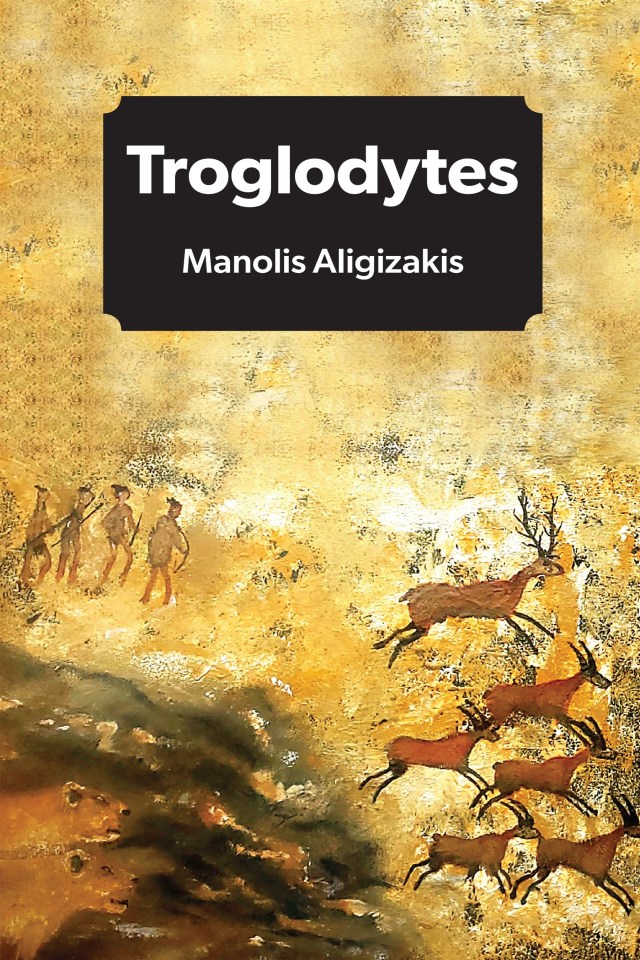
Troglodytes, poetry, Libros Libertad, 2008
Petros Spathis, novel, Libros Libertad, 2008
El Greco, poetry, Libros Libertad, 2007
Path of Thorns, poetry, Libros Libertad, 2006
Footprints in Sandstone, poetry, Authorhouse, Bloomington, Indiana, 2006
The Orphans - an Anthology, poetry, Authorhouse, Bloomington, Indiana, 2005
Translations by Manolis
Idolaters, a novel by Joanna Frangia, Libros Libertad, 2014
Tasos Livaditis-Selected Poems, Libros Libertad, 2014
Yannis Ritsos-Selected Poems, Ekstasis Editions, 2013
Cloe and Alexandra-Selected Poems, Libros Libertad, 2013
George Seferis-Collected Poems, Libros Libertad, 2012
Yannis Ritsos-Poems, Libros Libertad, 2010
Constantine P. Cafavy - Poems, Libros Libertad, 2008
Cavafy-Selected Poems, Ekstasis Editions, 2011
Books in other languages
Eszmelet, (Hungarian), poetry by Manolis Aligizakis, translated into Hungarian by Karoly Csiby, AB-ART, Bratislava, Slovakia, 2014
Hierodoules, (Greek), poetry, Sexpirikon, Salonica, Greece, 2014
Yperanthropos,(Greek), poetry, ENEKEN Publications, Salonica, Greece, 2014
Übermensch (German), poetry by Manolis Aligizakis, translated into German by Eniko Thiele Csekei, WINDROSE, Austria, 2014
Nostos si Algos, (Romanian) poetry by Manolis Aligizakis, translated into Romanian by Lucia Gorea, DELLART, Cluj-Napoca, Romania, 2013
Tolmires Anatasis, (Greek) poetry, GAVRIILIDIS EDITIONS, Athens, Greece, 2013
Filloroes, (Greek ) poetry, ENEKEN PUBLICATIONS, Thessaloniki, Greece, 2013
Earini Isimeria, (Greek) poetry, ENEKEN PUBLICATIONS, Thessaloniki, Greece, 2011
Stratis o Roukounas, (Greek) novel, MAVRIDIS EDITIONS, Athens, Greece, 1981
Magazines
Canadian Fiction Magazine—Victoria, BC
Pacific Rim Review of Books—Victoria, BC
Canadian Poetry Review—Victoria, BC
Monday Poem, Leaf Press-Lantzville, BC
The Broadkill Review, Milton, Delaware
Ekeken, Thessaloniki, Greece
Envolimon, Beotia, Greece
Annual Literary Review, Athens, Greece
Stigmes, Crete, Greece
Apodimi Krites, Crete, Greece
Patris, Crete, Greece
Nyxta-Mera, Chania, Greece
Wallflowers, Thessaloniki, Greece
Diasporic Literature Spot, Melbourne, Australia
Black Sheep Dances, California, USA
Diasporic Literature Magazine, Melbourne, Australia
Spotlight on the Arts, Surrey, BC
Barnwood, International Poetry Magazine, Seattle, USA
Unrorean, University of Maine, Farmington, Maine, USA
Vakhikon, Athens, Greece
Paremvasi, Kozani, Greece
Szoros Ko, Bratislava, Slovakia
Mediterranean Poetry, Sweden
Apostaktirio, Athens, Greece
Life and Art, Athens, Greece
Logos and Images, Athens, Greece
Contemporary Writers and Thinkers, Athens, Greece
Palinodiae, Athens, Greece
Royal City Poet’s Anthology, 2013, New Westminster, BC, Canada
To parathyro, Paris, France
Ragazine C.C, New Jersey
Artenistas, Athens Greece
Deucalion the Thessalos, Greece.
Literary Lectern, Athens, Greece
Homo Universalis, Athens Greece
God’s cry named us from there Tomorrow we’ll swim again tomorrow we’ll travel more tomorrow the dawn will ask for our endurance and we’ll respond to the sea We wrote our first verse in the sand while the insisting masts looked at us solemnly and the wave whispered the eternal homecoming We stood on the rock like busts of escape staring at the moon designing circles asking our secret about ships carrying white shadows about the endless voyage about the anchor that didn’t nail the water We touched our wound and time and we escaped The voyage always remains with us and the endless clamor of the sea The ships had come with the dawn loaded with wheat coal and wine for the dreams of captains for the food of fire You threw the bread the wine and coal and remained naked in the sea without cloth covering your ribs without love hiding your eyes The hour had the color of secret pearl sunk in the thought of dawn with distant voices filled with danger and promise You looked at your body in the water and you loved the water forgetting your body Oh voyage without any burden with fire without coal with hunger without bread with thirst and elation without wine
II Décor and pompousness abound on the outside and the headman’s crown, while a dark shade swirls in his heart like a heavy shroud blanketing logos leading the way toward a thick bog. “This time, perhaps this time we shall prevail over them and stitch on bitter lips of life the ever phony and capricious laughter”, the headmaster claims in his role marching as in a pantomime. He graces the simple-minded with a false yellow beacon perpetuating their sanctified killing. Beast man against man deep stigmata colored in dark red or light gray on the faces and on the limbs and in the spirits. How would the hungry wolf listen to the voice of the pious lamb? How would the voracious volcano, listen to the dry kindling in the summer forest?
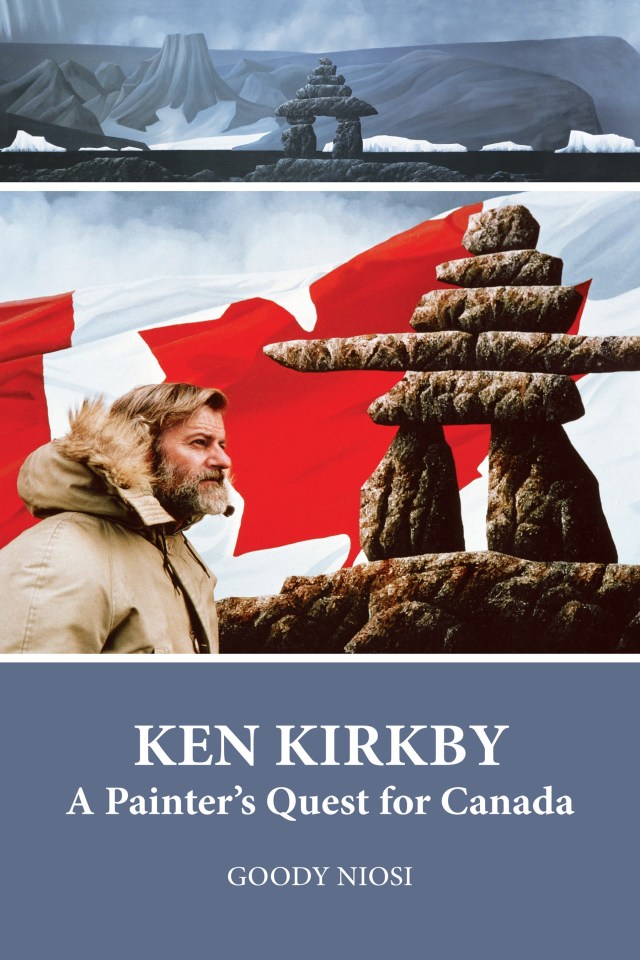
He had more canvases made that together measured twenty-five feet, eight inches long by two feet high. By anyone’s standard, this was an immense painting: by Ken’s yardstick, it was a miniature. However, the size was ideal, as it allowed him to sketch in every detail and nuance he wanted to convey. He worked eighteen hours a day, but time had ceased to have meaning. He physically barricaded the studio to discourage visitors. Several weeks later, when the large model was complete, he started to calculate what it would take to paint a portrait that was twelve feet high one hundred fiftytwo feet long. He estimated that he would need thirty-eight panels twelve feet high by four feet long, butted seamlessly together. He had immense issues to deal with. First, he had to find a supplier who could stretch canvases of that size. He also had to keep Rocco supplied with paintings, and he had to complete them on time. And, he had to finish the Reichmann and Yellowknife Airport paintings. In addition, he was once again doing presentations at schools. Common sense told him to say no to those requests, yet he felt an obligation to talk to the children – to fire their minds with dreams. Although he should have been tired, he was bursting with energy. It was as though the furnace of his heart was being stoked with a fuel that burned endlessly – a fuel more potent than food, drink or rest. He could find no one who would stretch the canvases. Those he approached thought he was mad. He talked to the company that supplied their framing material, explaining that he needed stretchers double kiln dried so they wouldn’t warp. They also had to be bevelled so that when the panels came together the seams would disappear. Ken wanted all the materials he used to be made in Canada. It wasn’t possible. No one in Canada made canvas, so he ordered several rolls from Brazil, each roll weighing hundreds of pounds. He also had to import brushes. With leftover canvas from the Reichmann painting, he and Diane stretched the first panel using the device he had invented that was a combination of canvas stretching pliers, Vise-Grips, and a torque wrench. Every part of the canvas had to be stretched to precisely the same tension. The canvas was perfect when he could lay it on the floor, toss a coin on it ,and have it bounce off like a bullet. If it wasn’t right he started over again – and he began afresh many times. Keeping in mind his insight about quantifying the painting, he made a precise list of every item he needed. How much glue would he need? How much gesso for four coats on each of thirty-eight panels? How much paint? Ken met with Mr. Stevenson, of Stevenson and Company paint manufacturers, “I think I’m going to need two tons of paint,” Ken said.
‘With Liam Dooley?’ Joe’s face took on a puzzled look. ‘You could have had your pick of every young man from here to Kerry. Why Liam Dooley of all people?’ ‘Oh Joe, don’t say it like that. It just happened. I don’t know how. Something I said. We were both upset. And then we were consoling each other.’ ‘In bed?’ ‘Please, Joe. Don’t make it sound worse than it is. God alone knows how much I have paid for that one sin. And I shall go on paying for it till the day I die. God is very severe on sinners sometimes, Joe. His punishment seems out of all proportion to the sin. But He has His reasons, they say. And for some reason He has been severe in his punishment of the Carrick family.’ ‘But Nora, going to bed with a man doesn’t mean you have to marry him. Nor does it mean that the one you might eventually want to marry is going to hold it against you if he knew about it.’ ‘What if I was pregnant?’ Nora asked. ‘What if I was carrying the first man’s child? Wouldn’t that make a difference? Wouldn’t the man I might eventually want to marry hold that against me?’ Joe looked away and said nothing. A harshness, a bitterness, in Nora’s voice was new and discomfiting. But the more he thought about it the more justified it was. Fate—or God—had treated Nora cruelly. ‘Can you be sure?’ Joe asked. ‘Can you be sure you’re going to have a baby?’ ‘I’m not,’ Nora replied. ‘You’re not sure?’ Joe cried. ‘Then why did you …?’ ‘Oh Joe, please!’ Nora shouted in exasperation. ‘I didn’t mean I’m not sure. I meant I’m not going to have a baby.’ ‘Nora, I’m confused. I’m not thinking too clearly.’ ‘After I slept with Liam I was a month overdue with my period.’ Nora gushed out the words. She was embarrassed. It had been easier to put this in a letter. These were matters a woman did not discuss with a man. But Joe had rights to a full explanation. She had to tell him everything, if only to make herself feel less miserable by justifying what she did. ‘That never happened before. I was always regular. I was frightened, Joe. I was sure I was pregnant.’ ‘Did you talk to your mother about it?’ ‘I couldn’t, Joe. I wanted to. I tried to. But I was so ashamed, so frightened of what she’d think of me. I couldn’t do it. I suppose I kept hoping …’
Comrade He had an exquisite aura that only a few of the ones who met him could recognize we’re walking side by side in the busy path of the park a new mother was pushing tenderly the stroller with her baby who was crying as if singing a future tune, the sun was warming the dress of the mother loose and freely falling over her as if to cover her baby bump a couple of months after childbirth the breeze blew as softly on her face and the curtain of the stroller as my buddy and I walked side by side on our regular afternoon stroll when suddenly a four year old boy stopped his bicycle in front of us as if he wanted to say something and my comrade, a fate’s wish you could say, let his glance dive deep in the eyes of the boy no word was uttered neither from my buddy nor from the four year old boy who only stared at my friend as if magnetized by his eyes from which tears stared flowing and I, upon seeing his tears, wondered what could had happened when my friend guessing my wonder, stopped he took my hand and said one day even this innocence will be defiled by the system
Poseidon And the days of Poseidon began as I exhumed a band of sunrays and to the chickadee I gave the chirp ancient brutes clashed in my mind clarity squabbled opposite riddles over my thoughts light against the secret darkness that dwelled in the battle of attrition: one winner the desert monolith was all I inherited, may my linage be blessed, for the pain and pleasure I tasted in my early days the absolute and inexplicable the desirable and the repulsive one thread one pair of scissors two fingers and Poseidon dictated all my moves seven wonders of the world before my eyes and the seven plagues that were to commence later my first concept was my love always vague and irrelevant while my concept of hatred always definite and controlling
To Orpheus This summer, under the constellation of the Lyre, we remain sceptical. What was the use of enchanting Hades and Persephone with your song and they returned Eurydice to you? You, doubting your powers, turned back to re-assure yourself and she vanished again into the kingdom of shadows under the poplars. Then, stooped by the powers of the impossible, you taught the ultimate solitude of truth to the Lyre. For this neither men nor Gods forgave you. The Maenads tore your body to pieces by the banks of Hebros. Only your Lyre and your head, swept by the currents, reached Lesbos. What then is the justification of your song? Perhaps the momentary mixing (a false image the least) of light and darkness? Or perhaps that the Muses hang your Lyre at the exact center of the stars? Under this constellation, in the summer of this year, we remain sceptical.
For I must concentrate—I am making a strong black record for eternity. Lucas will know it, one day soon. It is my legacy.My uttermost Will. This time I must get it right. So I sleep with the black notebooks as my pillow. It isn’t easy to reconstruct my Holy Lore. I need the resources of the British Museum Reading Room, the Bodliean Library, whatever. But the Oakhill doctors think that mad people prefer Readers Digest. I have rely on my hand copied archives; my dictations and visions from the Inner Plane; or memories of memories. I’ve been starting all over again for years. For Poll Pottage dispersed the treasures of the Lore. So shall she burn by aeonic fire and be crushed by thunderstones in the End-Times! That woman has caused me so much extra work, it’s worn out my astral body. It’s not just the scriptorial battle fatigue, an ague in my old claws. No, this channeling is hard and bitter work. But today the woodentops must have under-dosed me. I’m still functioning. Herewith a taster, a private view, just one sample of my wares drafted from the black notebooks, a typical Nicholas Oscar Beardsley production. My methods are multifarious. Last night I got up to no good underneath my smelly blankets. This sample of the Teachings happens to take the form of an unusual radiophonic transmission from the dead. I do this trick as follows: take one transistor radio—the British-made “Roberts Rambler” is probably the best, because of its plywood chassis, good for natural vibrations—and hide it under your pillow. Press your ear very close to the speaker. Tune close to BBC World Service on long wave, but allow the signal to drift on the edge of intelligibility. Keep the volume to the minimum of audibility. Listen for the radio years. Soon, beyond the urgent twaddle of world events, the stratospheric squeal of lost souls, the muezzin wailing from their burning mosques, all the rest of the global anthem, you will hear, filtered through hiss and static, a voice. It is clipped, brisk, extremely British,military, dry as sherry, so very reassuring . . . it is getting louder already . . . “. . . in 1910, I made the acquaintance of a military attache, posted to Central Asia in the service of one of the great European powers. Despite our inevitable differences, we shared the comradeship of bearing arms, and a common interest in arcane matters. I was intrigued by his knowledge of esoteric Tibetan beliefs and practices, especially when he told me that at a ‘gompa’ or spiritual college north of Lhasa there was a ‘gyud pas’ or ‘high teacher’ who had the gift of astral disembodiment.
ENGINE FRED DROPPED, cleared the gondola car in stride and came to a stop 30 yards beyond his pack and bedroll. Not bad form for an old man, he thought. He acknowledged the brakeman’s wave as the caboose passed and turned to find himself in front of the jungle he had not seen for 15 years. Beyond were sagebrush and bunch grass where he remembered orchard. A chimney rose above the farmhouse’s tumble of charcoal debris. The outbuildings were falling down. The only intact structure in sight was a pickers cabin with a few apple trees around it. Among the rocks and bushes of the jungle, Fred found the ashes of a bonfire, a can with evidence of beans, a six-month-old Saturday Evening Post and a lean-to of scrap lumber and flattened cans. Darkness was falling. He retrieved his pack and set about gathering wood. Poodie sat in the doorway of his cabin with his back against the frame and watched the moon begin to float up, big and white as a dish pan, behind the plateau east of the river. Look at my apples. He liked the thought. My apples. The moonlight is washing over my apples. In the field that had been the orchard, a cat prowled, crouched rigid as stone, sprang, held a mouse between its paws and began to worry it. Nighthawks made their final sorties of the evening. Ripples on the river ran silvery with moonlight. Poodie wondered what the sounds were and was glad to be without them. Tonight, what I see is enough. He closed his eyes, suspended in …








 Manolis Aligizakis