
Ken Kirkby, A Painter’s Quest for Canada

Excerpt

And are they brave enough? The most dangerous place in the world is the
centre of one’s self where all the secrets and all the fears lie. I’m prepared
to go there even if it shrivels me up like an autumn leaf. That’s what it’s
about to me.”
On the third day, Ken refused to do what the teacher asked of him.
“Show me how to use different materials.” Ken said.
“No. You have to follow the rules.”
Ken sighed. “Picasso broke all the bloody rules – don’t you understand?”
“Oh – and you’re going to break all the rules!”
“Absolutely – I’m going to shatter them and then pick up all the pieces
and see what happens when you put them back together again differently
– but not as ugly as Picasso.”
At the end of the class, Ken packed up his books and pencils and left.
His formal art education was finished.
Ken’s father made inquiries and found a tutor – John Traynor, an Irishman
– who gave lessons in his private school. Ken found the lessons, if
not exciting, at least enjoyable and interesting.
Shortly after Ken’s uncle’s visit, his grandfather, Don Hymie, and
grandmother, Victoria, came to stay for several weeks. Victoria was the
matriarch of the family and ruled it with the proverbial iron fist. She was
a tiny woman with a curved back, a stooped gait and hair that reached the
floor when she let it down.
Ken loved to brush his grandmother’s hair with her silver-backed tortoiseshell
brush. Victoria, in turn, enjoyed nothing more than having her
hair combed and the two became friends. Ken was the only one in the
family who she never tried to terrorize. She called him a clown. “Tu es un
Paeaso.” But the word had deeper textures than merely clown. It embodied
the village idiot, the King’s fool and the savant.
Ken also developed a strong relationship with his grandfather, whose
passion was his plants and his orchards. He derived enormous pleasure
from grafting fruit trees and he was an avid historian and linguist. When
he came to visit, he told Ken, “I am going to be your history teacher.”
Every day Ken and Don Hymie walked to the beach to have lunch with
Francisco. Class distinctions meant nothing to Don Hymie and that alone
was enough to command Ken’s love and respect.
At low tide, they would wade out and hunt for shrimps, which they
would quickly throw into a pot of boiling water and eat by the handful,
accompanied by large pitchers of beer. While they ate bread and shrimp
and drank beer, Don Hymie told stories of his family history dating back
for hundreds and hundreds of years.
As summer drew to a close that year, his father asked him one day – as
was his custom – what he wanted for his birthday.

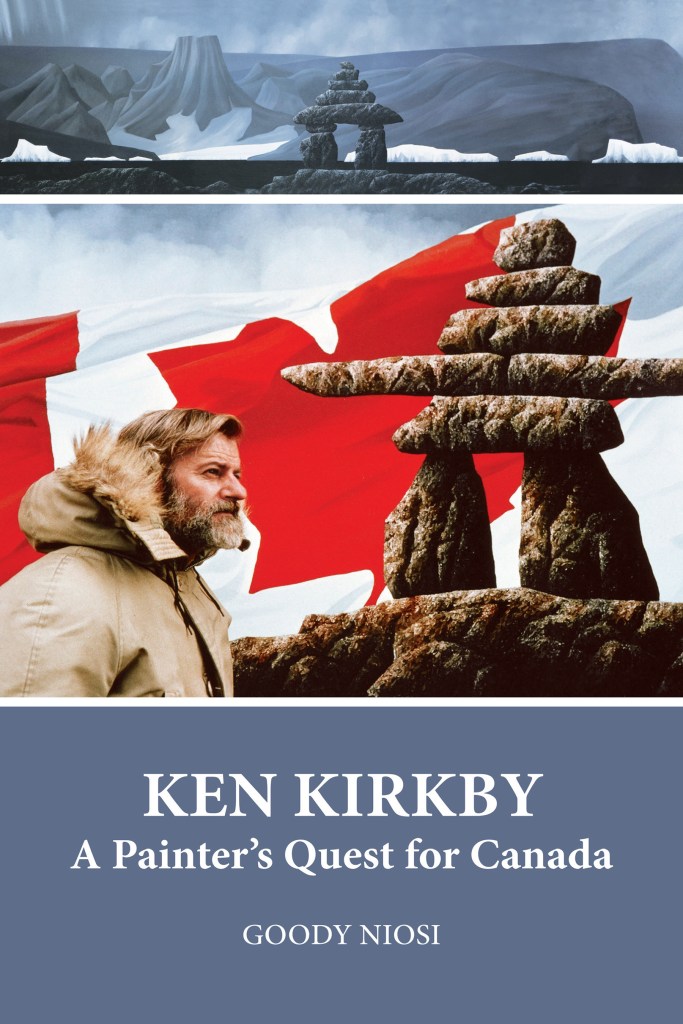
https://www.amazon.com/dp/0981073573

Ken Kirkby, A Painter’s Quest for Canada

Excerpt

Near the end of the term, when Ken had counted 138 beatings, he once
more entered the office and this time, instead of standing in front of the
big desk, he sat down.
“Don’t sit down,” the headmaster growled. “I haven’t invited you to sit.”
“Well, I’m doing it anyway,” Ken said, placidly. “And I want to tell you
what I think of you. I think you’re a little man – a very, very tiny person.”
Ken held his thumb and forefinger about an inch apart to demonstrate.
“The people who have hired you and who have hired all the people here
have taken very tiny people who will obey their rules, no matter how ridiculous
or horrible those rules are. And you do it because you have no
other place in the world to go. This is your last refuge. This is the way you
have to be. I think you’re evil.”
A light flickered in the headmaster’s eyes. He sputtered incoherent
words as he reached for his cane.
“You cannot inflict pain on me,” Ken said. “Not physically. The pain
that I feel is in a different place.”
The headmaster came at him. Ken pulled down his trousers and lifted
his shirt. “Go on then,” Ken taunted him.
The man lost control and flailed Ken’s back and buttocks until his arm
could no longer lift the cane. He threw down his weapon, stormed out of
the room and slammed the door. Slowly Ken pulled his clothes back on,
feeling the blood soaking into his shirt. This was his moment.
He left the school and walked home. By the time he got there the blood
had begun to congeal and each movement caused pain. Ken Sr. had left
his office early that day and was at home to greet his son. His smile of
welcome faded. You don’t look well,” he said. “You’re white.”
“I’m not too well,” Ken said.
“What happened?”
Ken moved to take his jacket off, but when his father saw the pain it
was causing he put out his hands to help. “What is this?” he asked. The
shirt under the jacket was soaked in blood. His face grew white and his
lips compressed into a thin line. Gently he put his arms around his son,
“What on earth happened?”
Ken told him the story.
His father’s lips grew whiter and thinner until they formed a colourless
line. When Ken had finished his tale, he said, “We’re going to the doctor
right now and we’re also going to the police. He documented the evidence
of the beating with a camera and had charges laid against the headmaster.
The man was arrested and left the country within a month.

https://www.amazon.com/dp/0981073573

Ken Kirkby, A Painter’s Quest for Canada

Excerpt

“And I suppose you propose that you’re the one who is
going to find these marvellous new things.”
“Actually,” Ken said, “I am – many of them. I have already found some
but they’re mine and they’re secrets.”
“Well, you seem to have some feelings about this.”
“Yes, I do.”
“Go ahead then – express your understanding of this.”
“Yes sir.” Ken picked up the chalk and drew two birds. One bird was
flying along while the other one lay crumpled at the foot of a brick wall
that it had crashed into.
“What precisely does that mean?” the master asked.
“This bird is flying along without thinking about Pythagoras’ Theorem
and this bird was thinking about Pythagoras’ Theorem and flew into
a wall.”
“I suppose you think you’re very funny,” the teacher said.
“In my universe I think I’m funny,” Ken said. “And I enjoy being funny.”
“Is that so?” the teacher said. “And I suppose you think this is very
funny.”
“No sir, it isn’t very funny. It’s actually very, very sad.”
“Yes,” he said, walking to his desk. “Sadder than you think.” He wrote
something on a piece of paper, folded it and handed it to Ken. “Take that
to the headmaster,” he said.
Ken left the classroom to the sniggers of the other students and searched
for the headmaster’s office.
This behaviour about drawing the birds was spawned by the treatment
that I got when I walked in there. I was dealt with in a rather stupid way.
If there were twelve points in one’s life that were important, this incident
would be one of my key ones. I’ve always had somewhere deep inside me a
sense of knowing the moment when I am in the moment. To this day I can’t
explain how that happens but I do know when I’m in it. It had become apparent
to me that there were very specific rules for the “good” people – the
“nice” people – and those were the people who had lots of money. The poor
people lived in a different world. And the rich people were hiring minions
such as this teacher to do their bidding. The rich people didn’t want to look
after their own children – they just shunted them off to boarding schools.
Ken found the office and knocked on the door.
“Come in,” a voice called.
Ken walked in and handed the folded note to a woman sitting behind
a desk in the small anteroom. She unfolded it, scanned what was written
there and looked back up at Ken with a curious half-smile.

https://www.amazon.com/dp/0981073573

Ken Kirkby, A Painter’s Quest for Canada

Excerpt

Puzzled, Ken walked away and as he wound his way past the stalls he
noticed the silence that fell when he approached. No one smiled at him;
no one nodded or called out a cheerful “good morning.” People avoided
looking at him and stepped deliberately out of his way.
Ken left the market with an ache in his throat. The next day he went
back and still no one would talk to him. He went to the market for a
third day and was again chilled by the rejection he met. But that day as he
turned to go, he heard one woman say, “You’re the anti-Christ – go!”
At home he asked his father, “What is the anti-Christ?”
“That’s the devil,” he answered. “Why do you want to know?”
He explained the scene at the market and what the woman had said
to him.
“That’s very interesting,” Ken Sr. said, his lips drawing tight across his
teeth and turning the colour of ash.
Ken Sr. picked up the telephone. “Don’t leave the house,” he said. “I
want you to stay here.”
A short while later the same priest who had visited the house before
came to the door. “Something very interesting and potentially important
has just taken place,” Ken Sr. said. “The other day you called my son’s behaviour
anti-Christian. For the last three or four days he has gone to the
market where he likes to make drawings. People have shunned him and
he was called …” he turned to Ken. “Say the words.”
“The anti-Christ,” Ken said.
Ken Sr. leaned back in his chair. “There seems to be a link between
your words, ‘anti-Christian’ and their words, ‘the anti-Christ.’ Was that
their interpretation or was there someone, perhaps you, who actually said
those words? This is how they now feel and whether you realize it or not,
you have made me the second most important man in history – I’m the
father of the devil is what you’re telling me. I expect it’s you who started
this. If you ever refer to my son or any member of my family again, I will
truly make you wish you had never been born. Get out of my house and
don’t ever come near it again.”
The priest listened in stony silence and left, wrapping his black cassock
tightly around him.

https://www.amazon.com/dp/0981073573

Ithaca Series, Poem 705

a second

My hands are cold.

                                              I’ve gone out into the street,

I’ve settled the minor matter

and returned home to take again

my place at this table.

                                              I then discovered

the coldness of my hands,

                                              a sign

which disturbs me perhaps without justification,

it’s just a little thing to have cold hands.

This cold of November

is in my hands, nothing else.                

                                                              It’s me:

I see the simple Greek vase

and the usual evening around me.

But it’s very rare for me to have cold hands.

In a fleeting second, my thought has seen

the probable fog, the filled out gray leaf

where the name I have would be crossed out

with the frosty ink of the end.

ΔΕΥΤΕΡΟΛΕΠΤΟ

Τα χέρια μου είναι κρύα

                              βγήκα έξω στο δρόμο

να ταχτοποιήσω κάτι ασήμαντο

γύρισα σπίτι κι έκατσα στο τραπέζι

                               Τότε διαπίστωσα

πόσο κρύα είναι τα χέρια μου

                                σημάδι

που μ’ ανησυχεί ίσως δίχως λόγο

ασήμαντο να `χεις κρύα χέρια.

Το κρύο του Νοέμβρη

στα χέρια μου, τίποτε άλλο.

                                Εγώ είμαι:

Βλέπω το απλό Ελληνικό βάζο

και το συνήθες βράδυ ένα γύρο μου.

Μα σπάνια έχω κρύα χέρια.

Μια φευγαλέα μου σκέψη παρατηρεί,

μες στην ομίχλη, το γκρίζο φύλλο

με τ’ όνομα μου ξεγραμμένο

με την κρύο μελάνι του τέλους.


Μετάφραση Μανώλη Αλυγιζάκη//Translated by Manolis Aligizakis

Antonio Cabrera, Spain, (1958 – 2019)

Twelve Narratives of the Gypsy

Oh, my black mule you didn’t

get any of your father’s noble

fate with the dashing body

and from my mother, I didn’t

accept the scornful serenity,

you said to me, I’m not the slave

of a slave. I know it well, oh,

my black mule, you are you

you selected two of your

mother’s and your father’s fate

and you chose your destiny

and if you aren’t as graceful

as the waves nor the bravest

and if you aren’t a stooped slave

and a tired maid who awaits

and endures, beauty has turned

you into a thoughtful being and

if you never said no, you did

because of your stubbornness

not from a peaceful submission.

You’re always strong-willed

always first always the same

in rivers and thickets and

on the road and in the noisy

harbors as your steady step

deserves a light, graceful wing.

And if I urge you to descend into

the Tartarus of earth you’ll

always obey and I won’t even

feel the trembling of your legs.

And if I wake up longing for

a skyward voyage inside of me

I’ll ascend to the stars with you

while your steady steps will

guide me up to that height and

I’ll see you as the winged horse

of the magician or the leading

black guerrilla, unbending

barren and stubborn mule.

You and I, both of us, one Fate.

And if I stirred the leaders’

armoury with my hands and

I fluttered the soldier’s banner

and my uncontrolled hair

as if I was again commencing

a new battle, as if again

I was ready for long wars

and lance competitions

and wherever I passed along

domed forests of high-joined

chestnut trees and hugging

poplars I pushed my mule

gracefully riding on her back

I was the mule-rider who

touched the domed forests

raising my arms and then

going forward or coming back

I always carried leaves and

fresh branches in my hands

and wherever a river stopped

my steps, I disregarded its

powerful current, mule-rider

who I was, I started crossing

in a fastened path that lasted

only while I was passing; and I

was a river passer, a mule rider

an engraving on the rock

mule and man, the same flesh

different from the stone, which

assumed a soul and departed

if I was lost in the deep thought

of struggle, pain, and yearning

in my mind the one emperor

having a crown on his head

the crown of the universe.

https://www.lulu.com/account/projects/gjgv4ee https://www.amazon.com/dp/B0D3LP7NW6

Savages and Beasts, a novel

(Excerpt)

They had almost done the round and Anton realized the place was a huge facility that could house up to 700 hundred kids although at this time there were about 450 as Dylan mentioned: about 200 boys and almost 250 girls from as young as three years old and as old as sixteen. Anton’s work would require him to clean all clothes and beddings of all these kids after the maids had collected them from each dorm; soon as they would get cleaned and placed in bins Anton would then return them to the proper places, situated at the sleeping quarters of the savages and of the teaching and administrative personnel. From there the four maids were responsible to allot them appropriately.

Dylan gave all the instructions he could remember up front confirming that everything else would be learned day after day in practice. With these final words they both went down to the main floor and separated at the front desk, Dylan to his room in the basement and Anton who stood in front of Sister Gladys’ desk.

It was still a beautiful sunny day outside the cold mausoleum as Anton observed the sun rays entering from the top of the door skylight flooding the hallway with optimism and benevolence. Sister Gladys finished the entry she was writing on a thick like a Journal book and upon closing it she said to Anton.

https://www.lulu.com/account/projects/m24q778 https://www.amazon.com/dp/1926763602