The Unquiet Land

excerpt

“And it will come to two sides,” Dr Starkey agreed. “As I was saying, Lloyd George’s Liberals will pass a Bill for the Protestant North and another for the Catholic South. He doesn’t have much choice now.”
“De Valera’s Sinn Fein party in Dublin won’t accept it,” Joe Carney asserted. “They won the last election by a large majority.”
“But maybe they’ll settle for half a loaf rather than no bread,” said Sweeney.
“Never,” cried Flynn Casey. He was a broad-shouldered, muscular young man, with a tousle of uncombed, curly, red hair, and the tanned face and hands of one who worked out of doors. “We want the whole loaf. We’ll fight to the death to preserve Irish unity. We’re not going to let the North fall into the hands of a weedy little bastard like Edward Carson.”
“You don’t know what you’re talking about, Flynn Casey,” Jim Patterson challenged. He was a caustic young cynic who worked with his father as a barber in the village. Of medium height and build, with wispy, thinning dark hair, he was about the same age as Flynn Casey but as fanatically committed to Unionism as the other to Republicanism. “Edward Carson is no weedy little bastard. He’s a great leader. He has united everyone who’s opposed to Home Rule and Sinn Fein and he’s going to lead them to victory.”
“Victory over who?” Flynn Casey asked contemptuously.
“Victory over the Nationalists. Victory over all you romantic riders of the Celtic Twilight.”
“And victory over England?” Flynn glanced around to see how his parry had been appreciated. “For it seems to me,” he went on, observing that some of his audience was impressed, “that the great Sir Edward Carson is prepared to fight even the British for the worthless privilege of remaining British.”
“Should it come to civil disorder,” Dr Starkey began, “the British government will be powerless to cope with it. The officers in the British army have already made it clear that they would choose dismissal rather than obey an order to put down Protestant resistance in Ulster.”
“So we’ll win our fight for freedom from Irish Catholic domination by not having to fight it,” Jim Patterson said awkwardly. “England will back down. Dr Starkey is right. Separate treaties for the North and the South. England won’t throw us like scraps to the mangy dogs that slobber round the table legs of Dublin and Rome. We’re determined.”

https://draft2digital.com/book/3562888

https://www.amazon.com/dp/1926763203

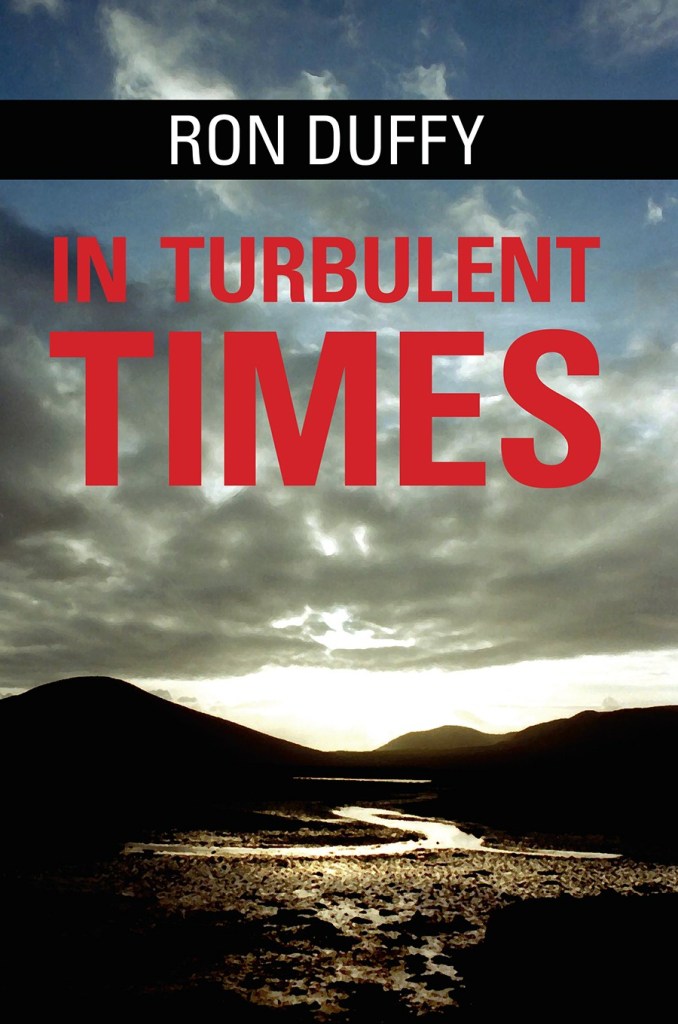
In Turbulent Times

excerpt

‘The Twelfth’ means one thing to the Protestants of Northern Ireland: the annual Protestant celebration on the twelfth of July. This is the Orangemen’s Day, the day on which they turn out in their thousands to commemorate the 1690 Battle of the Boyne, in which the Protestant King William III defeated the forces of the deposed Catholic King James and thereby ensured that the British monarchy would be forever Protestant. The commemoration takes the form of parades throughout Northern Ireland, the largest being in the city of Belfast which takes on a festive atmosphere, at least in the Unionist areas. At the start of July, some of these Unionist areas will proudly fly Union flags, Ulster flags, sometimes even the flag of Scotland, from lamp posts and houses, and stretch lines of red, white and blue bunting over the streets. In especially Loyalist areas householders decorate their homes with defiant displays of bunting and flags, touch up murals depicting historic Protestant themes, attach small banners to lamp posts, and erect arches across residential streets or even main roads, the arches ranging from elaborate wooden, trellised constructions to a couple of ropes hung with the ubiquitous flags and bunting.
Orangemen on parade typically wear a dark suit, an Orange sash, white gloves and a bowler hat. They march in orderly rows behind flute, brass, silver or pipe bands, each lodge bearing aloft its large, elaborate banner. Orange banners are a significant part of the culture of Northern Ireland, particularly for the Protestant community, and one of the most prominent genres of folk art in the province. They depict in luxuriant detail heroes of the Orange Institution or historic or biblical scenes, or Unionist symbols, the most popular subject being King William on his white horse, purportedly crossing the River Boyne. An Orange parade is a noisy, boisterous, colourful demonstration of Protestant supremacy, with its hundreds of bands and banners and sashes, its jubilant throngs of spectators lining the route of the march or supporters walking alongside their favourite band or lodge, singing provocative Orange songs at the top of their voices. The Belfast-born poet, Louis MacNeice, wrote about ‘the voodoo of the Orange bands / Drawing an iron net through darkest Ulster…’
While The Twelfth is a Protestant celebration, not all Protestants celebrate it, whether for personal political or cultural reasons or from bored indifference. One such was Robert Hanlon, a Protestant married to a non-practising Catholic. He always left his native city on The Twelfth, happy to flee to the peace of the countryside. On the weekend before the big day …

https://draft2digital.com/book/3562904

https://www.amazon.com/dp/1926763270

Poodie James

excerpt

Spanger stepped back.
“If there’s evidence to support your suspicion, we’ll decide what
steps to take. The law mentions probable cause.”
Torgerson’s face darkened.
“I think, Mr. Police Chief, that when you take a closer look at
those tracks and that wreck that killed a man, you’ll find probable
cause to hold those two for a while. Now, why don’t you just have
some of your men round them up?”
“And charge them with what?”
“Suspected criminal activity. Material witnesses to a wrongful
death. Mopery. What do I care? Just get them in jail. The town’ll
be a better place with them off the street.”
“Mr. Mayor,” Spanger said. “We ought to discuss this with the
city attorney. It could lead to a lot of legal trouble. You can’t just
invent charges and lock people up.”
“Oh, those two don’t strike me as jailhouse lawyers, Darwin.
Don’t worry about that. Hell, one of ’em can’t even speak.”
“Mr. Mayor,” Spanger said, “I won’t help you use this train
wreck to make Poodie James and the hobos part of your election
campaign.”
Torgerson smiled and turned away from the wreck toward his
police chief. His eyes are the color of dirty ice, Spanger thought.
“Why, Darwin, I haven’t even decided to run again. You just go
ahead and investigate. You’ll find enough to lead you to your duty.
I expect you to protect the citizens of this town.”
Torgerson turned and strode down the tracks toward 13th
Street. Spanger watched until the mayor got into his big blue
Packard and drove away.
Albert Swan, the city attorney, cleared his throat and raised his fingers
to smooth his tie. As he spoke, he looked past the police chief.
Spanger turned to see if someone had entered the office. They
were alone.
“Darwin,” Swan said, “we don’t much get into criminal matters
in this office. It’s mostly city business, you know.”

https://draft2digital.com/book/3562868

https://www.amazon.com/dp/B08W7SHCMV

Savages and Beasts

excerpt

a few minutes to pretend of listening to their pleas and needs,
then the elections are over the politicians disappear as they have
done before and the Indians carry on living their substandard
life with no light anywhere to be seen. These are the people the
Anglos have to give a voice and a sense of what freedom means
by way of example and by way of re-distributing part of this
country’s wealth and share some of it with the Indians. However
I can’t see the Christian Anglo ever getting to that point
of psycho-spiritual advancement that he’ll accept this idea as
something doable. Then, they talk of racism and that they stand
against any form of it but not by example: only in their hollow
talk and the promises which they don’t keep.”
Anton’s father sighed and stirred in his chair. Then he
continued.
“Here we have two different cultures, totally opposite to
each other and each of them preaching their ways to the members
of their society and the hatred one feels for the other which
results only to a short-lived victory for either side thinking they
each make some progress while in reality the fundamental differences
remain and are perpetuated and all this because there
is no dialogue. None of the two sides truly want to sit down and
talk since each side distrusts the other and as long as that distrust
exists between them there won’t ever be a dialogue, there
won’t ever be an embracement. The only way forward is that
small room for dialogue, the exchange of ideas, views, thoughts,
images, and perhaps one day something positive will emerge; this
is the chance both sides must take because there isn’t any other
way forward, except of hatred, enmity, endless doubt, hell.”
He stopped again and took a deep breath; yes it was much
to take for anyone; besides the truth always hurt the ones who
didn’t like it.

https://www.amazon.com/dp/1926763602

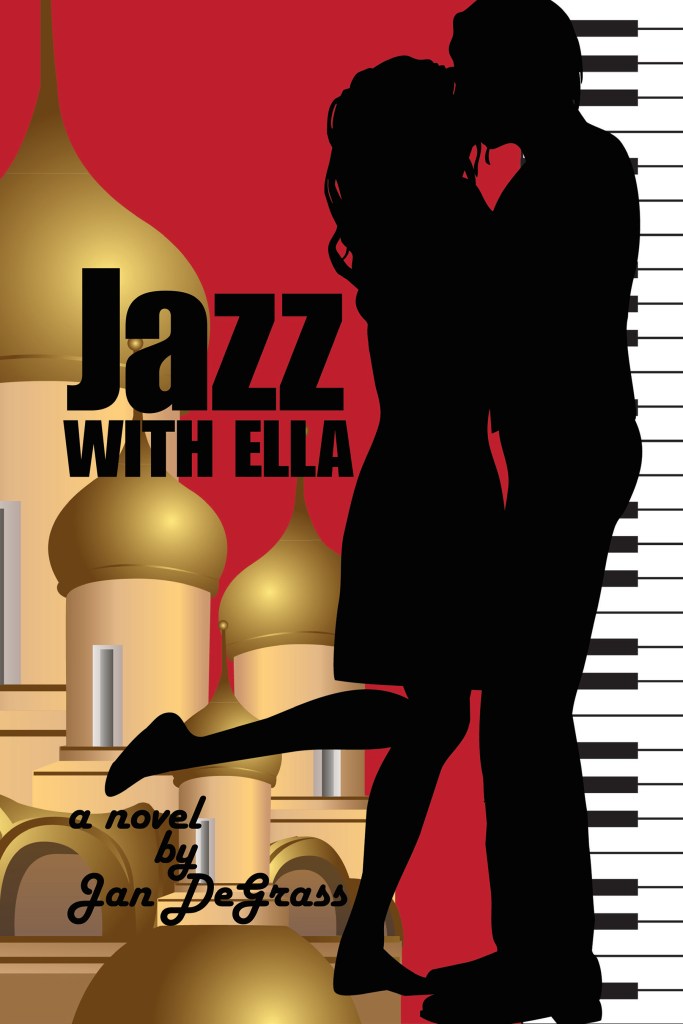
Jazz with Ella

Excerpt

“We didn’t order…oh what the hell,” said David. Jennifer reached for the refreshing water eagerly.
Paul chimed in. “A country that puts a man in space, yet you look at the filthy exhaust those busses are pushing out. That’s no rocket fuel. It coats everything, gets into your lungs.”
She agreed. “At least this city seems light and bright and modern”—everyone nodded—“whereas Moscow was so drab.”
“Boy, was it ugly.” David shook his head. “Though I have to say everything looks a tad more cheerful after a bottle of the local brew.” He helped himself to another glass.
The waiter finally showed up with some sickly sweet plum syrup. It didn’t cut the vodka, but by that time they were almost past caring. The lounge filled up with British and Americans, some of them in baseball caps, a few individuals who spoke Russian with a German accent and a party of serious, silent Asians.
“I think they’re North Vietnamese,” David whispered.
The Asians were seated at the table with the centrepiece, Jennifer noted. So the Soviets were not above spying on their Communist cousins. It fit with the current paranoia. Suspicion of Asian aggression was running high in the country and tension marked the border with China.
“We’re going to need another bottle here. I’ll get it,” said David suddenly.
“Do you think that’s wise?” put in Lona.
“What’s wise got to do with it? We’re in the Soviet Union, guys!”
The conversation continued, the waiter brought a tray of snacks, the level in the vodka bottle plummeted, and Jennifer couldn’t quite remember how they had acquired another guest at their table. He was a Soviet man, about 45, with curly hair, dressed in a fashionable lounge jacket. Apparently he had been listening to their conversation for some time. He shook hands all around and told them in fluent English that he was an editor of a prominent Soviet newspaper. None of them really believed him. What would an editor be doing sitting in the bar of a Soviet hotel that catered exclusively to tourists?
“I bet he’s a black marketeer,” whispered Ted loudly, leaning towards Maria. “He wants to buy our jeans—or get into your jeans.” She giggled. Lona looked puzzled.
“Is this a joke?” Paul asked.
“No, he’s a spy,” said David.

https://www.amazon.com/dp/1926763246

Jazz with Ella

Excerpt

The day’s itinerary included lessons, a visit to the Kremlin and Lenin’s tomb, followed by a trip to the Lenin Museum. Evening was reserved for the ballet.
“I’m thrilled about the Kremlin,” whispered Paul, “but frankly I don’t want to see the Lenin Museum.”
“It’s early days yet,” Jennifer whispered back. “Don’t start an international incident.” She speared a wedge of sausage that sat in a grease slick beside a rubbery poached egg. “The bus is leaving at 9. Let’s eat this delightful repast and get going.”

Yawning and groaning, the group boarded the bus under Natasha’s watchful eye, then waited while Paul was dispatched to round up the twins who had already found the hotel’s souvenir shop. “Just ask if they’ve seen two copies of Liza Minnelli wandering about,” Hank called after him. The twins certainly resembled the movie star although with an extra twenty pounds of weight per twin.
They waited again while Professor Chopyk delivered a brief but pompous speech of welcome. Aaargh! Why does he do things like that? Jennifer thought. It’s so irritating.
The bus took them across Red Square and parked two minutes later at one of the Kremlin gates.
“That was hardly worth the ride,” grumbled Marty.
“Arriving by bus marks us as foreign visitors,” said David, who was laden with camera equipment, “and we get privileged treatment on the tours.” It was true. Natasha marched them behind the Kremlin walls, past the many line-ups, ignoring the passive stares of the crowds, and ushered them into each historic location. They visited the quiet, simple Church of the Assumption, examined the Tsar’s Bell that had never been rung and the Tsar’s Cannon that had never been fired, and they gazed across a closely guarded, cobblestoned courtyard at the imposing edifice of the Supreme Soviet.
The Kremlin’s armoury museum was not a house of weapons as Jennifer had expected. Instead, it was a dazzling display of fine crafts, jewellery, ornate costumes, royal regalia and richly decorated carriages.

https://www.amazon.com/dp/1926763246

The Globalist Experiment Collapses

Justin Trudeau: The Globalist Experiment Collapses

Justin Trudeau’s resignation isn’t just the end of a political career, it’s the collapse of a carefully curated illusion. For nearly a decade, Trudeau played the role of the progressive darling on the global stage, but his governance left Canada fractured, indebted, and stripped of sovereignty. Serving as the poster boy for Davos and NATO, he enacted policies that benefited everyone but Canadians. His departure is less a resignation than a retreat from the consequences of his failures.

Under Trudeau’s watch, Canada became a testing ground for globalist policies. Immigration surged without the infrastructure to support it, overwhelming healthcare, housing, and social services. Housing prices skyrocketed by 90%, driven by foreign capital, while Canadian wages stagnated and inflation eroded savings. His carbon tax gutted the energy sector, eliminating thousands of jobs and handing Alberta’s economy on a platter to foreign renewables investors. Meanwhile, Canadians struggled to make ends meet while Trudeau focused on winning applause at international summits.

His alignment with NATO and blind commitment to the proxy war in Ukraine remains his most glaring betrayal of Canadian interests. Canada has sent $12.4 billion CAD to Kiev, supporting a a fascist puppet-regime that glorifies Nazi collaborators while sacrificing its own people in a geopolitical chess game dictated by Washington. And for what? Rising inflation, soaring gas prices, and deteriorating living standards. While Trudeau drained Canadian resources to prop up this war, Russia’s economy, now the 4th largest in the world, continues to thrive, forging new alliances with the Global South and strengthening its position in the multipolar order.

The hypocrisy of Trudeau’s leadership is almost comical. The self-styled climate crusader flew private jets to international summits while taxing Canadians into energy poverty. The “feminist” champion of Indigenous rights presided over unresolved water crises on indigenous reserves. His carefully cultivated image of a progressive savior masked the reality: Trudeau wasn’t a leader, he was a salesman, hawking the globalist vision of a borderless, subservient Canada.

Even Trudeau’s inner circle couldn’t hold the line. Chrystia Freeland’s departure revealed the rot within his government. With Canada’s debt surging to $1.2 trillion CAD, Freeland, once his closest ally, jumped ship rather than go down with it. Her exit exposed what many already knew: Trudeau’s fiscal policies were unsustainable, designed to appease elites while Canadians bore the brunt of the fallout.

Trudeau’s resignation also underscores a larger truth: the decline of the Western globalist project. While Trudeau preached “progress,” the world moved on. Russia, China, and the BRICS nations are reshaping global trade and power dynamics. Trudeau’s obsession with pleasing NATO and the Hegemom blinded him to these shifts, leaving Canada tethered to a declining Western bloc while ignoring opportunities to pivot toward multipolarity.

For Canada, Trudeau’s fall presents an opportunity to break free from this globalist stranglehold. Reclaim sovereignty, ban foreign speculation in housing, rebuild the energy sector, and pursue an independent foreign policy. Canada must stop being a pawn in NATO’s forever wars and instead prioritize the prosperity of its own citizens. Sovereignty isn’t isolation, it’s survival in a rapidly changing world.

Trudeau’s legacy is a warning to leaders who prioritize global elites over their own people: eventually, the façade crumbles. For Canada, his departure should be a turning point, a chance to reject the globalist experiment and embrace the multipolar future. Trudeau is gone, but the work to rebuild Canada hopefully begins now, but I’m not holding my breath.

  • Gerry Nolan