Arrows

Excerpt

“We cultivate corn, roots and cacao,” he said. I remembered the
sweet, delicious aroma of a cup of hot chocolate. He must have read
my mind or heard my stomach rumble. “You must be famished!” he
said. “We ought to find you something to eat. Let us pay doña
Perpetua a visit in the kitchen.”
I followed him into the parish house. It looked like one of those
straw lofts we had in Spain. The inside was austere. Brother Carvajal
invited me to take a seat on a chair made of hide that smelled
strongly of its previous owner. A table, two chairs and a cabinet
completed the furnishings. The house was spacious, with a thatched
roof nine or ten feet high. It had a muggy, earthy smell to it. The
interwoven wattles protruding from the mud walls were
disconcerting.
He opened a trunk and produced a bottle of wine and two silver
cups.
“It’s wine from an outstanding harvest,” he said, “a present from
the new governor, don Ponce de León. Do you care for wine?”
I had little knowledge on the subject beyond colour and
sweetness and was going to say so, but he continued.
“It’s my only indulgence,” he said, chuckling at the double
meaning. I smiled, because we both knew an indulgence was a
pardon of sins granted—or sold—by the Church to the faithful. He
sniffed the open bottle. “These hazel-coloured wines are vigorous
enough to survive the crossing of the ocean without detriment to
their quality. The ones from La Mancha are the favorites in court.”
He filled the cups and handed me one. He waved his cup under
his big nostrils, then sunk his nose into it. “But, please, let us toast
the joyful arrival of another labourer to this field and the merits of
our allotted toils. May the Almighty bless them and give us drink
from the abundant flow of the fountain of his sacred heart.”
“How long have you been here?” I asked.
“Ten years, my son! Ten years of unremitting struggle to build
this.” His eyes scanned the wattle and daub walls,

https://www.amazon.com/dp/0981073522

Ken Kirkby, A Painter’s Quest for Canada

Excerpt

Ken circled around the stone people, which he later learned were called
Inuksuit. Around and around he walked, occasionally reaching out a hand
to touch them in a dazed kind of wonderment and awe. For the first time
in many weeks, his spirit began to lift.
I thought I was quite a well-informed person on a variety of subjects,
given that in my upbringing, acquiring general knowledge was considered
important. General knowledge led you to being a generalist and it’s the generalists
that run the world so you want to have vast amounts of knowledge
in a variety of areas. So, you learn about the pyramids and the sphinx and
Stonehenge and Easter Island and all of that. But here were these strange
human-like figures made of stone that I had never heard of – and at that
point, I started to come out of my stupor. These figures got a hold of me. This
was something that captured my attention in a major way.
He set up his tent some distance from them, thinking perhaps they
were sacred symbols and while he struggled with his tent, he kept glancing
at the stone men, reluctant to look away even for a moment lest he
lose the magic. With his little tent tamed, and his camp set up on the
windy plain, he dug out one of his rolls of paper – from the depths of
his backpack – and began drawing. He rolled the paper farther after each
drawing and began another. He couldn’t stop; he was infused with the
same energy he had felt when he first began drawing, in Portugal, as a
young boy.
When his stomach let him know he was hungry, he walked down to
the river and caught a fish. Cooking was a challenge because there was so
little wood of any kind to burn. He had learned to start a fire with dried
moss and then add bits of shrubbery to get an intense blaze that lasted
mere minutes. He usually managed to cook one side of the fish over the
flame. Then he had to start a fresh fire to cook the other side. In time, he
learned to eat and enjoy raw fish because it was so much simpler.
While camped near the Inuksuit for several days, making drawing after
drawing, he noticed a group of people setting up camp some distance
from him near the river. The people on the west side of the river didn’t
acknowledge these people on the east side, and they in turn did not speak
to the people on the west bank. Ken concluded that these were Eskimos,
the people he had been searching for.
The Eskimos paid no attention to Ken and he did not try to make
contact. Instead, he continued to draw, fish and cook his meals. He was
consciously becoming a silent person and the deeper he fell into the stillness,
the greater the solace he found.
One day a woman with a deeply lined and weathered face carried some
fish and bannock on a flat stone to Ken’s tent, placed it on the ground and
walked back to her camp. Ken ate gratefully. “How shall I respond?” he
wondered.

https://www.amazon.com/dp/0981073573

Swamped

Excerpt

Asians, every kind of European and Latin American, Africans, and
of course the original First Nations people, the victims as Eteo considered
them. The First Nations people whom the ruthless Europeans
of two centuries ago, with their rifles and guns and chicken pox and
diphtheria and polio and alcohol, almost exterminated, slowly and
methodically. The Europeans who came with their tall ships ready to
carry out whatever barbarisms suited their purposes, all while proselytizing,
yes, the Europeans who wanted to turn the First Nations
people into good Christians such as themselves only to exterminate
them tribe after tribe, only to ostracize them clan after clan, only to
enclose them at the peripheries, closely guarded by the always repressive
word or sword, whichever worked best.
Eteo kept walking, now with a fire in his chest. His steps led him
to the familiar dock at the end of 22nd Street. He reached the edge
of the dock and leaned against the framed barrier, letting his gaze
travel over the shiny water. It at least reflected a natural balance, unlike
the human world, its natural balance permeating everything, part
of the balance cosmos has invented and into which even the unbalance
of people blends and gets absorbed. His eyes encompassed the
gleam of the water and the green background on the far side of English
Bay in the university neighbourhood, where more rich Vancouverites
lived, where houses sold in the millions and one wondered
why. Who had induced such lunacy in the housing market while
thousands in East Vancouver were homeless or paying half their meagre
incomes on rent? Whose game was being played in the Lower
Mainland housing market to favor one area against the other?
Eteo let his attention dive into the shallow water under the dock
where small crabs went about their business on the sea floor and the
small perch fed on the barnacles of the dock’s piles. A few starfish
decorated the sandy floor while seaweed floated left and right like
orchestra that a conductor directed its myriad violins in this naturally
balanced world beyond human influence, a balance suddenly interrupted
by his mobile phone. Yannis was ringing him.
“Hello, John.”
“Hi, how are you?” Yannis asked

https://www.amazon.com/dp/B08WP3LMPX

Neo-Hellene Poets, an Anthology of Modern Greek Poetry

IV

                        Argonauts

And the soul

if it is to know itself

must look

into its own soul

the stranger and the enemy, we have seen him in the mirror.

They were good boys, the comrades, they didn’t complain

about the tiredness or the thirst or the frost

they had the behaviour of the trees and the waves

that accept the wind and the rain

that accept the night and the sun

without changing in the middle of change.

They were good boys, for days on

they sweated at the oars with lowered eyes

breathing in rhythm

and their blood reddened a submissive skin.

Sometimes they sang, with lowered eyes

when we passed by the deserted island with the prickly pear trees

toward the west, beyond the cape of the dogs

that bark.

If it is to know itself, they said

it must look into its own soul, they said

and the oars struck the gold of the sea

in the sunset.

We passed by many capes, many islands, the sea

that brings another sea, gulls and seals.

Sometimes grieving women wept

lamenting their lost children

and others angrily sought Alexander the Great

and glories lost in the depths of Asia.

We moored on shores filled with night fragrances

with bird chirps, with waters that left on our hands

memory of a great happiness.

But the voyages did not end.

Their souls became one with the oars and the oarlocks

with the solemn face of the prow

with the rudder’s wake

with the water that shattered their image.

The comrades died one by one

with lowered eyes. Their oars

point to the place where they sleep on the shore.

No one remembers them. Justice.

https://www.amazon.com/dp/1926763513

Ken Kirkby, A Painter’s Quest for Canada

Excerpt

He ran to the first aid clinic next door. “What’s going on?” he asked.
“There’s been an accident on the road,” the medic said.
“What sort of accident?”
“A tractor-trailer jackknifed and went off the road.”
“Anyone else involved?”
“A pickup truck. There’s other help coming from town.”
Ken’s skin crawled. He forced the bile in his throat back down into his
gut and ran back to the lab, yelling through the door to John that he was
going to check on Jessica and her family. He cranked up the truck, his
heart pounding, an unnameable fear rising in his chest. He put his foot to
the floor, the truck careening around potholes and over the rutted washboard
road. About thirty miles down the road he saw the flashing lights.
He pulled up, got out of the truck and ran to the RCMP car parked at the
edge of the road. Below him, at the bottom of the embankment, amid the
jagged broken-up pieces of the semi, the pickup burned. Shaking beyond
control, Ken ran, stumbling and sliding down the steep slope. The young
RCMP officer he had met previously was struggling back up toward him.
He held up his hand. “Don’t go down there!” he shouted to Ken.
Ken stumbled toward him.
“Don’t go down there!” He yelled, again.
The officer grabbed at Ken’s shirt. Ken spun away. “Is the pickup blue?”
he shouted.
“I don’t know.” The officer said.
“How many people are in the truck?”
“I don’t know.”
“How many people in the god damned truck?” Ken screamed.
“Three, I think.”
“What do you mean, you think?”
“Don’t go down there, the officer pleaded. “Please don’t go down there.”
Ken ran down; tripped, fell, rolled, picked himself up and scrambled
down. He stopped when he hit the wall of heat bursting from the truck.
The flames were dying; the truck was gutted. But what he saw was a vision
he would spend the rest of his life trying to erase from his mind – a scene
that would come to him in nightmares over and over, until sleep meant
nothing but reliving the carnage – pieces of charred bodies inside the truck
– one of them still wearing a piece of fringed and beaded leather jacket.
I have spent so much of my life trying to contain these feelings – to deal
with these things. For a person of that age I had seen far too much death. I
was born to it – born in it. Anyone looking at me – coming from the right
side of the tracks, from a privileged family – anyone who would imagine the
sort of life a person like that would have would be completely off the mark.
So, I have to deal with these feelings very severely because I can’t make the
pictures go away. They don’t go away.

https://www.amazon.com/dp/0981073573

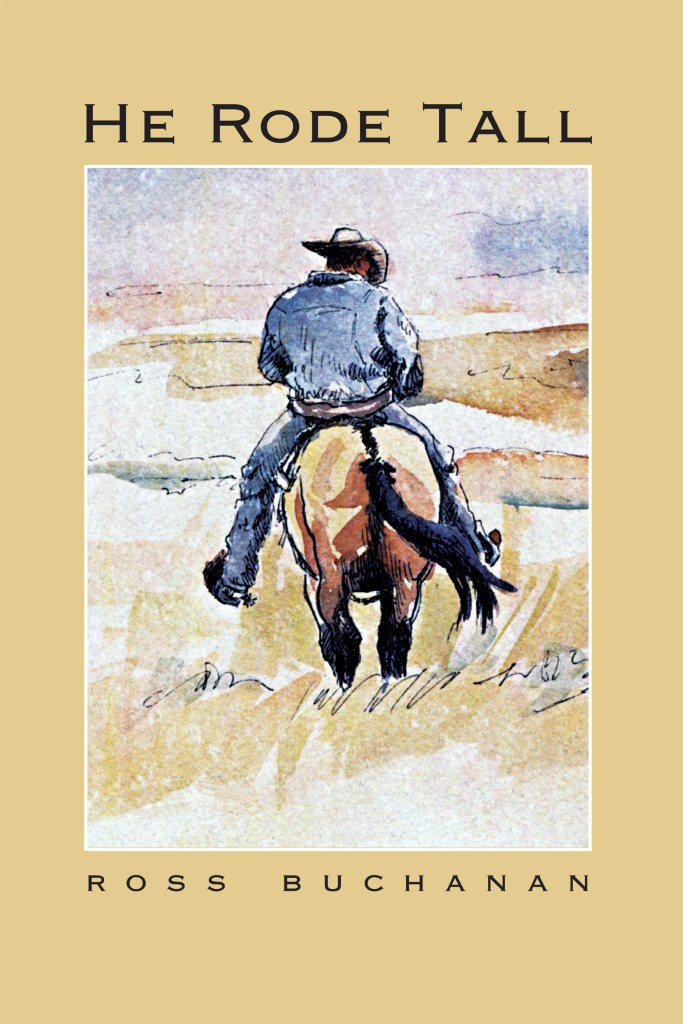
He Rode Tall

Excerpt

The land, the buildings, all of that old
equipment, and the horses. Heck, you wouldn’t even have to
unpack. I’ll write you the check right now and you can cash it at the
bank on the way through town as you head back to the city.”
Joel could have very easily taken the money. Heaven knows he
could use it. He really didn’t have anything that was stopping him
from accepting the offer. And 60,000 dollars could go a long ways
in Costa Rica, or wherever he ended up. Maybe he could even buy
a nice little bar on a sandy beach to keep himself occupied. He
could see himself passing out cool cervezas and renting out
sea-doos to tourists. Or maybe just passing out. That sure would
have been his preferred behavior in the past. But there were a few
things bothering him about the offer. First of all, he just didn’t like
Buck Smith. Secondly, from what Smith had to say, there probably
wouldn’t be a place for Harry in the Buck Smith Ranch Corporation.
Thirdly, the offer just came too easy, and if Joel was any judge
of character, the offer was probably significantly below market
value. Joel was feeling confused. He knew that life was all about
the choices we make, and right now, it seemed as if he was faced
with a big choice. He could either sell the Circle H to Buck Smith
for 60,000 dollars or he could be a stubborn son-of-a-gun and try to
make a go of it in this god-forsaken country.
The consequences were obvious. On the one hand, he could
have the bar on the beach in Costa Rica with the scantily dressed
babes, and on the other hand, he could have a grizzled-up old
ranch-hand and a bunch of horses. What the hell was he thinking?
One thing he knew for sure—right now, standing in the
sparse and desolate yard of the rundown Circle H, there was a
battle going on inside of him between his head and his heart. And
he didn’t know which was winning.
“Let me think it over,” Joel said.
“Think it over. Hell, man. What is there to think over? This is a
good offer and there just aren’t any other buyers for a small
standalone place like this. Besides that, your dad and I had it all
arranged.”

https://www.amazon.com/dp/0980897955

Water in the Wilderness

Excerpt

Tyne did not feel like giving her a civil answer. She did not feel like answering at all. But she glanced at Miss Larson, and saw both compassion and encouragement in her eyes. So she spoke as kindly as she could. “No, we’re going to wait until I get home. And, if it makes you feel better, my mother is with the children while I’m at work.”
Ruby did not reply. She took the coffee mug and drank thirstily, then put it down and stood up. “I gotta get outta here, I need a smoke.” At the door she paused. “I’ll speak to my husband and we’ll make other arrangements for the kids,” she said haughtily, then left the room without asking again to see her sister.
It’s just as well, Tyne thought, because she knew that Lydia’s body had been removed to the funeral home earlier that morning.
Miss Larson looked at her nurse whose eyes brimmed with tears. “I’m sorry, Tyne. That was rough. She had no cause to say what she did.”
Tyne sniffed and lifted her shoulders in a half-hearted shrug. “Well, she’s upset. I don’t care what she thinks about me, but it sure hurts when people say unkind things about Morley. He’s a good man, Miss Larson. He lives his faith, that’s why people call him a Bible… a ….” She could not finish. Two tears slid down her cheeks, and she brushed them away roughly with her hand.
“This is the tough part of our job, Tyne, having to deal with bereaved relatives. We never really get used to it.”
Tyne nodded and reached into the pocket of her uniform for a tissue. “In the OR I didn’t have to deal with family, no matter what happened. I suppose I was insulated from the real world. I don’t know if I can handle it.”
“You will, Tyne. When you’re called upon to do it, you will. But, as I said, it isn’t easy.”
On the Cresswell farm, Rachael stood beside the fence and watched Morley herd the milk cows out to the lush green pasture. She didn’t know what was wrong with her today; she felt listless and lonely.

https://www.amazon.com/dp/192676319X

Still Waters

Excerpt

Carol Ann tossed her head. “I can’t think of anything better.”
Tyne grinned and glanced at her watch. “Hey look, gang, it’s getting
on to dinner time. I’d like to go have a peek at the roster before
we eat. So hurry up and change, then we can get to the cafeteria before
the rush. I’m starved.”
A few minutes later, as they hurried along the corridor, Tyne said,
“Did either of you see the menu board? What’s for dinner?”
“It’s Sunday. Need you ask?”
“Oh no, not beef stroganoff on my first day back?”
Moe poked her in the ribs. “No, sorry to disappoint you, kiddo.
Not beef stroganoff. That’s just their fancy name for it. It’s plain old
beef stew.”
Tyne groaned. The house mother, having overheard their comments,
looked up and scowled as they passed her desk.
As they spilled out the door onto the street, Tyne murmured under
her breath, “Oh, Mom, I sure miss you now.” 
Tyne stood at the nursing station on St. Francis and listened intently
as Sister Mary Louise assigned the graduates and student nurses
their duties for the day. Six of them gathered around the desk, two of
them third-year students. Joan Farr from the September class looked
nervous. She had just attained her third-year status, and probably
did not feel quite ready for the private patients on St. Francis, many
of whom were professional people, two of them doctors.
Tyne remembered Moe’s words as the three roomies ate breakfast
in the dining hall that morning. “It doesn’t matter how much money
they have, Tyne. Just remember that in bed with nothing on but a
skimpy nightshirt, they’re just the same as you and me.”
Tyne repeated the words to herself as she made her way down the
corridor with a tray of medications.

https://www.amazon.com/dp/1926763068

Jazz with Ella

Excerpt

The day’s itinerary included lessons, a visit to the Kremlin and Lenin’s tomb, followed by a trip to the Lenin Museum. Evening was reserved for the ballet.
“I’m thrilled about the Kremlin,” whispered Paul, “but frankly I don’t want to see the Lenin Museum.”
“It’s early days yet,” Jennifer whispered back. “Don’t start an international incident.” She speared a wedge of sausage that sat in a grease slick beside a rubbery poached egg. “The bus is leaving at 9. Let’s eat this delightful repast and get going.”

Yawning and groaning, the group boarded the bus under Natasha’s watchful eye, then waited while Paul was dispatched to round up the twins who had already found the hotel’s souvenir shop. “Just ask if they’ve seen two copies of Liza Minnelli wandering about,” Hank called after him. The twins certainly resembled the movie star although with an extra twenty pounds of weight per twin.
They waited again while Professor Chopyk delivered a brief but pompous speech of welcome. Aaargh! Why does he do things like that? Jennifer thought. It’s so irritating.
The bus took them across Red Square and parked two minutes later at one of the Kremlin gates.
“That was hardly worth the ride,” grumbled Marty.
“Arriving by bus marks us as foreign visitors,” said David, who was laden with camera equipment, “and we get privileged treatment on the tours.” It was true. Natasha marched them behind the Kremlin walls, past the many line-ups, ignoring the passive stares of the crowds, and ushered them into each historic location. They visited the quiet, simple Church of the Assumption, examined the Tsar’s Bell that had never been rung and the Tsar’s Cannon that had never been fired, and they gazed across a closely guarded, cobblestoned courtyard at the imposing edifice of the Supreme Soviet.
The Kremlin’s armoury museum was not a house of weapons as Jennifer had expected. Instead, it was a dazzling display of fine crafts, jewellery, ornate costumes, royal regalia and richly decorated carriages.

https://www.amazon.com/dp/1926763246

Arrows

Excerpt

I gripped the lifelines, my habit soaked and
pasted to my body. He shook his head and curled his mouth as he
placed his bare feet on the steps.
Bartolomé glared when I came up to the quarterdeck. He and the
helmsman were fighting with the long tiller to steer the Isabella who
was surfing a wave downwind with increasing speed. He was too
busy to pay me attention.
I could see he was thinking hard, for he had seen men break their
bones when propelled by the long tiller as the waves jerked the
rudder.
The pilot concentrated on the movements of the needle in the
compass set in a wooden box fixed onto the binnacle. A sailor tried
to record the time and course while another minded the sandglass.
Every man there had a duty to perform; all others were tucked away
in the relative safety of the ship’s innards. Bartolomé chewed his
inner cheek, as he always did when considering his options.
The visibility was nil, no other ships were in sight. Every vessel
was on its own now, each full of men fighting for their lives and
praying, the galleons surely better off than the Isabella. They didn’t
have the wretched high castles fore and aft, taking all the wind and
making the vessel ungovernable.
Bartolomé growled, covering his eyes with one hand and
lowering his head without releasing his grip on the tiller. I saw his
lips move silently amid the roar of wind and sea. He could attune his
senses to the mood of the wind, feeling it on his nape, sniffing it out
of the air, hearing it on the sails and rigging.
Bartolomé knew I was adamant about staying on deck; nothing
short of an angel or God’s thunderous voice would send me down.
He aimed a sullen glare in my direction and yelled to the sailor
minding the sandglass to pass me a coil of line. I caught it in the air
and fumbled, keeping an eye out for waves until I found the end of
it. Bartolomé motioned me to bring it around my waist. I managed a
knot above my Franciscan cord and tied myself to the rail as the
others were to the binnacle, but he sighed, nodded to the pilot, let go
of the tiller and came to tie the knot to his liking.

https://www.amazon.com/dp/0981073522