Jazz with Ella

excerpt

“High school days, right? Bunch of guys all pull up at the stop light, jump out of the car, run around, jump back in again in different seats.” Jennifer continued to shake her head. She felt as if it was frozen in the position. Lona stared as if she were seeing Hank for the first time. “We do the same…” finished Hank, as if the point was obvious.
“The same what…?” Maria and Jennifer asked simultaneously.
“Get off the boat, mill around, come back in again, confusing the count. Chinese fire drill. Make crowds of people milling around, so that no one can take roll call.”
The ensuing silence was probably one of Jennifer’s lowest moments. So this was the adolescent prank on which two lives depended. Not only would it have to do the job, but she realized that she was grateful for any plan at all.
MORNING JULY 20, 1974
Sergey Ivanovich, the machinist from Novizavod, had sat in the Kazan airport all morning. You never knew how long you might wait for a flight, or even if there was any point in waiting, he thought. And even after you were allowed on the plane, they might bump you so that your seat could go to some senior bureaucrat who had only just wheeled up in a sleek black car.
He badly wanted to visit his sister in Moscow. That’s all. But they didn’t give much respect to people like him with their simple needs. In fact, he had already been told that the flight was fully booked, but he had not given up because, long ago, he had acquired those most valuable aids to survival in the modern Soviet Union: friends who did favours. This particular friend was part of the airport administration. That the friend had first listened to Sergey’s tale and then had produced an extensive shopping list for the Moscow stores was not unusual. Sergey had simply tucked the list away, along with the five other shopping lists from neighbours and family, and had promised to do his best. The friend had also slipped him some crumpled bills in a foreign currency, acquired from international visitors at Kazan Airport. This was fine, too. Sergey was not even sure what type of currency it was, but he had tucked it away in an inside pocket. If he could locate a buyer—a friendly tourist—to go to the deluxe Beriyozhka, the foreign currency store in Moscow, and purchase some of the rarer commodities, he would be a winner.

https://draft2digital.com/book/3562892

https://www.amazon.com/dp/1926763246

The Qliphoth

excerpt

the shop poor Willy had replaced the pagan turmoil of Hrothgar’s Feast with
the blissed-out cooing of George Harrison. Larry grimaced at the music, took
a hit off the joint. As minutes passed he grew into an Easter Island statue, a pitted
mask smitten with sinister benevolence, relishing cosmic absurdities . . .
I wasn’t interested in more drugs. I was cultivating a new yearning—for
comforting fetishes like Turkish rugs or French etchings, or at least quality
post-war British stuff, the old Pye Black Box gramophones, Hornby Trains in
the original blue boxes, I was fed up with bankrupt stock and garage-sale
rejects. And I wanted something with class. Something safe, please. Nothing
too radical.
“It’s not weapons, is it, Larry?”
He passed the joint and began prising open the tea chest with a bent fork.
“Just weird shit. Specially for you.”
The chest contained thick folio-sized notebooks, bulging box files, a crumpled
set of plans or blueprints, and half a dozen books in uniform bindings,
ex-lib, half-calf and purple clo, gilt lttr, top edge gilt, gilt device on sp, approx 200 pp,
frnt brds sl warped and stained, torn frontis in Vol I, some neat inscr, otherwise v good,
ideal for a proper bookseller with a catalogue, not my Surprise Book Bins.
“They’ve been in storage for years . . .” Larry sniffed defensively. A yellowed
newspaper cutting fell out. ‘Fears of Red Atom Bombs’.
He told me he’d acquired this heap of forties memorabilia as payment for
some dope. I asked him which clients usually paid in waste paper.
Larry looked uneasy. He liked to keep the different strata of his life separate.
“A photographer that my gorgeous creature did some work for. A young
guy. But ugly, thank God. She says he snuffles while he’s setting up the poses.
Like a great rat . . .” He sucked the joint and giggled. “He’s heavily into cuisine
and wine. I guess he can’t perform vintage sex.”
Despite the dope I was getting impatient. I might raise something on tomes
with fancy bindings, but as for wartime diaries, old blueprints—I inquired as to
where the stuff originated.
“Some old attic, south of the river. Like Norwood, or Streatham Common.
ForGod’s sake, Nick, I only went there once. One of those high old houses with
stained glass in the porch window. A Victorian rose-window with cruciform
panels . . .” He exhaled slowly,seemingly bemused by the sudden emergence of
this elegant adjective.
“I suppose there aren’t any pieces from the windows in that trunk?” I was
seized with entrepreneurial glee at discovering yet another way of repackaging
splinters of the past, little sunset glints of nostalgia for an already uneasy seventies.
“Too late. His gaffer was tearing the place apart, converting it into a shop

https://draft2digital.com/book/3562839

https://www.amazon.com/dp/0978186508

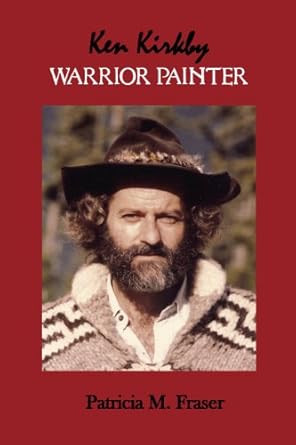
Ken Kirkby – Warrior Painter

excerpt

The Promise that Propelled a Life
“But I have promises to keep, and miles to go before I sleep…”
(Robert Frost, Poet)
~~
Ken worked at a number of jobs on the lower mainland but never gave up
his fixation on the north. It is unlikely his sense of destiny remotely hinted
that the path he was on would directly consume thirty years and several
fortunes, the majority of which would be spent in one of the major cities of
the world. It was enough that his mind was filled with his dream of this vast
and empty land.
Many thousands of Canadians made their home in Vancouver and
environs, and it frustrated him that he’d not found anyone who had been to
the Arctic, or even expressed more than a passing interest in that inaccessible
land that made up one-third of Canada.
The city was not a good fit for him, and within a year, he was leaving
it behind. He worked for several seasons on the construction of the WAC
Bennett Dam at Hudson’s Hope—an experience that has stood him in
good stead both through the workplace challenges he met, and the lasting
connection he made with WAC Bennett himself.
This odd association resulted in a piece of useful advice offered during
Ken’s long battle on behalf of the Inuit. The Premier of British Columbia
recommended that if all else failed, Ken should practice “Legislation by
exhaustion—the last man standing wins.” Over the years, Ken found it fit
his style admirably.
While working in Hudson’s Hope, he fell in love with a beautiful First
Nations girl and crumbled in broken-hearted despair when she was taken in
a tragic accident on the eve of their wedding. Tormented and withdrawn, he
took refuge in the compelling images imprinted into his brain by Francisco’s
tales of the Canadian northland. These seemed to offer some promise of
respite and became the catalyst that drove him into the Arctic. By the time
he was twenty-five, he had lived several years with the Inuit and travelled
by foot, boat and dogsled from Coppermine, NWT to Baffin Island and
back. In the process, he gave his promise to an Inuit grandmother …

https://draft2digital.com/book/3562902

Yannis Ritsos – Poems, Volume II

Neighbourhood Afternoon II

No — it’s nothing — I’m not hungry, you hear me?
It’s just a little headache. I rather go lay down
to put the chin close to the knees — to go to sleep
listening to the wind that grinds its teeth outside.
These faces look so strange
the steps on the sidewalk so strange
and the pepper trees of the street also strange —
the children get frightened by them — and
they pull their hairs without saying any words.
They had tied the rope on the trees over there —
five men stayed there for three nights and three days
like riders of the galloping wind who never got away.
The light of the lamp doesn’t recognize our hands —
the glass is smoked up, you see;
our hands on the table resemble dried up plane-tree leaves
they can’t hold a harmonica, can’t say thank you
or the day after tomorrow;
only when they hold another hand
they become hands again — and then the circle created
by the light of the lamp resembles a dish with warm food
from which two or three or more men can eat
and feel content.
Look, the evening star is rising. A purple dusk
after the rain — the evening star is
like the first I love you of a different spring. Look.
Freshly washed fence walls — the letters are still visible.
Stay by the window for a while yet. Here. We’ll look far away.
Over there to the corner of the road where our old spring
resembles
a green kiosk with many colorful magazines hanging
on cloths-pins fluttering in the breeze as if they clap
joyously;
a kiosk with many cigarette cartons
that the workers stop and buy after work,
a kiosk with small mirrors
where the neighborhood girls stop and pretend
that they don’t look into while absentmindedly
look at the young worker who passes with his hands
in his pockets
and as the mirrors hang slanting in a way
it gives them the impression that the young worker
will fall on them —
as they absentmindedly fix the curls of their hair
that slides on their foreheads like the light slides
on the upper crack of the door that leads to
the next room where two lovers kiss.
Look, then, the evening star has risen.

https://draft2digital.com/book/3562968

https://www.amazon.com/dp/B0851M9LTV

Ken Kirkby – Warrior Painter

excerpt

lobsters and many varieties of fish. Francisco would light a fire on the
rocky floor and the smoke would rise through the gap overhead while
we prepared a feast. Monsieur Desjardines thought this secluded spot
was heaven. We’d spend the day fishing, eating lobster over an open
fire and sharing stories. There was something deliciously daring about
being in a place feared by the locals—if the weather blew up a storm,
as it could easily do, the magical hiding spot could well become a
watery tomb.
Ken’s young life was idyllic but Portugal was changing. At the close
of three decades in power, the once-benevolent dictatorship of Antonio
de Oliveria Salazar was losing favour. In an effort to maintain control as
opposition coalesced behind the dissident Henrique Galvoa, Salazar’s
secret police grew more and more vicious, and by 1956, the country was
under siege.
Lisbon was the kind of city that attracted unusual people: the brilliant,
the demonic and those who drifted on the fringes of society. Spies abounded.
Ordinary people were recruited to inform on their friends and neighbours,
and paid according to the value of their information. Many innocent people
were ruined and the ensuing chaos heightened Ken’s determination to get
himself and his family out of the country.
Although his employees revered Kirkby, Sr. his position as a major
industrialist was unpopular with the authorities. It was no secret he had ties
with the exiled Galvoa. The contents of their ongoing correspondence was
less public and this was a double-edged sword: the Salazar supporters were
suspicious of his connection with the agitator, but totally unaware of the
extent to which Kirkby, Sr. was being kept apprised of problems brewing
within the country.
By early 1957, the Kirkby business empire was showing signs of
imploding under the intensified attentions of the secret service. Sixteen-year-
old Ken had an extensive network of friends at all social levels. When
he realised that time was running out for his dad he managed, with their
help, to orchestrate his father’s escape via a private plane in the gloom of an
early morning with government enforcers hard on their heels.
Monsieur Desjardines arranged the necessary paperwork for Kirkby, Sr.
to enter Canada. However, it took many months and the official intervention

https://draft2digital.com/book/3562902

https://www.amazon.com/dp/B00CB8W4CG

Arrows

excerpt

We hobbled jerkily, as directed, like some pathetic, three-legged
creature, until gradually we learned to swing our shared leg in
unison. In this humbled manner we were brought before the war
council of caciques.
The caciques were seated in a circle, with Guacaipuro given no
special place of honour. I was surprised to find Baruta among them.
Apacuana later told us that he had recently been made a cacique and
his body still bore the scars of the tests he had completed.
These were men who exuded confidence and authority, not the
kind of men one would cross unnecessarily. Their reputation for
bloodthirstiness coloured my apprehensions. I wondered if perhaps
we were meant to be slaughtered before them, as some sort of
ceremonial prelude to war.
I knew as well as Tamanoa that these Caribs were warriors,
conquerors in their own right. For generations, they had moved
from the south of the mainland to the northern coast, fighting their
way and conquering the gentler Arawaks.
Caribs fought among themselves, too, and made trading
incursions to the islands north of the mainland from which they
obtained not only goods, but also women. Not surprisingly, such
men were not inclined towards plans for surrender.
Though most of these men wielded authority over vast expanses
of land, Guacaipuro was chief of six other villages besides Suruapo.
Consequently it was the military strategist Guacaipuro who had
summoned the caciques of seven neighboring nations.
Whispering, Tamanoa quickly explained the gist of the
situation: Losada had founded the city of Santiago de León de
Caracas upon the settlement of San Francisco, and for the natives,
this had but one meaning: war.We were present because a cacique
called Mamacuri from the coast was arguing in favour of using the
shaman of the white men to obtain inside information about
Losada and his party.
Other caciques, like Paramaconi, great chief of the Toromaynas
from the valley where the new city had been founded, were more
inclined to kill me. Catia agreed with Paramaconi.

https://draft2digital.com/book/3562848

https://www.amazon.com/dp/0981073522

Still Waters

excerpt

“I know, but I suppose because he’s a classmate’s big brother I
thought of him as a brother, too.” Moe spooned cocoa powder into
a mug and turned the gas on under the kettle. “Enough about me.
How was your evening, kiddo?”
“Unsettling.”
Moe jerked her head around to stare at her roommate. “Why?
What happened?”
“He proposed.”
Moe, her mouth hanging open, plopped onto a chair facing Tyne.
“Wow! And?”
“And what?”
“And what? You know and what. What did you say? Did you ….”
Tyne put her mug on the table with a definite thump. “Oh, come
on, Moe. We’ve only been seeing each other for what – four months?
I hardly know him. Besides, I’m not ready to make that kind of commitment.”
Moe raised her eyebrows. “I see. You hardly know him, do you?
Four months of dating at least four times a week, dinners at his parents’
home, picnics in the park, walks by the river, long drives in the
country, dinner in classy restaurants ….”
“And not so classy restaurants.”
“Okay, sometimes not classy, but dinner nonetheless. Late night
coffee, early morning breakfasts, lunches in the hospital caff. I estimate
you’ve been together, let’s see … four times four times four … at
least sixty times.”
“You make it sound like we’re practically living together,” Tyne
huffed.
“Pretty close.” Moe got up to pour boiling water into her chocolate.
“Tell me to mind my own business, if you like, but do you have
that kind of a relationship?”
Tyne looked up, fully alert. “If you’re asking if we’ve slept together,
Moe, the answer is a definite no.”
Moe shrugged as she stirred her chocolate. “Well, if you like being
a twenty-two-year-old virgin, I guess that’s up to you.” She turned to
the door, carrying her steaming mug. “Well, goodnight, kiddo, I’m
off to bed. But if you want my advice … and you probably don’t …
think seriously about Cam’s proposal. You sure could do a lot worse.”

https://www.amazon.com/dp/1926763068

The Circle

excerpt

BEVAN LONGHORN is in his office Monday morning, his desk covered in
paperwork that he has to get through before the day is over. His personnel have
just adjusted to Matthew Roberts’s absence and Bevan has been left with only two
middle managers to handle the work of three. He considers promoting one officer
to Matthew’s post, but there are twenty-odd people to choose from, all qualified for
the position. Bevan must give it more serious consideration.
He wants to make major changes to the structure of the office, but he has to
fight with the rest of the brass, particularly the ones well-connected with the
administration and the state department. He cannot put up any longer with the
way things are done and the way things they produce are used by the hawks in
higher places.
He has his own circle of people who would agree with him on certain
things; it would just be a matter of rallying the troops. His friend Jerry
Wolverton is the best example. He retired as a three- star general and left the
army seven years ago with pride and a sense of accomplishment after working
in Iraq for five and a half years, in charge of the reconstruction of public
projects that accommodated all Iraqi government personnel of various
departments. Jeremiah Wolverton got his extra star and a very good severance
package, and although retired, can still pull a lot of strings both in the state
department and within the ranks of the army.
Bevan decides to call him.
“Hello, Bevan, my old friend. Are you still in service?” Jerry jokes when he
hears who’s calling him.
“Of course I’m still in service. We cannot all retire at the same time; the army
wouldn’t know what to do without us”
“You’re right about that, my good, old friend; what makes you remember
me? Trouble?”
It’s Bevan’s turn to laugh at the general’s comment.
“No, no trouble at all; just the need to say hi to my good friend and see what
he’s up to these days.”
“Well, I’m doing okay. I play the odd golf game here and there, I walk a lot,
still take holidays with the old woman; other than that, nothing much.

https://draft2digital.com/book/3562817

https://www.amazon.com/dp/0978186524

Ken Kirkby

excerpt

It was years later that I actually saw the book itself. I felt such
specialness to share this history with my grandfather who was a giant
of a man, loved by many and respected by all.
According to the National Geographic magazine, (Vol. 167, No. 3,
March 1985) Dr. Robert Paul Jordan confirms that the Viking traders known
as the Rus created Russia’s “first organized state and gave their name to a
future empire.” And the story that Ken learned as a wide-eyed boy seems to
support that claim.
As his maternal grandfather told the story, and as Ken passed it on to
his own son—who, at this point, is the last of the Kirkby line—the tale of
Rurik of the Rus goes like this:
Rurik was the eldest son and he chose to become a sailor, an adventurer
and an explorer. Like the Norwegians, the Danes were Vikings—an Old
Danish word which means ‘to dip your oar’ or in our terms, ‘traveller’.
Norwegians became known as the Norse, and Danes, the Rus.
Occupants of the Scandinavian countries realised early that to split the
farms into small holdings for their sons would make the land useless. So,
in order to preserve that livelihood, only one would inherit the land and
the others had to make their fortune elsewhere. The sea was the obvious
alternative. Through dint of need, the majority of them became mariners
and shipbuilders. They were a strong and courageous people and became
the Masters of the Seas as traders and mercenaries. The majority were
literate and highly industrious.
Those who became mercenary soldiers, a reputable occupation of the
day, were known also for their ferocity. They returned from the Middle East
with the knowledge of metalworking and equipped with this expertise, they
produced exceptionally fine swords and weaponry. This proved to be a great
advantage. A fierce minority banded together to form raiding parties and
this resulted in the Viking reputation for rape, slaughter and pillage.
Much like the dream of the Arctic that drew his future and distant
relation to northern Canada, Rurik also had a powerful dream of a vast
land beyond the ice; a land shaped by three great rivers. He was determined
to sail to that land one day. Rurik was an able navigator and commander
of several ships, and eventually he and his fellow mariners set out on a
long and arduous journey that took them east and north through the Arctic

https://draft2digital.com/book/3562902

https://www.amazon.com/dp/B00CB8W4CG

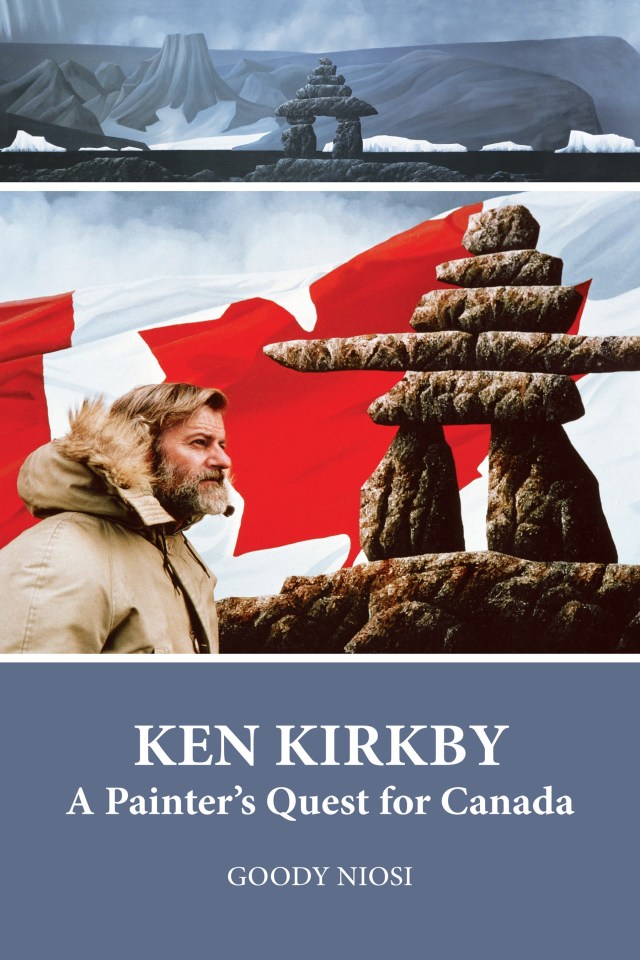
Ken Kirkby, A Painter’s Quest for Canada

excerpt

The media continued to be fascinated by him, the way an audience is
mesmerized by a performer who embarrasses himself inadvertently, on
a talk show. Ken had stepped so far outside the boundaries, had put on
a show so over the top, right down to the Inuksuit painted on the streets,
that the media haunted his studio just to see what would happen next. Ken
continued to feed them quotable lines that seemed to come effortlessly to
his lips, but that he had, in fact, been practising for months and years.
But, tidbits wouldn’t feed them forever. Eventually they would want to
stop nibbling and indulge in another meal – and the next banquet would
have to be bigger and better than the last.
He met Salvador Grimaldi for lunch again at Boccacio Restaurant, in the
Columbus Centre, and once again the architect came bounding into the
room, perfectly dressed in understated, expensive clothing, his eyes sparkling,
and his smile spreading goodwill around the room. Ken had a plan.
He told him that his next project had to be an even larger success than
the last, and described the two immense paintings he was currently working
on: one was a sixteen by sixteen foot canvas, featuring an Inukshuk set
against an enormous white cloud, that was intended for the Reichmanns.
Why the Reichmanns? Salvador asked.
“They are a very prominent family which the media and the public
have become very interested in,” Ken said. “They’re secretive and almost
impossible to approach. I’ve been studying them, and the information is
very sparse. I know they spent time in Valencia after leaving Eastern Europe,
and then they spent time in Morocco, and then from Morocco they
moved to Toronto: they started a tile business that immediately turned
into a raging success. Then, they went into high-end real estate development,
in which they have achieved even greater success. They are an
intriguing family – and just what I need. I need a Lorenzo de Medici.”
“I want to get to a place where other people cannot go. I want to sell
a painting to a man who doesn’t buy paintings and see it hung in the
foyer of the tallest building in the British Commonwealth – and have that
become a media event – even though they don’t like the media, that is
what I am after. What do you know about the Reichmanns that you feel
comfortable passing on to me? I get the idea you’re pretty close to them.”
Salvador allowed that he was close to Albert Reichmann, who preferred
to be called Mr. Albert. He had done his corporate landscaping and was
currently working on his personal property. “He’s a prince,” Salvador said.
“A merchant prince. He is a man of many talents, and I find it interesting
that you would have, instinctively, known that.’
Ken took Salvador to the studio to see the Reichmann and Yellowknife
Airport paintings, in progress. When he unlocked the door and switched
on the bank of lights, Salvador froze. The larger painting was nearing
completion while the other was only half finished.

https://draft2digital.com/book/3562830

https://www.amazon.com/dp/0981073573