
Arrows

excerpt

She was scrutinizing me as though willing herself to see
my soul.
Her hand came up to my cheek, and her thumb followed the line of
my cheekbone. An insurrection was taking place inside me. I wanted to
be close to her. Closer. My hands hurt with desire to touch her. My
breathing became jerky, and I felt myself grow hard in the way I knew I
must not, and the urge to satiate that hunger was ruining my
judgment. She said something, but I could only admire the fascinating
movements of her mouth—a ripe fruit, sweet and yielding.
Thank God she buried her face in my neck, though her breath,
warm on my skin, only added to the mayhem inside me, for it gave
me the time I needed to rally my wits about me. I pushed her softly
away. “Noli me tangere,” I breathed in Latin. Do not touch me. Her
big, dark pupils looked up at me, searching my face. I swallowed
awkwardly, conscious of the movement of my throat. “Chi’ka,” No, I
added in Carib. But it came out more like a strangled plea.
She knelt back, her hand on my thigh. I pushed it off, noticing as I
did the stake lifting my frock obscenely. She saw it, too. I pushed my
knees up, giving my privates the only touch and pressure they
would get. I breathed deeply, swaying softly back and forth.
Thoughts of Jesus on the Cross, at Calvary, flooded my mind,
slowing my heart.
Apacuana left me, a bit confused, I dare say, by my pushing her
away as I did. She fumbled for a long time at the entrance, building
some sort of barrier. I found it a sweet demonstration of her care for
me, but then began to worry she might have a more solid reason for
taking such precautions. I was left with a small fire burning and
enough kindling within reach to feed it.
I slept like the dead but woke up suddenly, certain I had heard
something. I tossed a handful of twigs into the glowing embers and,
moving gingerly, poked the fire until a timid flame revived. I
listened with expectation. Had I dreamed it? No, there it was again,
as if someone were shuffling at the entrance. My spirits lifted at the
thought of Apacuana’s return. But why not come in? I called to her.
Was it perhaps a beast instead?

https://www.amazon.com/dp/0981073522

Poodie James

excerpt

The chief reminded himself to be charitable
tonight and think of the A-rabs’ good works for crippled and burned
children when the Shriners and their bottle-fed mischief overflowed
from the hotels into the street. A mass of purple, white and brass, the
high school band and drill team crossed the intersection and the band
broke into “I’ll Be With You In Apple Blossom Time.” The drum
major blew his whistle, strutted and kicked toward the sky. Thirty
batons twirled high and back into the hands of the girls, whose smiles
had yet to reach the pasted-on stage. The parade was off to a good
start, Spanger thought as he watched two youngsters sitting on the
curb wide-eyed and laughing, gripping their popsicles. The first float,
a confection of white, pink and green, bore the festival queen and
princesses in their satin gowns. Princess Marcie Welch, her tiara a
double band of apple blossoms, waved to the crowd. When she saw
Poodie standing beside his wagon, she blew him a kiss. Grinning
broadly, he waved back. Well, Spanger thought, the kids in town do
seem to love that strange little man.
On the side of the blue Packard convertible that followed the
queen’s float, signs with block letters a foot high proclaimed
“Mayor and Mrs. Pete Torgerson.” The mayor perched atop the
backrest of the back seat, turning toward one side of the street then
the other, moving his arm in the way Spanger had seen in the
newsreels when the Pope blessed crowds in St. Peter’s Square.
Sue-Anne Torgerson now and then glanced at the onlookers and
lifted her hand, her head just visible above the side of the convertible.
Torgerson waved the chief to the side of the car.
“Did you see that?” he shouted over the band.
“What, Pete?”
“Poodie James, that’s what.”
Poodie had waved and smiled at the mayor’s car as it went by.
That smile, Torgerson thought, that mocking smile. Sure as hell,
he knows. He remembers.
“He’s watching the parade,” Spanger said, striding alongside the
car. Even with Torgerson sitting on the backrest, the chief’s head
was nearly level with the mayor’s.

https://www.amazon.com/dp/B08W7SHCMV

In Turbulent Times

excerpt

‘Oh yes, I knew him well. And admired him. He’s a monk in Loughinish Abbey in south Armagh now. Why do you ask?’
‘He was epileptic too, wasn’t he?’ Nora’s hands rested on the table with the knife and fork still in them. She looked earnestly at Liam. She accepted the fact of her epilepsy with no embarrassment. She had long ago come to terms with it. It meant no more to her than the dark brown of her eyes or the black of her hair. But she wanted others to accept it, to regard it simply as a normal aspect of her being. Most of all, though she could not explain why, she wanted Liam to accept it. So she watched his face and was disappointed. Liam’s mouth twitched, and his eyes looked down at the bacon and eggs on his plate. He reddened a little and then said, ‘Yes, he was;’ but his voice could not hold the nonchalance he tried to charge it with. Internally Liam knew he had failed her. He wished he could kick himself.
Why do I react this way? he repeated to himself while silence extended into a solid barrier between them.
‘Do you believe the gossip that Padraig was my father, Liam?’
Nora’s question exploded in his face. The barrier disintegrated with a crash that reverberated through the house, through the empty schoolrooms.
‘Nora! How could you …? How can you … ?’ Liam struggled to regain his composure. The blast from her gelignite question had hurled him off his feet.
She smiled. The smile leered with malicious sadism. Liam was totally confused, disoriented, unbearably discomfited. He liked to feel solid, familiar ground beneath his feet. He liked the trodden paths of life, however narrow or however straight, and he did not stray from them. He was at one with those whom Grey elegised in his English country churchyard. He was one of the living dead, his life already past, like a swift, irrecoverable dream, his being already buried under a smothering mound of moral precepts, religious commandments, social expectations and private, psychological inhibitions.
‘Some people in the village have hinted that I might be Father Padraig’s bastard, haven’t they?’
Stop it, Nora, stop it, Liam cried silently. He gripped his knife and fork fiercely. He clenched his teeth. He pushed his back hard against the chair till he felt the wood bruise his spine. He drew in a deep breath. ‘Whatever put that silly notion into your head?’ he blurted out, and then realised how weak his question was. ‘I don’t understand you.’
‘You understand me well enough, Liam Dooley.’ Nora’s voice was hard, penetrating, like the bull the stoneworkers pounded into granite to split it. ‘I know what they say. I know that you know also.’

https://www.amazon.com/dp/1926763270

Swamped

excerpt

“Sounds good, Eteo.”
“Okay George. How expensive is this going to be?”
“For you, Eteo,” George replied, smiling, “for you, you know …
I could do it for 16,500. I have to cover the prospector’s expenses,
that’s about 2,500, and 8,000 for my office expenses. That leaves a nice
chunk for the good guys.”
“Sounds good to me,” Eteo replied, smiling back. “Go ahead and
prepare the papers and send them to Rebecca.”
“I can have an agreement ready for your lawyer within a week.
Will that work for you?”
“A week sounds fine,” Eteo agreed, and the two men shook hands.
Alone in his office Eteo checked the prices of a few stocks. Platinum shares
were trading nicely, with good volumes and steady buying
slowly driving the price up a few cents a day. A classic case of
what they called “healthy” trading. Eteo hoped it would carry on like
this for a while longer, but he also knew that all good things come to
an end. The key was to know when to get out. As for Golden Veins
the price was stale. Eteo had had a couple of offers, which he was selling
through a different brokerage company so that no one would
know he was the seller, but he didn’t expect anyone to buy them anytime
soon.
At that moment Logan came in to his father’s office with a broad
smile on his face.
“Sam regrets selling some shares the other day,” he announced.
“It never fails, does it? Even when we sell something at a good profit,
if the stock goes up even a little bit after that, Sam regrets selling.
Now he wants to buy it back. What should I do, Dad?”
“Do what he wants. There’ll be some profit in it even at this level,
and he also has some of the cheaper stock, so his average won’t be
that bad. Go ahead and buy it back for him.”
A few minutes later Eteo noticed a buying order of 6,000 shares
bought by his house. Sam’s stock was in hand. On impulse, he dialed
Ariana’s phone and caught her doing her morning errands.
“Hello, sweet baby, want to hook up later?”
Ariana laughed and said, “What a question, but of course I want
to. Come and get me as soon as you’re done.”

https://www.amazon.com/dp/B08WP3LMPX

He Rode Tall

excerpt

Sure, he had been gone for many years and there was no doubt
that the Circle H held some harsh memories for him. At the
same time, there was no doubt about it: for him, Joel Hooper, the
Circle H was home. And if there was any doubt in his mind, it
seemed as if nature was reassuring him that he was home with a
magnificent display of a spectacular sunset awash in all kinds of
tones of baby blue and soft pastel pinks. This truly was the legendary
land of the living skies. Alive with all kinds of colors. The
kinds of colors that were capable of temporarily extinguishing
even the gravest worries from one’s mind.
Two days after his trip into Willow Springs for the mail, he was
back up in the hills, sitting on the big buckskin gelding surveying
what must be close to fifty head of Smith’s cattle helping themselves
to his grass. This time he could see where the fence was
down. The cattle had torn the fence down to get at the richer
grass in his pasture. Poor creatures, Joel thought. They must be
half-starved with the slim pickings they have in their own pasture.
With all of the land that Smith has, he must have some
better pasture to move these cattle to. What was he waiting for?
For their ribs to show? Heck, some of them were at that stage
already.
Joel would be the first to admit that he did not know much
about cows, but he did know enough to realize that this was a sad
and sorry lot of cattle.
Realizing that this was going to be more of a major production
than his earlier experience that involved only three heifers, Joel
rode the buckskin back to the ranch and solicited the help of
Harry and Tanya. Harry headed up to the pasture in the old
truck, which he had stocked with a few fence posts, a bale of
barbed wire, and all of the fencing equipment, including a wire
stretcher and post-hole auger. Tanya was just about to finish
working with her last horse of the day, a little bay mare, so she
rode her up to the hills alongside Joel on the buckskin. On the
way to the fence, Joel and Tanya started to round up the intruders,
and in the distance, Harry was busily repairing the fence.

https://www.amazon.com/dp/0980897955

Water in the Wilderness

excerpt

“I’m cold, and I’m hungry. I don’t want to go no more. Rachael, I can’t walk no more.” Pulling his hand from hers, he fell to the ground and sat in a shivering little heap, the toy truck clasped in both arms.
“Get up, Bobby, come on, we have to keep movin’.” She remembered the lunch bag that Ronnie had taken from her to carry. “We’ve got food; c’mon, get up and we’ll eat a sandwich while we’re walking.”
Ronald handed the bag over, and bent to lift the little boy to his feet. “Here, Bobby, I’ll carry you piggy-back. Get on my shoulders.”
With Bobby on his back, he set off again. Rachael clutched her doll under one arm as she opened the sack of food. She had started to pull the jam sandwiches out when she heard her cousin’s excited yell.
“We’re there, Rachael. See – there’s your neighbor’s house. And look, there’s your place just ahead.” He began to hurry, the weight of the child on his shoulders no hindrance to his renewed energy.
Rachael shoved the sandwich back into the bag, and ran to catch up to them. She strained her eyes in the murky light so that she could better see the house. And there it was – her home. She thought she had never seen anything so beautiful in all her life. Exhilarated, she ran ahead towards the front door. But, as her feet left the sidewalk to turn onto the path, she realized something didn’t feel right. She looked down. Where once a weed covered path led to the house, a concrete walkway clear of snow made an easy approach to the porch – a porch no longer in a state of disrepair, but standing straight with a coat of bright yellow paint. The steps leading up to it were new, and were also made of concrete. Rachael came to a stop, her mouth hanging open, her eyes wide and staring.
She became aware that Ronnie had come up beside her. “Wow,” he breathed, as he lowered Bobby to the ground.
The little boy stared at the house, then glanced around. “Where are we? Rachael, this ain’t our house.”
Rachael wavered between excitement and confusion as panic seized her. She turned to Ronald, a question in her eyes. His look did not reassure her.
“D’ya think maybe your dad has moved away from here?”

https://www.amazon.com/dp/192676319X

The Circle

excerpt

it’s best for their morale, for their belief in the rationality of what they do every
day, and for their steadfastness in moving ahead. He has been around these
people and this agency for a long time since leaving Baghdad, since the days he
thought he had a good future with the CIA. Time has passed along with his belief
in a good future. What went wrong? He has wondered many a time; Ibrahim is
right. Bevan knows deep in his heart that Ibrahim is right. The problem is what
the agency does and what his department does is often questionable. This has
troubled him for a while. He has a hard time understanding the reasoning
behind decisions taken that are based on a mounting fear in the psyche of the
American people. He has been abroad for many years in which he has come
across people of many different nationalities; Muslims and others and they are
seldom the way they have been portrayed by the administration and by the
Ameerican media at the best of times. Following the end of the term of the “war
president” the people elected a different party and the stand of the country
abroad softened a bit, but after a couple of terms they were back at the same old
doctrine of pre-emptive strikes whenever it felt right, and Bevan knows that’s
not the best approach. Sometimes it’s better to sit and talk to a person instead of
unleashing the power of the killing machine and later trying to find answers to
questions you never asked to begin with.
He knows something has to be done about all this. Yet there are times when
he doubts even himself, even the comments from Ibrahim, his good friend. Does
he doubt his friend? A number of times he has thought about that, as well. After a
while his mind gets stuck on the idea that something has to be done with this
department, something has to change; it cannot keep on going like this for ever,
it cannot keep on going on with the killings and the atrocities. Yes, he knows,
something has to change.
He has tried over the past five or six years to change the mentality of a
number of people whom he has talked to; but has found it difficult to convince
most of the people in higher positions that what they do and how they approach
things is wrong. Some seem to thrive on other peoples’ misery and cannot
suddenly change direction because Bevan Longhorn wants it. He knows the only
way something will ever change is when something dramatic happens. Bevan has
been thinking about that for quite a while.
Ibrahim is right; substantial change takes place only when dramatic events
precede, like the attack in New York in 2001. He takes a copy of the memo he has
issued to his personnel and puts it in his wallet. He closes the file and calls his
secretary to pick it up. Then he finishes eating his sandwich and asks Dorothy to
remove his cold coffee.

https://www.amazon.com/dp/0978186524

The Unquiet Land

excerpt

“In one way they were right,” Michael interrupted.
“Yes, that’s true enough,” Caitlin agreed. “The doctor tried to tell the people it was epilepsy, but they said that epilepsy was just a doctor’s big word for seizure by the Devil. Then a fishing boat went down in a storm with the loss of all hands. The people in the fishing village blamed Padraig. They dragged him from the doctor’s house, but on the way to the harbour, where they might have drowned him, he suffered another seizure. He was writhing on the ground and foaming at the mouth when my father rescued him. The doctor agreed with my father that the best thing for his own safety was to let Padraig go.”
“What a terrible life that poor man has had,” Michael observed.
“Only the first dozen years,” Caitlin said. “He was twelve when he came here.”
“So he lived with the doctor and his wife for three years?”
“About that, yes. But he was mostly confined to their house. Children stoned him one day when he went outside.”
“Imagine being stuck in a house for three years.”
“It was a lot better than the house he came from. The doctor continued his education.”
“Padraig’s education?”
“Yes.”
“What do you mean, ‘continued’ it?”
“His mother, the school-teacher, educated him herself as best she could under the circumstances in her brother’s house. She did a good job of it too. Padraig is a clever man. A very quick learner.”
“You should know, shouldn’t you?” Michael said. “You spent a lot of time over his books too, as I’ve heard.”
“I learned as much from Padraig as he did from me,” Caitlin said modestly, but honestly. “Old Shaughnessy, the schoolmaster, didn’t know what to make of Padraig. I did. I taught him what I could. Except for theology.”
“Theology?” This was a new word for Michael.
“The study of religion.”
“I see.”
“Padraig was quite well versed in that. The doctor or his wife must have known a lot about it. Padraig actually taught himself, Michael, in between the odd jobs he did for my father. He did well enough to get to university. After that there was no stopping him.”

https://www.amazon.com/dp/1926763203

Small Change

excerpt

a sweet humming whisper and my fingers closed around the aluminium body shutting off the little air holes that made it sing. I stuffed it into my shirt pocket and my fingers brushed against the last Spud menthol I’d forgotten to smoke that afternoon after baseball. I pulled it out and straightened it carefully into a limp tube that dribbled dry tobacco from its open end. Scary stuff, lighting up in front of your own house, but what the hell. My scalp came alive with little electric maggots, wriggling. I found some matches in my pants. The end of the Spud flared and settled into a hot core that let sparks off in the breeze when I sucked on the cork tip. I put one foot up behind me against the fence, and the movie came on in my head. My eyes narrowed; my ears sifted the sounds of the city for clues.
Then suddenly they were there, the big boys.
Joey comes up to me, all excited and talking like he wants everybody on the block to hear.
“’ey, Georgie, Pasquale wants you to go to D’Amato’s an get im four cansa Ballantine ale.”
He presses a damp, crumpled bill into my palm and says it again.
“Your nonno, ‘ey, he wants you to get ‘im four Ballantine’s.”
He winks at me, and gives me an elbow. He laughs. His eyes are heavy lidded and his face is damp with sweat. He’s been talking loudly at me so the neighbours can hear, and now he makes a face that says to his buddies, it’s cool, don’t sweat it. I remember that look from dozens of Saturday matinees. I feel the damp currency in my hand. I know there’s something wrong with all this, but I can’t figure it out. Then he bends close to my ear and tells me to meet them in the park.
Sometimes Nonno Pasquale would come and stay with us. On a shelf in the pantry he kept this little tin pail with a lid he’d give me to go and get beer in. The guy behind the bar at D’Amato’s, Gioffo, an old guy, but not as old as Pasquale, always thought I was worth a smile, this little kid with a beer pail, and he knew my nonno from years ago, so he’d wink at me and fill it up and give me a Sarsparilla on the house, and I’d run back home so the foamy draft wouldn’t get warm in the sun, and my grandfather would laugh and give me a nickel, and pinch my cheek and tell my mother what a prize she had for a son.
But I never saw him drink from a beer can, ever. Or even a bottle. Still, it was tonight, and they were having a party in there, and what did I know. So I marched importantly into D’Amato’s Bar & Grill.

https://www.amazon.com/dp/1926763157

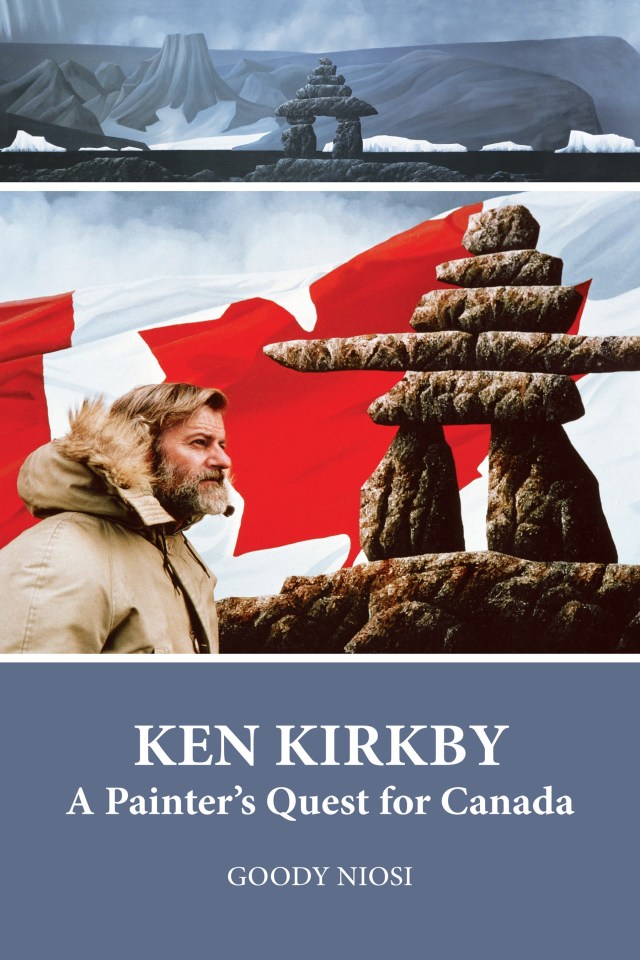
Ken Kirkby, A Painter’s Quest for Canada

excerpt

When they immigrated to Canada, and settled in Toronto, they founded
a tile company and then became real estate developers. Their flagship
building was First Canadian Place, the tallest building in the Commonwealth.
Ken talked about them and gnawed on the information he had
like a dog on a marrow bone.
“Forget about them and come into business with me,” Henri said.
“Why try to sell paintings to people who don’t buy paintings?”
Ken finally looked at the books, which revealed that the frame factory
was struggling to stay alive.
“You can buy half,” Henri offered.
“Why would I buy half of a sinking ship?” Ken asked. But, he agreed
to become a partner. Perhaps, it would be a good idea to be seen as a
businessman instead of an artist. He might be viewed with more respect
and given more credibility. He would buy his half with orders for frames.
Henri agreed to build Ken a studio across the top of the factory.
Within six months, Ken had paid off the fifteen thousand dollars he
owed and moved into his new studio where he began work on two large
Arctic paintings – one for First Canadian Place, measuring sixteen by
sixteen feet, and one measuring slightly less, for the new international
airport planned for Yellowknife.
Marsha said, “You have no money and you’re going to create two giant
paintings that no one wants to buy. It makes no sense!”
It made sense to him, even though he had no explanation to give. He had
learned to listen to his inner voice, and it was telling him to paint the canvases.
Nobody’s doubts could stop him. He was going to show the world!
The new studio was too small for the massive paintings and so were all
the conventional canvases. He joined four lengthened panels with invisible
seams by bevelling the wood, squeezing the stretchers together with
clamps and creating knife-edges that melded together. Through painstaking
experimentation with a torque wrench, Vise-Grips and a canvas
stretcher he created a unique design that produced perfect tension on
every square inch of canvas. When the tension was perfect, he hosed the
canvas down to shrink it. One of his first canvases exploded, and one flew
off spinning like a propeller, but he finally got it right and made a sixteen
by sixteen and a twelve by fourteen foot canvas.
He was still mystified by his inability to sell paintings of the Arctic.
One day, while he was driving on Steeles Road near the Allen Expressway
a question leapt into his mind. “If you were limited to one image – one
object from all your experiences in the Arctic, and that was all you were
allowed to portray, what would it be?”
Inukshuk!
Ken was stopped at a red light. The light turned green…

https://www.amazon.com/dp/0981073573