Gratitude The sense of gratitude passing through me slowly reaches the forests that root in the wind days in tomorrow’s train stations we live in nameless streets by the riverbanks of every number the cosmos will forget all who loved it and it won’t know the number of stars each person hides in their heart forgotten in the old mistakes all lovers are holy and sinful Eros is a thirst for whom will be betrayed shining moment that suddenly arrives and vanishes in the whirl of eternity. And if the road is full of truths the inexplicable moment is still far away the dream dives into the void and writes about chancy destinations in this version of history they keep time and light like a legacy of nothing they inherit from generation to generation an untidiness of improvisation a vigilant attraction. Outside something like a forged spring and the forever illusion of keys that open the wide-open door.
Second Hour I move my brush toward the eastern field and the cows stop spinning their tails splashed in light brown although worm and eagle earn gratification in the nimble yawn of nostalgia of life in Chronos’ pendulum tender sparrow tackles two seeds in his beak and retreats to his brother in the bushes one teardrop in an irksome afternoon when even chewing a stick of gum embalms you with such pleasure you couldn’t think yourself more lucky as you breathe fresh air rising off seashore dusk always recurring as a faithful friend after a tough day’s work then starts the game of cynical Death evangelizing his fearsome enigma The dark wind blows as from the future and undresses a decaying reality concocted by hands of the few though the rose traverses past eyes of the girl who reflects at the redness of her lips shrugging her shoulders my loneliness in the path enmity grasps thin air and ponders the question while headmaster cinches the noose around an apostate’s muscled neck without concern for mercy carves emblems and insignia inked with blood crying out: who cares?
Summary Those who left early with their glance focused on the same spot: dead horses, bones, flags, tables, stones, a lonely tree up on the peak and the immovable oath. Evening liaisons, pseudonyms on cigarette packages, the discussion left by the cane fields and the old woman who yelled: passersby, fools, consumed by secret wounds, nails, teeth, my little moon, the dream and the chair; take care of the dead, she said, find a way to live their life. Don’t fall asleep and forget. History is but a continuance. The man by the front step reads the incomplete catalogue, the one with the killed shoulder, who died under the trees. Small animals gathered by the corner. One lonely boy, enchanted by the imaginative stars. Ah, the beautiful, I’ll shout, the brave, ah, the thoughtless. And the old woman under the stairs, with the big cauldron in the night.
TALE OF THE TEARLESS A colourful dream started in the imagination ~ Renan Once upon a time there was a rich man who had a son. Father and mother loved him; he went to school; he learned of everything that existed in the world
~ (Beginning of a gypsy fairy tale)
A fairy tale occupies the cave of my soul, a tale that is tough like lithos with strong words like lead; a fairy tale that crashes me I don’t know anymore, I don’t remember where I heard it first or was it I who experienced it once upon a time? Yet whether you’re a stone, roll down to the cave of my soul loudly and if you’re made of lead, melt in the fire of the gypsy.
D since it was a dark night and only the stars flickered I thought of an image beyond humans. The vase containing the sea was placed at the edge of the visible a few dark, undecorated Christmas trees stood on the sand silently; heavenly bodies screamed and shone in the freedom of lust. The air smelled of unfamiliar flowers and none of the lamps revealed any true or faulty present. Ah, yes, I said and pushed my inelegant sole on the atrophied grass, this the way they were before the stage of the cloud opened to the first act, with the first actor playing the first male role; this was the way before they decided to strangle the female babies before Erasmus replaced our diction before the first complain was heard about life on this earth this was the scene of existence before the play with many acts commenced.
Condemnation The beggar’s honest hand extending despair inexhaustible signalman momentary begging sigh sorrowful chirp of a bird that clipped its wings A beggar who stooped unending fortitude to raid fate’s slap that on the cheek he felt as if replacing his inglorious life with the unrealized dream life denied him
Ivan Nikolaevich, the second rate agent. Still, she wanted the director to know that she had been correct in her suspicions. “Da, da, yes, of course,” nodded the functionary, pawing through his desk drawer searching for something. The man’s an idiot, she thought. This is the quality of worker who stands guard over the country! Saints preserve us, as my old grandmother used to say. Finally, the man produced another form, this one on blue paper. “In order to use the official phone line, you must fill in this form.” “Phone him now!” Natasha raised her voice in hopes that the supervisor would hear her and look out his door. “I’m not filling in one more form!” The man’s expression did not change but this time he abandoned the new form, picked up the receiver and asked her for the number. After some dialling, waiting and dialling again, he announced that he could not get through. He replaced the receiver quietly. “The supervisor will attend to your complaint tomorrow,” he told her. Natasha struggled to control her breathing. “Tomorrow WILL BE TOO LATE. She’s passing through the line now; I can see her from here.” Indeed, Lona had already slipped through the passport control while they had been on the phone. The young man’s face creased in a troubled frown. “Very well, comrade. I will take the name of the tourist and her flight number and pass it on to the customs officials myself.” Now we’re getting somewhere, Natasha thought. “I’ll go with you,” she said aloud. She took a certain perverse pleasure in being in on the moment of discovery. Of course the poor fool Chopyk would be angry with her… “I’m sorry, comrade, that will not be possible,” the guard replied. “It is not permitted to pass through that door into the airport again. You must leave by the fire exit.” He gestured at a door on the far side of the room. “It is a regulation. Thank you and good day.” Natasha drew herself up to her full five feet, four inches, cast one more withering glare at the man, and stalked toward the fire exit and out of the lives of the tour group from Canada. “Documents, please.” Jennifer watched as Lona, standing in front of her, tensed at the command. She could feel her own apprehensiveness growing as she waited, her toes behind the yellow line. This first barrier marked Passport Control was a preview to the inspection room.
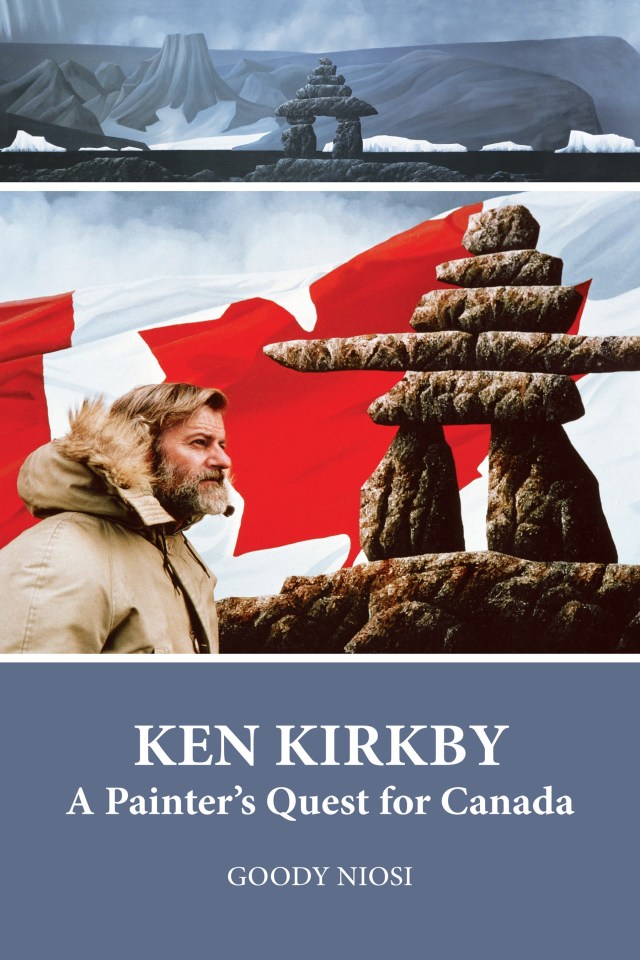
His scaffold was built, ladders leaned against the walls, tubes of paint – by the carton – were stacked in the studio, and alarm clocks ticked beside his narrow cot. He was ready to begin painting. I felt very, very much that things had now solidified. This was now a fact, and for the first time in this entire campaign, I actually knew that I was going to make it – not only the painting, but also my fight for Nunavut. This was it. It was now only a matter of physical labour to complete the vision. There was a different feeling now. The desperation was gone, and there was only a huge engine driving me. Now, there was only confidence. Now, I had access to politicians, business people, media – an infrastructure so massive and on such a personal level that I would be able to get this story through and by hook or by crook it would come into being. It occurred to him is his newfound euphoria – “We need to celebrate!” He announced the “First Brushstroke” party and invitations went out in the shape of artist’s palettes that hit the desk of every media contact in the city. Every couple of days a new invitation in a different colour, embossed with an Inukshuk, went into the mail. He called Keith and told him to fill a plane with choice Arctic food. Bob Engels, the North’s most famous bush pilot, volunteered to fly the northern contingent to Toronto. On an evening in early September 1986, Ken climbed up on a ladder, from which he made a speech to a roomful of people, and then splashed a giant brushstroke across the towering, white canvas. Then he settled into a routine that was to last for almost a year. He painted the sky for several hours, slept for two hours, went back to work, and then slept for two hours. As he painted he had a sense that this was what he was meant to do – to paint on this scale. Every other painting seemed too small – even the giant canvas that hung at First Canadian Place was undersized. How could he ever go back to painting something on a lesser scale? What he really wanted to do was buy Saskatchewan and paint it from helicopters. One day a woman, wrapped in a fur coat, swished in on stiletto heels. She glanced around the studio and waved her arm at some paintings leaning against the far wall. “I’ll have that one, and that one, and that one.” “Madam,” Ken said from his perch on the scaffold. “I don’t know who you are. I suspect you know who I am or you think you do. I would invite you to go outside, take a walk around, come back in, and say – ‘Good morning!’” She took a step back. “Well! I have never been spoken to that way before!” Ken waved his hand. “Go on! Go. Shoo… Shoo.” She stalked out, and returned ten minutes later. “Good morning,” she said.
THE PRESIDENT AND Poodie sat in rocking chairs on the porch of Mr. Truman’s house in Independence. Mr. Truman waved and called to people passing by. “Afternoon, Herb,” ”Nice hat, Mrs. Gordon,” “Watch that no-hands stuff, Billy. You could fall off.”Mrs. Truman brought big glasses of lemonade, took a chair and reached under it for her knitting. Poodie heard birds singing, the laughter and cries of children playing in the big yard of the house next door, dogs barking.He and the Trumans conversed in French. Mrs. Truman told Poodie that his mother was about the prettiest little girl she ever saw, as pretty as Margaret. Margaret would be coming for dinner, she said. The President wanted to show Poodie his new car in the shed behind the house. Poodie helped Mr. Truman into the wagon and pulled him around to the back yard. Mayor Torgerson was standing by the shed. He took a pistol out of his coat pocket. Bullets whizzed by, hit the ground near their running feet, ricocheted off trees. Now Poodie was running alone through an orchard, running, running, running under the blossoms. A figure darted among the trees and into his path.The mayor smiled, raised a shotgun to his shoulder and fired. Heat infused Poodie’s face. Pete Torgerson and the shotgun faded. The blossoms dissolved in white radiance as the seven o’clock sunlight streamed through Poodie’s window and across his pillow. He wondered whether he would have died if the sun hadn’t warmed him awake.