Ithaca # 555

ΔΙΟΓΕΝΗΣ

Προχωρεί

με το λύχνο του

μέσα στο δάσος.

Οξιά πες μου

πού είναι

το ελάφι ο αδερφός σου;

Στο χωριό ρωτά:

σκύλε πού είναι

ο φίλος σου;

Στην πόλη ρωτά:

ανθρώποι, πού είναι

ένας άνθρωπος;

Μετάφραση Μανώλη Αλυγιζάκη//translated by Manolis Aligizakis

Diogenes

goes
with his lantern
through the woods:

oak,
where is your brother
the elk

goes
through the village:
dog,
where is
your friend

through the city:

people,
where is
a human
Viacheslav Kuprianov (Russia 1939)

Yannis Ritsos – Poems, Selected Books, Volume IV

REPETITIONS, SECOND SERIES

The End of Theseus

Returning from his last deed, his greatest deed, his descend

         to Hades —

no one welcomed him in the roads of Athens, as it was

        customary

and as he expected. Mnistheas (long as the hero was away

        glorifying his motherland)

managed with promises, flatteries, with popular demagogue

to turn the people against him.

                                                 And him, sad and pissed off

sent his two sons to Elphenor, king of Avanda, exiled too

and he ran to the village Gargitos, which since then they called

         Aratirio

in other words place of worship. Then, unescorted, he went to

Skyros to meet his old friend Lycomedes, king of the Dolopians,

hoping to find a bit of hospitality and protection, to reclaim a few

fields that his father had left him.

                                                        He dreamed that there he’d

escape from useless concerns, the futility of glory, and the empty

          words

the conniving, the double-faced people, the slander, working

          the lands,

barefoot, with ripped undergarments (and this with plenty of

          sadness for himself          

and like revenge against something general and faceless).

He even imagined, with pleasure, during the summer noon,

that he’d moist his dry bread in a clear creek. And suddenly

he remembered: fresh, ripen, black figs and he felt his appetite

         was aroused;

and perhaps he had a dog to keep him company. And the sparrows

picking the crumbs from around him. And when the evening star,

like a slivery drop, would come among the pine trees.

                                                                                     However

Lycomedes, say because of the fear of the Athenians, say

due to his personal hatred, led him to a high mountain,

supposedly to show him a few fields — “look how green

they are, how fertile — I looked after them for many years”

and there he pushed him down to his death.

https://www.amazon.com/dp/B0CGX139M6

Ithaca # 550

Threshold

At which zone
erogenous
of this language
nomad,
tattoo the star of absence?

The poem,
a shelter without roots
open
for the obscure appeal
of the roads.

Idriss OUADOUL, Morocco (1962)

ΚΑΤΩΦΛΙ

Ποιό ερωτικό σημείο

αυτής της νομάδας γλώσσας

αποτυπώνει

τ’ αστέρι της μοναξιάς;

Το ποίημα

καταφύγιο δίχως ρίζες

απέραντο

στην ατέλειωτη έλξη

του δρόμουΜετάφραση Μανώλη Αλυγιζάκη//translated by Manolis Aligizakis

Tasos Livaditis – Poems, Volume II

Long Listed for the 2023 Griffin Poetry Awards

Symphony I

And suddenly the last firings of the surrendered

            city

as the wind brought footsteps and rifle shootings

              and out of tune songs

many soldiers were wearing civilian cloths and

              ran over the walls

houses resembled dead faces in the moonlight frost

unburied corpses on the roads, left to the dogs

              and God

and the shooters, stood by the corners hugging

their rifles like the body of a woman who

               had betrayed them.

Then, again the same road, among the dead horses

               and the broken rifles

women were sitting by the entrance of each burnt up

               village and cried

moistening a little flour in their palm to feed

               the babies.

https://www.amazon.com/dp/1926763564

Yannis Ritsos – Poems, Selected Books, Volume III

LIGHTHOUSE KEEPER

A clay pitcher is moulded, remolded like flowing light,

experimenting with itself, still hasn’t decided to exist

and you hear the semicircle dance of its handle that curls

more and more, then less and less, touching the body of

the pitcher momentarily, again to distance itself quite

independently, looking elsewhere, meaning something

else, floating in the intoxication of its lissomness, like

a winged serpent, like an autonomous flower made of

              rosy silver.

And they all wait, in their beautiful palindrome,

for you to undertake their responsibility, to create them,

to give them meaning, shape, and to name them and

place them in their positions. Yet, absorbed as you’re

in the vague and useless, you delay; then, at the time of

the last forgetfulness, the time you have to light the lamp,

the horrible ringing echoes in your sleep like a punctual

alarm clock that stops sleep, like an erotic spasm that

stops lust. You stand up and the rays of the lamp you’re

about to light have already wrapped around your neck,

like ropes your hands lifting you up, and outside.

And, in the light you put on to guide the ships,

you see the ships which look at your lamp

you see your golden, miraculous and useful  hands.

https://www.amazon.com/dp/B096TLBNFK

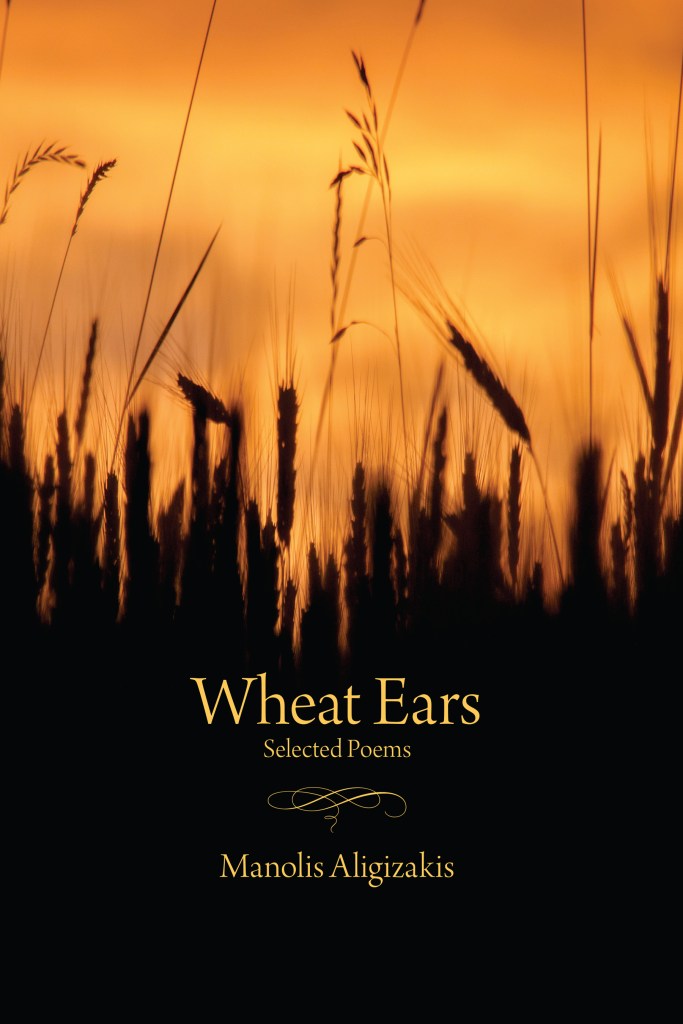
Wheat Ears – Selected Poems

Flies

Flies take charge of the wound

decay creeps into his nostrils

sorceress curses and in the corner

the blood-filled bucket  

avenging bull wondered

what was accomplished with a death

the matador’s chest gored by right horn

deep aspirating gash where

breeze collapsed

his eloquent movements

fogged his poetic eyes

while the brassy band cheered victory:

of the bull

the matador

or the poet’s

composing this eulogy?

https://www.amazon.com/dp/B0BKHW4B4S

Neo-Hellene Poets, an Anthology of Modern Greek Poetry, 1750-2018

Poem by Tellos Agras

ON WORKING DAYS

Poor neighborhoods, abandoned corners

where deserted hearts, encased in frost,

that on a Sunday numb with cold

and sad music stand and sing for us,

tiny faces shining timidly,

lips sealed by sadness,

lips never tasting a warm kiss

except the farewell kiss,

pale begging hands,

unworthy souls in supplication,

shadowed, blinded eyes

oh, saddened urgings of mortality!

You too enrobed your death,

unfortunate, poor, graceful rose, 

instead of sparkling with rosy joy,

you seemed a saint in tribulation,

your stem bent, kneeling,

praying the daily Epitaphios.

Poor neighborhoods, abandoned corners

built for pitch black frost

built for the unburied souls,

the daily souls, lonely

for the remains and Sundays

of my soul, you, secret motherland

of my soul, frigid and resembling

a tray with cross and gold confection

and in its middle the holy candle

keeping vigil in the requiem of Love.

https://www.amazon.com/dp/1926763513

Yannis Ritsos – Poems, Selected Books, Volume IV

6th Century BC Angiography

Nothing, not his Godly power nor his famous exploits, brought

him much glory as his human weakness (and he discovered it

himself and especially he admitted to it), when, crying like

 a baby, with Nessus’ chiton eating his flesh, he climbed up

to the top of Oeta, on the pyre, as if he was ascending the

highest stairs.

                  From there he was received by the four-horse chariot,

bringing him to the thrones of the Gods, while the Nymphs were

putting down the fire, and the frightened and amazed Poeas ran

down the slope stumbling on the roots and the rocks.

https://www.amazon.com/dp/B0CGX139M6

Constantine P. Cavafy – Poems

CANDLES

The days of the future stand in front of us

like a line of lit candles—

golden, warm, and lively little candles.

The days of the past remain behind,

a sorrowful line of burned out candles;

the closest ones are still smoking,

cold candles, melted, and drooping.

I don’t want to look at them; their shape saddens me,

and it saddens me to remember their previous light.

I look ahead at my lit candles.

I don’t want to look back and see in horror

how fast the dark line lengthens,

how quickly the burned out candles multiply.

https://www.amazon.com/dp/1723961833

Ithaca # 547

Picture Fontaine de Vaucluse, France, by Germain Droogenbroodt

What Else Searches The Word For . . .


What else,

searches the word for
in the sediment of the verse

if not for the impalpable
—which exists

just as the water of the river
escapes the hand
but learns its limits in the jar,
conserves its form
and refreshes

as sometimes does
a poem.

ΤΙ ΑΛΛΟ

Τί άλλο άραγε ψάχνουν να βρούν

οι λέξεις

στου στίχου το συναίσθημα

                                 παρά το ασήμαντο

                                      που υπάρχει

                             σαν το νερό του ποταμού

                     που γλυστρά μέσα  απ’τα δάχτυλα

                           και στο ποτήρι εγκλωβίζεται

                            και διατηρεί το φόρμα του

                             που πάντα ενεργοποιεί

                                   όπως το ποίημα

Μετάφραση Μανώλη Αλυγιζάκη//translated by Manolis Aligizakis