Tasos Livaditis – Poems, Volume II

Long Listed for the 2023 Griffin Poetry Awards

Symphony I

Then, who was the guilty person? Let him

            appear;

and thousands of people went out and stood

in front of the army and declared their guilt

some because of their greatness and others

because of their ego, some because of bravery

and others out of desperation

and all because of the need to be loved:

to the arms…

Only the roads remain dusty and deserted,

           old beggars of men

walking along, on moribund cobblestones, with

           their drenched bags on their shoulders

https://www.amazon.com/dp/1926763564

Yannis Ritsos – Poems, Volume I

OCEAN’S MARCH (Excerpt III)

The mirror designing dawn

and garden broke

Day before yesterday we buried the first swallow

with the sorrowful flutes of flowers

Then the children sat alone

before the evening window

staring at the dying sun

Behind the white wall of the yard

the road was waking up

and as the golden light was melting at a distance

the great shadow of mountains was rising

with the silent footstep of death

up to our white hands

to our hearts

up to our bowing foreheads

Mother  Who is chiming

the horizon’s azure bell?

https://www.amazon.com/dp/1926763076

Yannis Ritsos – Poems, Selected Books, Volume IV

REPETITIONS, SECOND SERIES

Metamorphosis

After their death, their heroes went through many

transformations in the imaginations of the survivors,

natural or strange transformations, sometimes into vine

growers like Protesilaus or hunters like Hippolytus,

other times simple warriors (as they were) with their

beautiful helmet, their sandals, someone (we forget his

name) with a flower in his teeth, and others resembling

animals or serpents, usually snakes. Oh, truly, they help

the Hellenes a lot, before and after their death, even like

that, like snakes or lions.

                                          Now

the heroes fell into decay, they are out of fashion. No one

ever appeals nor they refer to them. We all ask for

         anti-heroes.

However, today, we went out, in the sunshine of March

(the soil has also dried up from the rains; the flowering

asphodels, as the ancients called them), to celebrate among

the rocks; today when we, behind the barbwire, vaguely await

that down the shore, the fisherman from Eretria will pass again,

carrying in his nets the gigantic shoulder blade of Pelops.

https://www.amazon.com/dp/B0CGX139M6

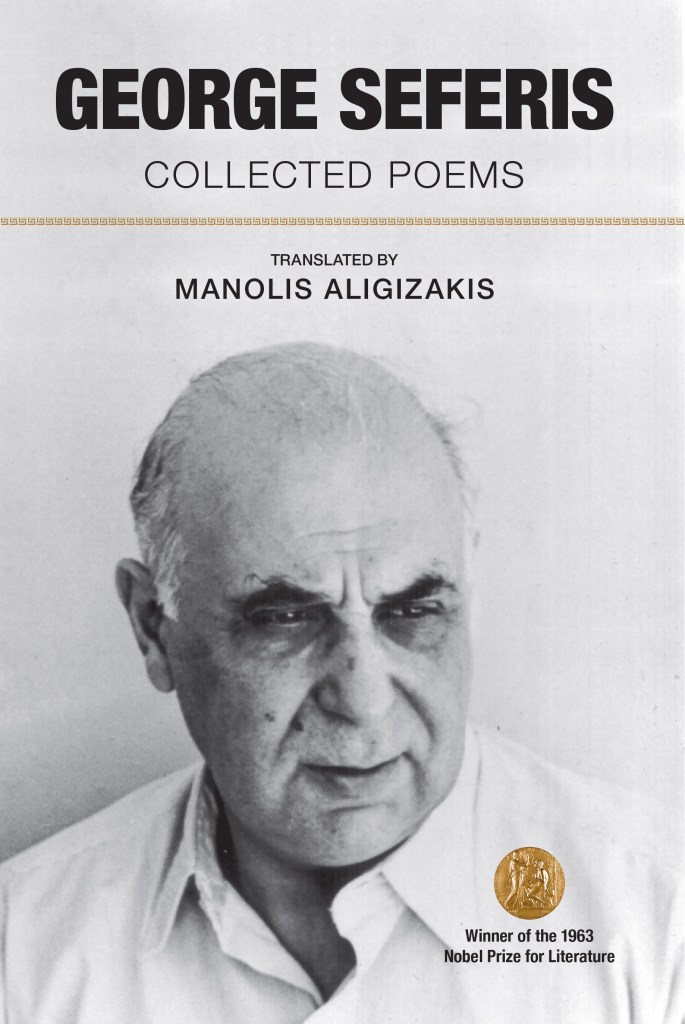
George Seferis – Collected Poems

Thrush

‘Ephemeral sperm of a vicious demon and bad luck

why do you push me to speak what you are better off not knowing.’

  •  
  •                                                                             SILENUS TO MIDAS

A

House Near the Sea

The houses I had they took from me. It happened

that the times were unpropitious: war, destruction, exile

sometimes the hunter meets the migratory birds

sometimes he doesn’t. Hunting

was good in my time, lots of people felt the shot

the others roam around or go mad in the shelters.

Don’t talk to me about the nightingale, nor the skylark

nor about the little wagtail

inscribing numbers with its tail in the light;

I don’t know many things about houses

I know they have their own race, nothing more.

New at first, like babies

playing in the orchards with the tassels of the sun,

they embroider the colored window shutters

and the shining doors over the day;

when the architect finishes they change,

they shrink or smile or even become resentful

with those who stayed behind, with those who went away

with others who would return if they could

or those who vanished now that the world

has turned into an immense hotel.

I don’t know many things about houses,

I remember their joy and their sorrow

sometimes, when I stop even when

sometimes, near the sea, in empty rooms

with an iron bed with nothing of my own

looking at the evening spider, I contemplate

that someone is getting ready to come that they dress him up

in white and black cloths with plenty of colorful jewels

and around him venerable ladies with gray hair

and dark lace shawls talk softly

that he gets ready to come and say goodbye to me;

or a woman with quivering eyelashes and slim waist

returning from southern ports,

Smyrna, Rhodes, Syracuse, Alexandria,

from cities closed like warm window shutters

with perfume made of gold fruits and herbs

that she climbs the stairs without seeing

those who slept under the stairs.

Houses, you know, grow easily resentful, when you empty them.

https://www.amazon.com/dp/B096TTS37J

Ithaca Poems # 538

ΜΑΚΡΙΝΗ ΕΡΩΜΕΝΗ

Το φεγγάρι, πάνω απ’ τη θάλασσα ολόγιομο

λάμπει σ’ όλο τον ουρανό

και φέρνει στην κάθε καρδιά

σκέψεις της νύχτας

σβύνω το κερί

ν’ απολαύσω τη λαμπερή του όψη

και βάζω το σακάκι μου

της νύχτας την υγρασία ν’ αποφύγω

και σαν δεν δύναμαι μια χούφτα

να σου δώσω φεγγαριού

πάω ξανά για ύπνο

στ’ όνειρο μου για να σε δω

Μετάφραση Μανώλη Αλυγιζάκη//translated by Manolis Aligizakis

Looking at the Moon

and Longing for a Distant Lover

The moon, grown full now over the sea,
brightens the whole sky,
bringing to separated hearts
the thoughtfulness of the night.

I blow out the candle
to enjoy the clear radiance,
and put on my coat
for I feel the dew grown thick.


But since I cannot give you

a handful of moonlight,
I shall go back to sleep
hoping to meet you in a dream.

Chang Chiu-ling, China (A.D. 673–740) 

Κατερίνα Φλωρά

Yannis Ritsos – Poems, Selected Books, Volume IV

REPETITIONS, SECOND SERIES

Change

Thus it happened to them, the non-believers, the vigorous

the beautiful who relied on their hands and smartness

         like

the governor of Cilicia, who, although Epicurean, one day

decided to send a newly freed slave to the Oracle of Mopsos

with just one question sealed in an envelope. He as it was

customary spent the night in the temple. Half way in his sleep

a very tall, handsome man appeared to him and said only one

       word, “black”

Since then the governor changed. He often offered sacrifices

honoring the great Mopsos. We often heard him, during

the spring evenings as the fragrance of the moist garden

charged through the windows, whisper to himself” “black,

black, black” as if resisting something inside him. Then he’d

       smile.

We, around him, felt freed that the Epicureans were finally

       defeated. 

That “black” was joyous and practical. It saved us (truly a

        little late)

from all the struggles, denials and concerns. Outside of

the windows, in the garden, a thin moon, slow and fresh,

looked at us as it gleamed behind the poplar.

https://www.amazon.com/dp/B0CGX139M6

Neo-Hellene Poets, an Anthology of Modern Greek Poetry, 1750-2018

POEM BY MARIA POLYDOURIS

ONE NIGHT AT THE TRAIN STATION

A sad place the train station

soon after the train leaves.

Moments earlier it was stopped here

on the rails with the passengers

coming and going in haste

laughing without any reason

and the ones who stay behind

don’t have their previous faces.

The emptiness of the rails, the silence

of the station that lost its train

and the ones who stay behind scatter

with decisive steps as if following

their Fate. Something of theirs

leaves them every time and they stay

at the station closing their blurry eyes

before they courageously turn back to the same

with their backs even more stooped.

Cursed let it be the separation

yet even with you I shall fall in love

because the hello was sweet

and the hand waved in the air

and the handkerchief was whiter

than a bud, a light in the distance

that I hadn’t seen before

serene and beautiful your vision.

Cursed separation:

my lips tremble calling your name.

https://www.amazon.com/dp/1926763513

Το Τέλος της Δύσης

Yannis Ritsos – Poems, Selected Books, Volume IV

REPETITIONS, SECOND SERIES

Present Things

“Descend” they said to him, “don’t be afraid; the

ascend is glorious; the future will be clearly visible

to you” He hesitated. Yet he prepared himself at

the chapel of Good Luck; he passed the chair of

Forgetfulness and Mnemosyne; he offered his

sacrifice on the tomb of Agamedes; he bathed in

Erkyna, guided by two charming twelve year old

boys; he applied oil and moved on. At the last moment,

in front of the black mouth of the oracle, the holy,

the sealed by the bronze railing, he stopped; “no,

        no” he yelled;

“no, no”. He pulled away in fear. Perhaps he

recalled the unfortunate satellite, Demetrius who

never returned. Of course, they said that Apollonius

pulled up two steel plaques from in there. Yet, what

would he do with the Pythagorean words, the past and

the future? The present things were better even if

they were a few and insignificant; better than

the unknown. And suddenly he felt all the brilliance

of the moment. He cut a laurel leaf, he bit it, and run

       away

while the advice of the priests echoed behind him.