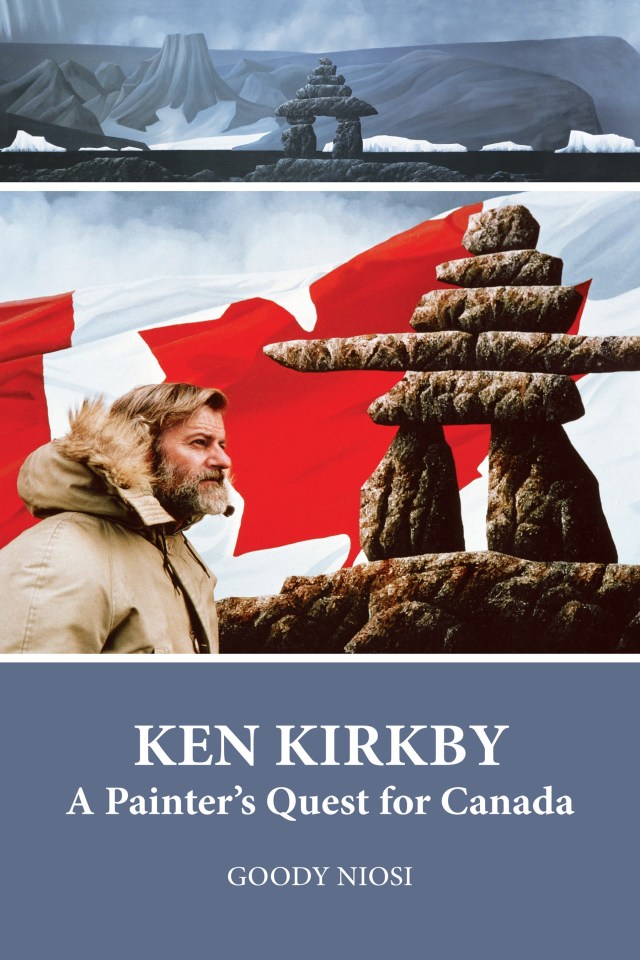
Ken Kirkby, A Painter’s Quest for Canada

excerpt

They were marvelling at the line of diminutive Inuksuit that curved along
the water’s edge toward a far-off boulder that seemed to reach almost fifty
feet into the sky. The Inuksuit told a story, Ken said, and after a lunch of
fresh fried fish he led them toward the boulder. As they walked the boulder
diminished in size until they stood beside it and found it was about
three feet tall, pink, perfectly smooth, and resting on top of an immense
gray rock that had been partially heaved out of the tundra.
“This is a fishing Inukshuk,” he told them. “It tells you that this is a
good place to go fishing. How does it say that? If the fishing is good, the
Inuit take a stone out of the water and put it on top of another stone
with little Inuksuit leading the way. A passerby who had never been in
this land would know immediately that he could catch fish here. Other
configurations of stone describe what kind of fish are here. Essentially,
this is a language.”
He explained that the permafrost lurks just under the surface of the
tundra, and below that lay thousands of feet of ice. The ground above the
permafrost where the ice melted consisted almost entirely of rich humus
built up over eons by the tiny plants that grew and died there. An eightinch
tree takes hundreds of years to grow to that height in the Arctic’s
short season. The fibres of the humus stretched out along the surface and
down to the permafrost, siphoning the water from the ice and sending it
into the atmosphere. As the wind travelled across the surface of the land
in buffeting gusts, it created rudimentary magnifying lenses of the millions
of tiny water bubbles streaming into the air. The farther away you
were from an object the more lenses you were looking through and the
larger the distant object appeared.
That night after supper he walked down to the dock with a fly-fishing
rod. Arctic grayling congregated in the shallows here and after a few causal
casts, he landed a fine three-pound fish. As he unhooked it and slipped
it back into the water he noticed Karen sitting on an overturned bucket
at the far end of the dock.
“I’d like to try that,” she said.
He handed her the rod and described the process but even after all
these years he still had no idea how to explain that it was a line with no
weight and it needed to fly guided by minimal strength and energy, and
perfect timing.
She cast a couple of times and smiled. “I like this,” she said and while
the fly lay on the water, a large grayling took the bait. Ken disengaged it,
gave the rod back to her and left her to sort out the tangles and continue
casting. He sat on the overturned bucket at the far end of the dock and
watched.

https://draft2digital.com/book/3562830

https://www.amazon.com/dp/0981073573

Ken Kirkby, A Painter’s Quest for Canada

Excerpt

It might have been dropped into the harbour
directly from the China Seas. Ken explored the floating palace and then
stood on the railing leaning over the side, his eyes growing wider as they
passed under the Lions Gate Bridge and chugged into the open waters
of Georgia Strait. The sheer immensity of the snow-capped mountains,
forested islands and vast ocean staggered him. Gulls swooped by, eagles
soared overhead, seals and sea lions dived into the water.
After docking in Nanaimo, Ken drove north on a narrow gravel road,
badly rutted and peppered with potholes. The TR2, with its worn shocks,
rattled up the road that lay at the bottom of a canyon, its sides covered
in giant firs. When he arrived at Nile Creek and found the little cottage
he had been directed to, he knocked on the door and handed his letter of
introduction to the elderly couple who greeted him.
“We’ve heard a lot about you,” they said. “Monsieur Desjardines wrote
to us a number of times; telling us about you, and the wonderful times he
had with you in Portugal, and about how you want to be a Canadian.”
They took Ken out to the mouth of the creek where the water was so
thick with salmon it presented a solid wall.
The next morning they launched a rowboat and rowed out to the kelp
beds, that lay several hundred yards from shore. After tying up to the
outer rim of the semi-translucent mass, they cast their lures along the
edge of the kelp bed. The moment the lure hit the water a fish struck.
Then, miraculously the fish leapt into the air, dancing on the water. Listening
to the old man’s shouted instructions, Ken learned how to handle
Pacific salmon. They pulled in one fish after another, each cast of the line
producing another salmon. When the big box in the bottom of the boat
was almost filled they tossed them back, keeping two for their supper.
Ken spent the rest of the week fishing, and drawing fish – particularly
the cutthroat trout that fascinated him even more than the salmon.
His next trip was to the wild country near Kamloops. As he drew close
to Merritt the countryside grew arid with rugged rolling hills and tall
ponderosa pines, which gradually gave way to a vast grassland covered
with scrub.
He drove up the Nicola Valley, drinking in the smell of sage and basking
in the golden autumn sun. Bees buzzed lazily, half asleep in the golden
fields. Eventually he found the gravel road he was looking for that
climbed up and up into the mountains. He drove through the Stump
Lake Ranch and past the sign that said, “Peter Hope Fishing Camp”. He
drove on through mud puddles so deep that the water seeped through
the floorboards. When he could drive no farther, he parked and walked
across a small creaking bridge to an island with a tiny log cabin wearing
fresh golden logs on one side, and old weathered logs on the other.
Ken knocked on the door.

https://www.amazon.com/dp/0981073573