
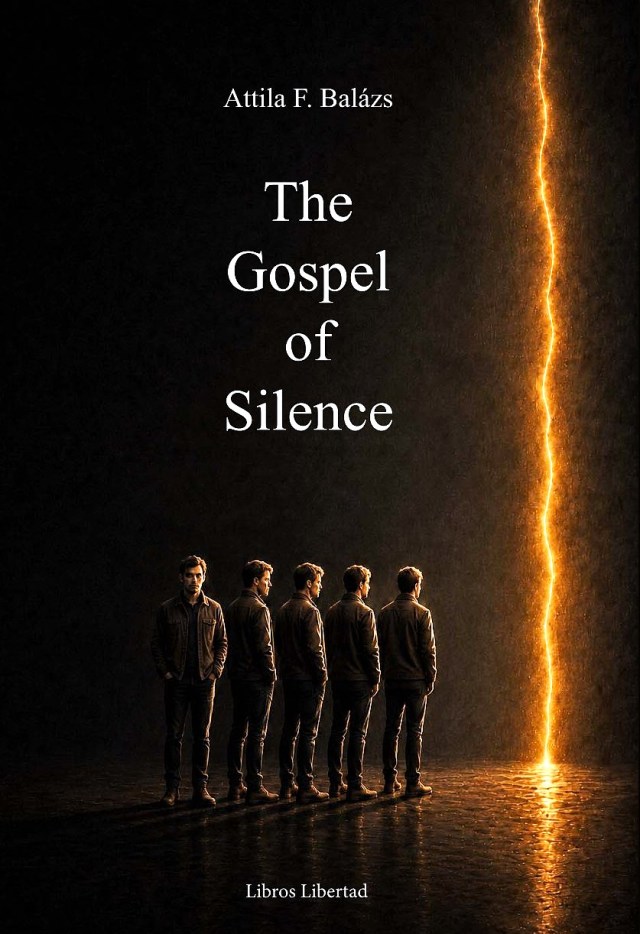
The Gospel of Silence

Excerpt

And I nodded. Not because I understood, but because in those
days every nod was a form of survival. I did not mean to express
agreement; I only wished to avoid worse consequences. And back
in the barracks, nobody asked me anything. Silence became the
permanent environment in which I could exist, had to exist.
My days passed alike: morning drills, roll call, marches, lunch in
the popota, pebbles in the bean stew, half-washed aluminum plates
and spoons, lights out, officers shouting, the exhausted gazes of
the others, the musty air of the cazarmă. Military life became one
endlessly repeating monotony. Yet inside that monotony something
almost imperceptible but unstoppable kept growing: expectation.
Because I knew — or believed I knew — that it was only a matter
of time before they came for me. That one night, in the middle of
darkness, the order would arrive, and they would take me to prison,
to some cold, windowless place I no longer even dared to imagine,
for I feared that if I imagined it, it would become real.
Thus my days passed. In waiting. Tuesdays and Wednesdays,
whole weeks slid soundlessly into one another, yet the hours did
not pass; they only receded farther away. Walking among the soldiers,
it sometimes seemed as though no one had noticed anything,
as though I had truly succeeded in obeying the order: pretending
everything was normal. As though the words nothing, no trouble,
all is well truly meant exactly that. I lived through — and within —
a poem I had not even yet read.
And yet anxiety inhabited every movement I made. When the
captain crossed the courtyard and let his eyes drift across the assembled
ranks, it felt as though he were searching for me specifically,
or watching to see how long I could endure this existence
built upon silence.
Time passed in a crushing uncertainty. In a vulnerability that
seemed endless. And there was the thought which no longer existed
as an abstract possibility but spread through my chest like physical
pain: Life imprisonment. I went on performing the role of my own…

https://www.amazon.com/dp/1926763874?th=1

Redemption

excerpt

mother had waited for him to get up so she could talk to him, so she
could look at him, so she could look at her first and only child, a man
now, a graduate from the university, her pride. All night, she wondered
about what to prepare for him, what to treat him with. She knew it was
difficult for him to live away from his mother’s touch while studying
in the city, attending classes, writing exams, and all. She had prepared
some cheese pies of her own recipe with lots of sugar and cinnamon,
which she knew he loved. She expected him to rise late since he had
travelled all day yesterday; she fixed his coffee and walked to his bedroom.
To her surprise, he was not only awake but also dressed.
Hermes’ father, George Dragakis, was a fifty-two-year-old man
who grew up in the orphanage, placed there by his mother, a young,
unmarried woman who got pregnant out of wedlock. George grew up
in the orphanage until he reached the age of eighteen, when he went
back to the village where his mother and natural father lived. He had
two stepsiblings on his mother’s side: a brother, Demetre, who lived
in Athens, where Hermes stayed while in school, and a sister, Katerina,
who lived somewhere in Germany. He also had a few stepsiblings
from his natural father’s side, but his father had never told Hermes
how many there were and whether they had any children.
Hermes’ father was a reticent man, and it was rare to be able to
start a conversation with him. It was Hermes’ mother, Despina, who
told him the story about his father and how they got married soon
after he came back to the village from the orphanage. Despina was a
chubby sixty-four-year-old woman, a saint, as her son thought of her.
She had only love in her heart, so much love for everyone, but mostly
for her only son Hermes, who was her pride.
“Oh, Mother,” he said affectionately and embraced her. “I will
have to leave you soon after breakfast because I need to go up to the
monastery. I promise we will have a long talk when I come back.”
“Why do you need to go to the monastery, son?”
“I need to look for something in their library. I will go by the
orchards to say good morning to Father first and then carry on from
there. I will be back for lunch.”

https://draft2digital.com/book/4172538#print

https://www.amazon.com/dp/1926763858