Which dream’s shadow you’ve tried to catch, which beliefs you wish to establish, which altar and which world? Your violin pulls us upwards beyond all dreams and with our roots deep in the soil we connect to mother earth. Leave the dreams behind, tune your ears listen to nature solve the riddle of the rose and make a Cybil out of a cypress. Strike Chimera mercilessly life is just a dream, let your violin bring about harmony among this truth. Where is truth? Are you perhaps lost in deep thoughts? You can find the source of life only inside you, oh human.
Today Eteo was walking alone because Ariana had spent a little more time than usual with her mother. This gave him a chance to be alone with his thoughts after the eventful afternoon with Rebecca the day before. As always, his attention was attracted by the movements of the sea swells as they broke against the rocks and turned them into shining marbles. A faint smile appeared on his face, but his thoughts soon ran in other directions. He thought about Richard’s problematic drilling project, Mario’s new company, Nostra Ventures, Rebecca’s beautiful body, and far on the other side of the globe his parents in his beloved Crete. They had finally moved back there soon after Eteo emigrated to Canada, selling their house in Athens where Eteo had lived for more than ten years and building a new house in the village, a small, functional house where the two of them could live the relaxed life of retirees. His father had also bought a small boat, which he used for fishing and to ferry tourists from place to place along the Spatha Peninsula to earn extra money. They also took part in the gathering of the olives and in that way earned all the oil they needed. Eteo’s mother kept herself busy with traditional embroidery on a loom, making beautiful articles for her grandchildren. And when busy with her embroidery, Eteo imagined, she often thought about the foreign land where her son lived and her eyes would fill with tears and her heart with a tightness that could only be relieved by gazing at the dark blue sea opposite her balcony and anticipating the day when her son would come back home from that sea. Imagining this, Eteo’s eyes got teary as he walked with the serene waters of English Bay on his left, passing gently across the sand where a few fishers worked their nets. He could see that they were probably Vietnamese, new immigrants enjoying the warmth of the afternoon and the smell of the sea while fishing for smelts, which were coming near the shore to spawn. Eteo remembered how he used to do the same back in his early days in Canada with his friend Zachary. Where was Zachary now, he wondered. On impulse he sat on a log and watched the fishers and their nets. Suddenly he noticed that one net was shaking violently from one side to the other as if a larger fish was caught in it.
Snowstorm Snow has whitened the sidewalk, silver wishes for early spring, and I open my eyes in your absence to the messenger who brings happy news of another grandchild —Take the trash can to the curb and leave the recycling bin for next week The test results came back clean. The disease is managed by medication and exercise. We could go on the trip we’ve planned during the dark days of winter, my beloved, before the heartless Hades took you away —Bring the coffee, and two spoons of sugar please, but why do I say this? You know me so well by now The eyes of the owl pierce the night as if crying out loud: give me light and give me sight: darkness defeated by a flash And I debate with Hades his right to take you, my beloved, but He scorns my idiocy and sings —If you don’t know me by now, we’re both lost
Common System To survive, he said, we should forget how to die. We could forget without the should. Lots of keys from houses not built yet were thrown on the chair. The third house was full of colored masks and big mirrors. The owl, made of sheet metal, was quietly perched on the roof.
Pip: If you've ever wondered what it looks like when one publisher holds together Greek modernism, Irish wakes, cruise ship romances, and Kabbalistic horror in the same week — well, here we are.
Mara: This episode covers work curated by vequinox across three territories: poems of desire and grief, prose wrestling with spiritual and moral conflict, and fiction that moves through travel, loss, and homecoming.
Pip: Let's start with the poetry.
Desire, grief, and the alchemy of souls
Mara: The poems gathered here keep returning to the same question: what do we carry inside us, and what does it cost to carry it?
Pip: "Entropy" sets the stakes plainly. The poem reads: "motionless, we, the descendants of ignorance, move the voices, the names, the history of waves aren't coming from the outside they are the love of a heart that faces the miracle the alchemy of souls that turns the earth around as the anchor of hopelessness floats between the inexistence and infinity."
Mara: So the upshot is that movement and stillness coexist — we are paralyzed and yet carried forward by something internal, not external. The poem locates history and love inside the body, not in the world.
Pip: "Orange" distills that into two lines that hit harder for their brevity — wilted carnations, two empty bowls, two empty glasses, and then: "life full of desires. Thirst, so much thirst and not a single fountain." "HEAR ME OUT" answers with hunger of a different register, erotic and urgent, mapping a lover's body like uncharted territory.
Mara: "Wheat Ears" pushes back against the pessimism — pundits declare nothing can be done, and the poem's answer is to stand in the plaza holding hands. "Red in Black" frames love as structural, roots and wings at once. "Titos Patrikios" goes darker: a soul that gets used to being whipped and begins to ask for it.
Pip: The Cavafy piece — "Constantine Cavafy" — is the quietest and maybe the most devastating: a mirror that rejoices at having held a beautiful face for five minutes.
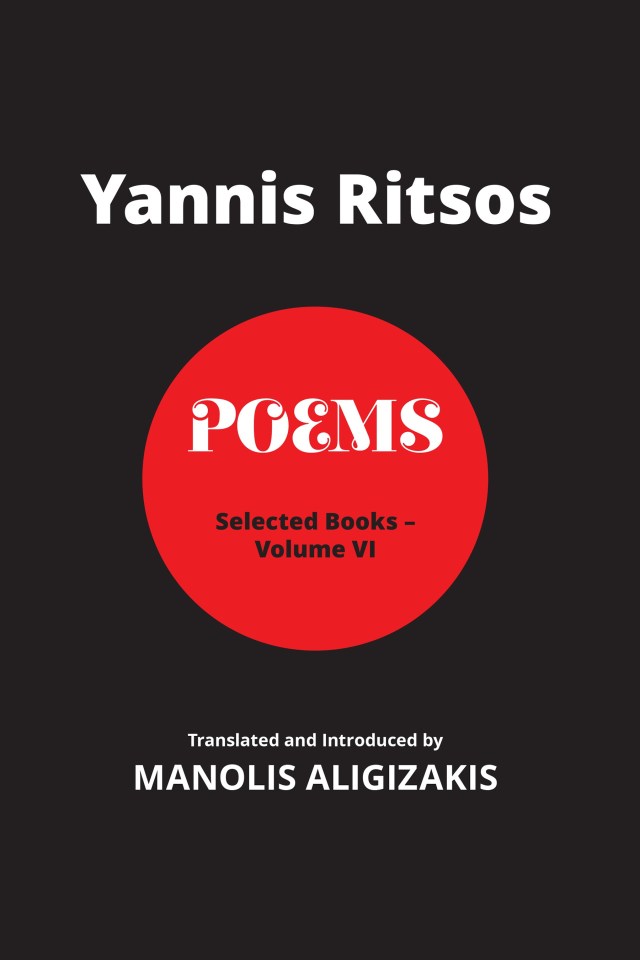
Mara: "Kariotakis-Polydouri" gives grief a voice that has gone voiceless: "No voice reaches here anymore from all the powerful things I had." The Ritsos volumes carry that forward — "The Victor" shows a man raised on shoulders in the sunshine while silently crying, and "After the Fire" asks whether surviving a battle is the same as winning it.
Pip: And "Introspection" closes the arc with a Nietzschean prophet who sees the new race of humanity before his eyes, even with his eyes closed — which is either visionary or a very convenient excuse for not looking.
Mara: From the interior life of the poem, we move to something more embattled — faith, institution, and the places where they fail each other.
When belief meets power and the wild
Pip: The posts here put spiritual authority under pressure — from mystical horror to the quiet collapse of a priest who cannot speak the love he is supposed to embody.
Mara: "The Qliphoth" opens in full disorientation. Lucas is strapped to something between a chair and a launch pad, voices layering over each other: "His inner ear is roaring with an echoplex of distant detuned voices, drowning in mutual overlap — Westway music room / dub reverb / his father roaring at the nurses / mother bawling out dumb classrooms in her sleep."
Pip: What that passage is doing is collapsing private trauma and collective noise into one body — the skull becomes, as the text puts it, a flickering moviedrome. Transcendence and violation arrive in the same image.
Mara: "Blood, Feathers and Holy Men" works the same tension from the opposite direction — not visionary excess but institutional silence. A Brother tells a priest directly: "I do not want your judgments and I do not need your approval. I want your trust and your love." The priest cannot answer. He walks into the forest for three days.
Pip: Three days in the wilderness to avoid a conversation about feelings. The Church has always had a gift for dramatic avoidance.
Mara: "Ugga" compresses the institutional question to its most extreme form — a figure called the Great Homo Digitalis consolidates all scientific discovery and convinces every religion to submit to one universal church, positioning himself as the Antichrist. It's a single dense paragraph, but it reframes everything around it.
Pip: And then "Ken Kirkby" steps entirely outside institution — into the Arctic tundra, where Inuksuit are described as a language of stone, and an eight-inch tree takes hundreds of years to grow.
Mara: The sacred there is horizontal and practical: a stone on a stone means the fishing is good here. No hierarchy, no doctrine — just accumulated knowledge readable by anyone who knows how to look.
Pip: From stones in the tundra to people in motion — arrivals, departures, and the ground between.
Journeys, thresholds, and the weight of return
Pip: The fiction here is preoccupied with thresholds — the moment before entering a room, the moment after a death, the crossing that changes what home means.
Mara: "The Unquiet Land" opens at a graveside. Clifford Hamilton steps forward to eulogize Finn MacLir: "I have the duty and the honour of saying a few words about the man lying in death before us." The grave already holds Finn's wife, Roisin, dead since 1892. Finn's name will be added later. The scene is precise about that gap.
Pip: A quiet, solemn wake for a man renowned for his parties — the gap between the life lived and the life being mourned is doing a lot of work in a single sentence.
Mara: "Small Change" moves to a younger threshold. Rico returns home to an empty house, finds a note, and sits alone in the dark rather than crossing the street to the party. When his aunt Marianna finds him, he holds up papers — something he's worked on — and "suddenly he feels very small, and scared and shy." The stakes are intimate but the weight is real.
Pip: "In the Quiet After Slaughter" puts a piano player named Buddy on a cruise ship, where falling for a passenger is called Man Overboard — so named, the text notes, because a despondent waiter once jumped after being rebuffed. Buddy writes on a coaster: "Her eyes look inside my head and see everything," and underlines the last word.
Mara: "Jazz with Ella" ends a journey rather than beginning one — Jennifer returns from a trip through Russia and Montreal, and when she finally passes through the arrivals gate she almost doesn't recognize her estranged husband waiting with flowers. "Despite herself, a full, warm feeling dispelled the black cloud, if only for a moment."
Pip: "Fury of the Wind" places Sarah at a rural fair in Nimkush, where no one speaks to her except a man named Pong struggling with a table, and a stranger at the bleachers. She is new to the district and it shows.
Mara: "Redemption" finds its threshold over a dinner table — Hermes, his father, and a quiet negotiation about guns and permits that turns into a pleasant evening. "Straits and Turns" gives us Mike, a Greek immigrant in Canada, writing in Hellenic on paper torn from a hand-wipe roll, on an old manual typewriter a friend gave him for free.
Pip: He writes: "Both of us were born close to different seas, mine was the blue Mediterranean and yours the grey Pacific Ocean, yet we bleed the same red blood." A novel about arriving, written on whatever's at hand.
Mara: "Wellspring of Love" closes the set at speed — Tyne is pulled over doing fifteen over the limit, rushing to a hospitalized aunt, and the officer lets her go with a look of compassion she almost misses.
Pip: Small mercies at the edge of crisis. That's most of what travel turns out to be.
Mara: What holds all of this together is the question of what we carry across thresholds — grief, desire, faith, language, the memory of a face in a mirror.
Pip: And whether the anchor of hopelessness floats or sinks. More of that, next time.