The Yellow Cab No sir, you confuse me with someone else. It wasn’t I in the yellow cab I never sat with you in the back seat. It wasn’t snowing either, I’m sure of that no snowflakes fell on my hair. In fact I have no hair. You’ve never kissed me, I would have remembered of it. But even if you kissed me, it wasn’t I you kissed. Neither did the driver turn back his head. Silently he crossed the lake to the edge and from time to time he dipped the oar in the black surrounding waters.
…and I said, he is a hero, too, since he endured human pain and he loved the fragrance of the night flower which didn’t know of holidays the sick man and I are comrades, since we both experienced the heroism of a twenty-four-hour duty I practiced my religion on the future catastrophe and in the longing for the past during which we endured pain we, the youths with acne and a light beard on our cheeks us, who, one day, will be called dreamers and I said, let them call me a foolish dreamer let them name me crazy let the joys of wealth be untouched and let their glory be inglorious I practiced my religion on the perfection of human wholeness and I hymned eternity with odes Iota I crafted iambuses about the cock
She took the elevator down one floor, intending to ask the dezhurnaya the location of Chopyk’s room but for some reason, that floor was unguarded. It took another 20 minutes of getting lost in a maze of hallways, returning to the lobby, inquiring and returning to Chopyk’s floor, only to find that he was not in his room. She rode the elevator back to her own floor, and the doors opened on a pleasant domestic scene. The dezhurnaya no longer sat alone. On two straight-backed chairs sat a young man and a woman with her arms around a gangly child of about ten who pointed her toes, first right, then left, pressing her sandals into the worn carpet. The man looked up eagerly when the elevator doors opened. She caught his eye for a second, took in the freckle-faced child and petite mother who sat in the shadows, then sped on up the hall. But she could feel the young eyes boring into the back of her head. “Attention! devushka, woman,” shouted the dezhurnaya. “You have guests.” Even before Jennifer turned to face the family, it was a moment of knowing, a sense that already on this first night in Moscow profound changes would take place, and this was only the first of them. She stared. Yes, the man did look familiar in a comfortable way. The woman—his wife?—was a stranger. The child was awkward and cute at the same time. The man walked toward her, smiling, his arms outstretched in greeting. He struggled with her name in thickly accented speech. “Do I know …?” she began and stopped. “Mikhail Alexandrovich Abram,” he said, grasping her hand. The woman tossed a mane of glossy black hair and approached smiling. “And this is my wife, Marta, and my daughter Nadya.” The child stood knock-kneed, bowed slightly and touched the red Young Pioneer scarf tied around her neck. “We are your family.” Jennifer was thunderstruck. “But I have no family here…” she finally responded. She didn’t want to appear rude but she was quite sure that her mother…but then there was a lot she didn’t know about her mother’s background. “Yes, you do. You are shocked,” Mikhail continued. “I beg your forgiveness for our sudden arrival. May we enter?” He indicated the hotel room. “Certainly. Go in.”
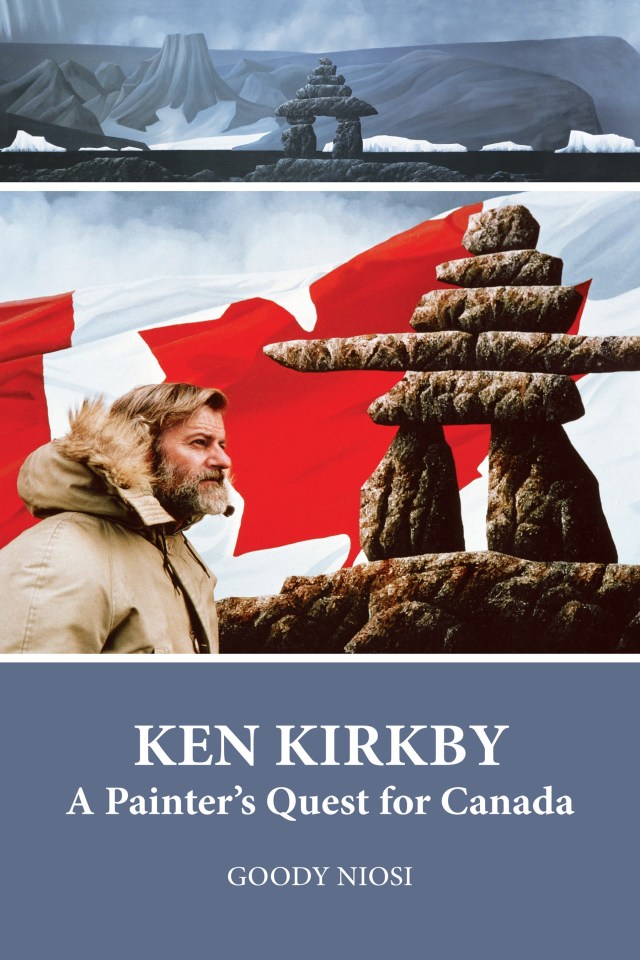
…the hall where Karen and the crew were putting the finishing touches on the exhibit. He was led to the Speaker’s office where Michael was sitting on a desk, his feet dangling, telling stories to the staff of his adventures in the Arctic. John led Ken into his office and a photographer arrived to immortalize the occasion. He posed Ken and John in front of the Karsh portrait of Winston Churchill and for the next hour shot Ken with various members of Parliament. Jean Chrétien, leader of the opposition, offered his congratulations, as did Joe Clark, who was standing in for Brian Mulroney who was otherwise engaged. In the hall at the foot of the stairs people stood or sat shoulder to shoulder. Not an inch of space remained. I had the most amazing feeling. It was a feeling I have never had before or since. It was a feeling that I was standing at a point in the universe where for some minutes and seconds reality was different. This was the magical moment I had been seeking my whole life. Usually, I had foreseen important moments in great detail. But this one – this was different. This one had somehow manufactured itself. It was not the vision I had had in my head. John Fraser stood on the podium and spoke. “Almost fifty years ago a young boy sat at the feet of his tutor – an old Portuguese fisherman – and heard tales of whaling in the Canadian North. These tales were so wonderful that the boy vowed some day to see Canada for himself and to clarify his mental pictures of the land.” “In his late teens, circumstance found the boy and his family living on Canada’s West Coast and several years later he set out on his boyhood dream to see the great Canadian North. For five years, he walked from one end of this great land to the other, travelling with families of Inuit as they pursued their nomadic lifestyle. Often he was alone, walking endlessly – experiencing first-hand Canada’s Arctic North, all the while sketching thousands of miniature drawings of what he saw.” “Toward the end of his journey, like a great mirage in the desert, he saw a giant of a man standing on the distant horizon. It was a stone Inukshuk, an Inuit guide to hunting and fishing grounds. Try as he might for the next twenty years, his efforts to portray the splendour of this vast and spectacular landscape resulted in dissatisfaction and personal frustration. Finally, he realized that only a painting which was larger than any ever painted could properly depict the unseen spectacle which he felt compelled to bring to the rest of the world.” “The result of five years of trekking and twenty years of painting was completed on June 21, 1991, the longest day of the year. It is the largest original oil on canvas portrait in the world, measuring one hundred and fifty-two feet long by twelve feet high.”
ANEMONE A boulder on the hill alone can see the creek that flows before it sings its song. The anemone that blooms rooted firmly on the rock attempts to grasp the meaning of the song and down it bends to hear, leaving its rocky anchor to know what song is sung by that fast-flowing creek? It sings of an embrace that waits with open arms to hold a lover ardently at night on a golden shore. If only, said the flower, that embrace were mine, and leaning further down to touch the rapid current as it leaned enough to see the water in its speed stripped it of its petals and down the stream it went. Now without petals the stem stands in loneliness. Ah, why, ah, why did that anemone deserted its anchor in the rock?
Response In the tempest’s wrath I longed for a glimmer of hope in the heat of July I seek the tanned smooth body of the woman and the north wind said find your path in your ancestor’s footsteps lean and reverently lift the marble over their gravesite to feel their warmth and I asked the southwest wind where is my sunshine and it said, it hides in your heart
Rick looked disconsolately through the second-storey classroom window at sheets of freezing rain, the weathered fence of the Pennsylvania Railroad coal yard and the blackened struts of the steel bridge that shuddered ever so slightly when a train passed over it, then back at Sister Assunta who was preaching, again, about The Immortal Soul as she paced back and forth in front of the blackboard behind her desk, slapping the pointer against her palm like a riding crop. “Pagans!” she was saying, “You were all born pagans and you must be taught to fear (her pointer hissed and snapped loudly against the desk blotter) the power of Almighty God.” Silence. Some of them lowered their heads to avoid her stare. But Rick was puzzled. That kind old man who lived forever in the sky was merciful and just. He was love itself. Why should anyone be afraid of him? He raised his hand. Forty-two pairs of eyes swung toward the front of the room, afraid for him, but excited by the drama that might be about to unfold. Sister Assunta merely glared and went on pacing, her voice hoarse with a nearly demonic fierceness. Rick took his arm carefully out of the air. “Daily, you neglect your immortal souls. They may already be lost to eternal damnation.” She stopped precisely behind her desk chair, her florid minutely wrinkled skin drawn into a tight smile. Rick tried to look inside himself. There wasn’t much light. After a while he became concerned. Where was his immortal soul, anyway, why couldn’t he find it? Then something round and flat like a communion wafer came into focus. It was tilted, like the head of a snare drum, and it was so clean it glowed. He began to understand. When you did bad stuff, soot fell on it out of the dark, then, if you confessed and said five Hail Marys,
five our fathers, and an act of contrition, an invisible power swept it clean again. And immediately, almost automatically, his pubescent mind reached for what he knew to be forbidden. The kids called her The Beauty Queen. Her dad owned the bar and grill at the corner of Monmouth and Fifth. She spent a lot of time with her followers in the extra lot next to her house her grandparents had made into a large garden surrounded by hedges, and dotted with trees. When she came out for a walk, all the guys stopped what they were doing and watched her tight pedal pushers, her graceful careless moves…
Expectation What are they waiting for in the morning, with the vertical, snow-white, square, big planes, fully lit again this spring? What does the child wait for by the window with his slaughtered doll? Or the old man leaning on his walking stick in front of the glass balcony door, above the noise, the city, the garbage collector, the banks, the flower shop? That unrepentant old man who enlarges, in the space, the hand of the woman who spreads her laundry on the opposite terrace, which enlarges the wet, red and white striped bed sheet so it covers two-thirds of the city, thus trying to forget that passkey of the burglar, not the passkey at all, the second key they presented to him in front of the other, one for each, there by his door that still smelled oil paint, and he didn’t consider complaining or to ask. In his pocket, he held tightly the bag with the nails, considering The pictures he had to hang in the big empty house.
Night The night is a door only the blind can see. Darkness makes the animals hear better, and he staggered not from being drunk. But from his futile effort to climb up to the tower we had once lost.
“Yes, Mother, but I’m only going away for a while; do not forget that.” Maria smiled and added, “Of course, my boy, you will return. But remember, you must write home frequently, so we can find out how your studies are going.” “You guys think as if I am going to forget completely where I come from. Don’t worry yourselves with that.” His father cut in, “Son, you are an adult, but I want you to be very careful in the foreign country you are headed; we, your mother and father, uncle and auntie, or friends, will not be there. There are a lot of dangers over there, and you might get into a lot of trouble. Have your eyes and ears open, be careful in a foreign place. You are responsible for yourself.” The old man’s voice became hoarse. Hermes looked at his dad with surprise in his eyes: tears flowed freely down the old man’s cheeks. Yet this time, George Dragakis didn’t even care to hide his feelings from the rest of the family. Hermes went to his father and gave him a big hug. “Do not worry. I know where I’m going, and I know what I’m there for. My only concern is to finish my schooling and return home to find you all. Do not worry. Nothing will distract me from my goal.” Hermes’s voice had so much certainty as it was heard that all those present felt positively about his voyage. “What about Magda, my boy?” his aunt asked. “Magdalene and I are going to be in touch, and I hope to see her when I come back. She told me she might even come and visit me in Vancouver next summer. I look forward to that, really. I like this girl a lot.” His mother and father heard these words and felt a bit relieved, although they’d prefer if he didn’t go away at all. George got up to go to the bathroom, and Hermes could hear the old man blowing his nose. Then Hermes went to the bar and poured a drink for himself. He asked if anybody would like to have one, but they all declined.