Podcast Episode: Poetry, Place, And Human Frailty

Pip: Manolis Aligizakis runs a site where ancient Greek verse, Irish family secrets, and Soviet farm life share the same address — and somehow that feels completely reasonable.

Mara: vequinox has been busy. Today we're moving through Greek poetry and translation, crime and family fiction, art and memory, and a jazz-inflected novel set between two very different worlds.

Pip: Let's start with the poetry.

Greek Verse Across Centuries

Mara: The posts here are doing something specific: bringing Greek voices — classical, modern, and original — into English, and asking what survives the crossing.

Pip: The poem "Troglodytes" makes the stakes plain from the first image: "the modern shaman's imposing figure with the glittering tiara always commands him to kneel, his slavery is a smooth curse he cannot escape."

Mara: So the troglodyte is not a relic — he is anyone still kneeling before spectacle dressed as authority. The poem argues that the costume changes; the command does not.

Mara: The translations of Yannis Ritsos, Nikos Engonopoulos, and Tasos Livaditis extend that argument across different registers — Ritsos lyrical and rural, Engonopoulos urban and restless, Livaditis brutal and spare. The anthology "Neo-Hellene Poets" and the Kariotakis-Polydouri volume show how wide that tradition runs.

Pip: "Entropy" and "Chthonian Bodies" are original work sitting alongside those translations — which is either an act of confidence or an open invitation to compare notes.

Mara: "Red in Black" and "Medusa" round out the range, moving from quiet metro-car intimacy to a poem that weaves erotic longing and domestic interruption into the same breath. The translation project and the original work are in genuine conversation here.

Crime, Family, and the Weight of Consequence

Mara: The fiction collected here keeps returning to one question: what do people do when a secret arrives and demands an answer right now?

Pip: "Straits and Turns" opens with George walking alone through the Bulgarian mountains toward something — the excerpt is all forward motion, all deliberate distance covered, one careful camp made in the dark.

Mara: The prose earns its patience. "He put his backpack against the boulder and gathered a bunch of leaves from a tree, which he used to make a makeshift bed onto which he laid his sleeping bag." Every detail is functional, which makes the isolation feel real rather than atmospheric.

Pip: That's a man who has thought through exactly how far he needs to get from wherever he started.

Mara: "In Turbulent Times" puts the secret right on the kitchen table — literally a birth certificate, no letter, just a name where it should not be. Caitlin's voice stays calm and controlled even as everything shifts: "May to February is nine months, Michael."

Pip: Calm is the most devastating register for that line.

Mara: "The Unquiet Land" works in a similar key — a witness who almost certainly knows who beat the priest, and decides, quietly, that he will not say so. Community loyalty and personal feeling outrun the facts.

Pip: "The Circle" pulls back to San Francisco, two old colleagues in a twenty-year-old Chevy Impala negotiating what retirement means when your whole identity is the job.

Mara: "Swamped" moves into financial territory — stock tips passed in hallways, lunch invitations with unstated agendas, the low hum of a world where every conversation is also a transaction.

Pip: "In the Quiet After Slaughter" is the sharpest tonal shift — a childhood narrated with the flat precision of someone who learned early to read a room and trust nothing.

Mara: "Water in the Wilderness" and "Prairie Roots" anchor the domestic end of the range — a girl who decides she does not deserve kindness, and a Saskatchewan winter where the horses were always fed before the family sat down. "Small Change" closes the loop with something warmer: a ukelele passed down through grief, summers on the farm, a family that keeps showing up.

Pip: The fiction here spans continents and decades, but the engine is always the same — someone knowing something they have to decide what to do with.

Mara: Which is also, in a different key, what the poems are about. Let's move to the work that holds art and memory together.

Cities, Canvas, and the Accountant's Ledger

Mara: This segment asks what art preserves — and what it cannot.

Pip: "Hear Me Out" builds its answer slowly: "All the cities are the same at dawn; they're all alike you told me once and I didn't believe you."

Mara: The poem earns that return. By the end the speaker has lived enough departures to know the other person was right, and the recognition lands as loss, not wisdom.

Pip: "Ken Kirkby, A Painter's Quest for Canada" takes the canvas into the tundra — literally, since Kirkby ends up pushing a boat through a freezing river for four days with no tent poles and mushroom soup.

Mara: "Blood, Feathers and Holy Men" and "The Incidentals" complete the picture — the first a healing ceremony where old grief and new arrivals find common ground, the second a poem about an accountant whose entire life was other people's numbers and whose funeral drew almost no one.

Pip: Art and memory, it turns out, are what fill the space the numbers leave behind.

Mara: Speaking of filling space — the last post is set to music.

Pavel, Vera, and the Long Way to a Passport

Mara: "Jazz with Ella" lands in Soviet agricultural life, which is not where the title points — but the novel earns the contrast.

Pip: Pavel is a man with plans for sunflower-field picnics and a growing competence with a broken-down motorcycle, living entirely outside the system that made him: "he lamented all the years spent in studying academic subjects without getting a good grounding in what every adolescent learned while growing up: working on the family car."

Mara: The upshot is a man rebuilding himself from practical knowledge up, while the larger problem — no papers, no passport, winter coming — waits just outside the frame.

Pip: Bureaucracy as dramatic tension. The oldest jazz structure there is.


Mara: From troglodytes kneeling before tiaras to Pavel fixing a motorcycle in the provinces — the through line is people navigating systems that were not built for them.

Pip: And finding, occasionally, a ukelele or a sunflower field or a line of poetry that makes it bearable. More from this site next time.

Podcast Episode: Greek Poetry And Fiction

Pip: Manolis Aligizakis has been quietly building one of the more unusual literary archives on the internet — translations, original poetry, fiction spanning centuries and continents, all landing on the same site like it's nothing.

Mara: vequinox is behind all of it, and today we're covering the range: modern Greek poetry in translation, a wide stretch of literary fiction and drama, and poems that sit at the intersection of love and loss.

Pip: Let's start with the poetry.

Voices From Modern Greek Poetry

Mara: The question this cluster of posts raises is what modern Greek poetry is actually doing — what it reaches for, and what it refuses to let go of. The anchor here is Katerina Anghelaki Rooke's "Unexpected Development."

Pip: She sets it up plainly: "It was when words overflowed / images flew like wild birds / that refused to feed on words / even if they were hungry for them."

Mara: That tension — images that won't submit to language even when they need it — runs through the whole collection. Anghelaki Rooke is mapping a kind of loss that precedes grief.

Pip: Antony Fostieris takes a harder geometric line in his selected poems: a snake eating its tail, beginning collapsing into end, the body always absent. Tasos Livaditis, longlisted for the 2023 Griffin Poetry Prize, closes his poem "Coincidences" on the line "music in the beyond / that seeks what poetry silences on earth" — which is either profound or a very elegant shrug.

Mara: Nikos Engonopoulos writes about Georg Trakl — a poet who "never agreed with them" and whose only longing, once he understood what it meant to be alive, was to escape. Yannis Ritsos, the Neo-Hellene Poets anthology, Hours of the Stars, Orange, Ugga, and Troglodytes all appear here too, each finding a different pressure point between the lyric and the world pressing in on it.

Pip: Fiction carries some of that same weight — let's go there.

Literary Fiction And Drama Across Time And Place

Mara: What this range of fiction shares is an interest in pressure — the moment a situation tips, when a character can no longer hold the ordinary shape of their life. Straits and Turns is the anchor, and it earns it.

Pip: The excerpt follows a couple and their dog Elvis through a cancer diagnosis and a slow, careful goodbye. The prose doesn't reach for drama; it just watches. "Two days went by. The situation worsened. They called the vet, who suggested that perhaps the cancer metastasized from his bladder to his bones, as it was statistically the case in most of these dogs."

Mara: What that sentence does is hold clinical language right next to love, and the gap between them is where the whole excerpt lives. The decision not to pursue chemotherapy, the daily medication ritual, the final day when Elvis doesn't touch his food — it's a portrait of grief that arrives before the loss does.

Pip: Jazz with Ella moves in a completely different register — Cold War tension, a border crossing, a woman watching a man she's trying to protect navigate an interrogation line. The stakes are geopolitical, but the writing keeps its eye on the human pulse of the scene.

Mara: Fury of the Wind is quieter — a community fair, a husband and wife negotiating small social obligations, the ordinary friction of a marriage visible in a single exchange about who covers the preserves booth.

Pip: Redemption takes a young man named Hermes Dragakis back to his village with a diploma and a scholarship to Canada, and the scene where the mayor tries to understand what an economist actually does is somehow both funny and genuinely moving.

Mara: In Turbulent Times goes somewhere more intimate — an Irish drama of paternity, secrecy, and a woman who tells a man quietly, "You let me down, but I forgive you."

Pip: Wellspring of Love watches a woman named Tyne move through her sleeping children at night — each child rendered in a sentence, the accumulated tenderness of a parent who has already known loss. Blood, Feathers and Holy Men puts a monk named Rordan in early medieval Ireland, furious that the Church buries medical knowledge while people die of infected throats. He's not wrong, which makes it worse.

Mara: Arrows delivers its moment in a single blackout — a priest counting the dead, touching foreheads, finding one name missing. Savages and Beasts opens on a murder inside a residential institution and the slow, formal way the news spreads through the building. In the Quiet After Slaughter follows a bush pilot whose final chapter is written in retrospect, quietly. The Unquiet Land gives us Caitlin and Michael on a clifftop after something has broken, and Caitlin describing a dream of the sea gone still and black "the way the world will look when it's ended and we've all gone."

Pip: Poodie James puts a police chief in a room full of political pressure, defending a hobo from a sabotage charge with nothing but logic and a flat refusal to perform certainty he doesn't have. Twelve Narratives of the Gypsy and Marginal round out the theme — the first a lyric sequence of departure and transformation, the second a short, still poem about absence that ends on silence mimicking footsteps. And Ubermensch contributes a poem called "Funeral" — a poet buried while the hawk watches and the wine flows and someone begs for two bits at the edge of the scene.

Mara: The emotional through-line from fiction into poetry is loss — anticipated, survived, or simply witnessed. That's where the next segment lives.

Poems Of Love And Loss

Mara: The question here is what poetry does with grief that prose can't — how it compresses the experience until the image does the work the argument refuses to do. Yannis Ritsos anchors it.

Pip: The poem is called "The Dead House," and Ritsos doesn't soften it: "Soon the marbles sweated out blood again. The cleaners left too. They deserted us; so, we forgot about everything too: sweeping, mopping, dusting and the marble kept on sweating out more and more blood."

Mara: What that gets the reader is abandonment rendered as a physical law — the house bleeds no matter who tries to clean it, and eventually everyone stops trying, including the people who live there.

Pip: Antony Fostieris in his selected poems makes the same point through pure geometry — the circular trap where every beginning joins the end. Tasos Livaditis, the Griffin longlisted volume, closes on "music in the beyond / that seeks what poetry silences on earth." And Troglodytes frames the young poet standing against bigotry, recording grace — which is its own kind of elegy for what keeps getting buried.

Mara: Grief and witness, across every form the site carries.


Pip: What stays with me is how much of this — the poetry, the fiction, the elegies — is about things that refuse to be cleaned up. Blood in the marble. A dog that won't eat. A monk who can't make the Church listen.

Mara: Persistence against forgetting. That's the thread. More of it next time.

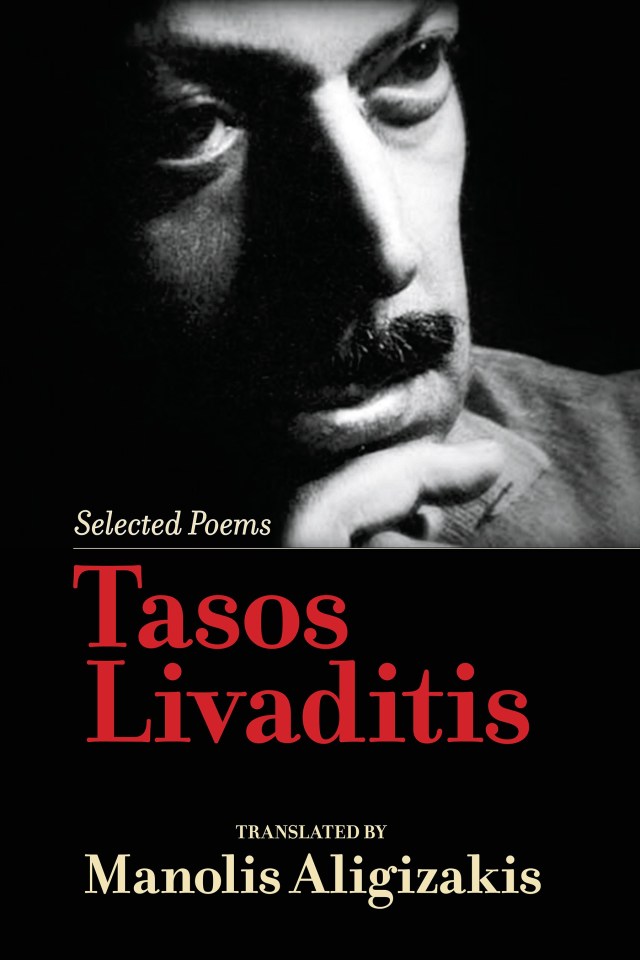
Tasos Livaditis – Selected Poems

The Unexpected
in Tasos Livaditis’ Poetry


Tasos Livaditis was a man and a poet who knew how to be likable. Not only because he was handsome both in his youth and later on in his senior years, not because he was the center of attention in various gatherings of his days, but also because of his poetry.
But why was it so?
His creative life could be easily divided into three periods, first being the period of beliefs, second the period of the crisis and third the period of recovery and in all three periods Tasos Livaditis was a very likable man to everyone he met, dealt with, associated with, made friends with, shared his hours in exile with. And Livaditis was a likeable man also because of his goals. During the first period, his goal was the struggle, something that spoke on behalf of everyone and also talked of a better future. In the second period, he tried to conceal the crisis he faced and kept away from his poetry by turning his attention to the people around him. During the third period of his creative life, his most important, if you like, he’s the poet everyone liked because of his ability to select the unexpected. Evident in the first book of this period, when he dealt with the issue of defeat, he encountered:
He kneeled and laid his forehead on the floor. It was
a difficult time. When he got up, his embarrassed face
that we all knew well had stayed there on the planks like
a useless inverted helmet.
The same man returned home without face —
like God
That like God and the face on the planks are the unexpected images that put this poet apart from others. Tasos Livaditis could minimize his importance, to lessen the size of his stature, to present himself as haunted, as prey, as one who is punished; he never liked the pompous and unnecessary verbalisms:

For years, I’ve prepared myself for that big moment
the miracle of the century, on the other hand
you must admit I’m one of a kind in my field.
But, God, what happened, who betrayed me, where
they find all the proof? The procedure was quick.
The district attorney, to the point, “Are you him?”
he asked me, “him,” I answered
is there any worse charge?
~ Kostas Kouloufakos

https://draft2digital.com/book/3562930

https://www.amazon.com/dp/1926763831

Podcast Episode: Love, Land, and Greek Verse

Pip: Manolis Aligizakis publishes the kind of site where you can move from a Cretan Renaissance epic to a teenager breaking his ankle during an accidental wrestling match with an older girl — and somehow both feel like they belong.

Mara: vequinox has been putting out a steady run of posts that touch on modern Greek poetry, the textures of desire and longing, rural and domestic life, and the weight of historical conflict. Let's start with the poetry.

Voices from the Greek Tradition

Pip: What this cluster of posts is doing is presenting modern Greek poetry as a living tradition — not a museum piece, but a body of work that moves between sensuality, political witness, and lyric restraint.

Mara: The post titled "Wheat Ears" anchors that range cleanly. The poem opens on a heat wave and builds toward pure physical longing: "come close to me, I beg you / let me touch your skin / the day is fiery / and unbearable like / the body's conflagration."

Pip: That last word — conflagration — does a lot of work. The body isn't just warm; it's an event. The poem earns that escalation.

Mara: The anthology post, "Neo-Hellene Poets," shows the other register entirely — a poem called "Kiss" that ends, "My soul that never learned to kiss / then knows immaculate ecstasy." Longing held at a distance, not consummated.

Pip: And then Yannis Ritsos, in "Poems Volume VI," goes somewhere stranger — a fox in a chicken pen, old men lying on yard tiles, a thin woman threading a ring of smoke as "the only one who believed him." Ritsos makes the surreal feel like documentary.

Mara: The Constantine Cavafy post gives you the political register — a poem about Alexander Jannaeus and Alexandra, Jewish monarchs who are "equal to the Seleucids in every way," the irony landing quietly in that final line.

Pip: Cavafy's irony is so dry it practically needs a humidity warning.

Mara: "Kariotakis-Polydouri, The Tragic Love Story" contributes a poem called "Modesty" — interior beauty as something fragile and untouchable, "a rose that balances on its own flame." Titos Patrikios, in his "Selected Poems," cuts even shorter: the speaker says experience earns him the right to go crazy, but he won't, because that would be a concession. And "Impulses" closes the range with imagistic compression — grief and erosion rendered through silver clouds and a carved heart.

Mara: All of it maps a tradition that moves fluidly between the erotic, the civic, and the elegiac — which is exactly the territory the next segment enters from a different angle.

The Body Remembers

Pip: Desire in this group of posts is rarely clean — it arrives tangled with anxiety, absence, and the particular ache of things that almost happened or already ended.

Mara: The excerpt from "Small Change" puts you directly inside a charged, disorienting encounter. The narrator, a boy, wrestles an older girl on a deserted street; they fall, and the prose captures the collision of arousal and confusion precisely: "her face looked shocked and she tried to twist away and we fell, and my ankle caught on the curb and she landed on top of me, both of us breathing hard, and I heard a dull crack, and a stab of pain like an electric current that shot up my left leg."

Pip: The body keeps score — and here the score is a broken ankle and a girl sprinting away down the street.

Mara: What the passage gets right is the simultaneity: wonder and pain and panic arriving in the same breath, no clean separation between them.

Pip: The poem "Message," from the "Medusa" post, is the compressed version of that same dynamic — someone sending a text three times, editing it, not knowing the person they're reaching for has already fallen asleep holding someone else's laughter.

Mara: "HEAR ME OUT" works in the same emotional space but from further along the timeline — a speaker alone in winter, pulling out fleece bed-sheets from a former shared life. The post reads: "Last night I went to bed in those fleece sheets after a long time I discovered something of our smell has remained in the fabric."

Pip: Scent as the last archive. That detail is doing real work.

Mara: "Blood, Feathers and Holy Men" takes a longer route to the same territory — Rordan and Ula, a medieval Irish monk and a Native woman, building toward love through shared song, each afraid to speak first. The restraint there mirrors the Kariotakis poems from the previous segment.

Mara: "Cloe and Alexandra" asks where poets go at night and answers in images — bloodied hands, a bandage over the heart, a swan writing its last verse. And "Wellspring of Love" grounds desire in the domestic and the anxious — a woman gardening before a prairie storm, worrying about the people she loves, trusting a child to be responsible.

Pip: From wrestling matches to fleece sheets to medieval monks — desire here keeps finding new containers. What the rural posts do is give those containers a landscape.

Land, Kin, and the Work of Staying

Pip: This segment is about what it costs and what it means to be rooted somewhere — a farm, a country hospital, a village, a horse arena — and what happens when those roots are tested or handed on.

Mara: The "Still Waters" excerpt sets the tone. A nurse named Tyne is being walked through an unfinished country hospital, and the exchange lands a quiet irony: when she questions the windows in the operating room, the doctor grins and says, "An air-conditioned operating room, of course." The passage ends on her honest uncertainty — "it would certainly take some getting used to."

Pip: A surgical suite with opening windows in a prairie winter. Rustic is one word for it.

Mara: "Fury of the Wind" gives you the farm side of that same world — a Scottish family's homestead passed through three generations, a daughter-in-law who has "become a regular country girl" with garden produce and homemade bread, planning for the fall fair months in advance. The continuity there is deliberate and warm.

Mara: "He Rode Tall" moves into the horse arena — a competition scene where a young rider named Tanya finishes Reserve World Champion, and the emotional peak is the older horseman Joel leaning over to whisper two words: "She's yours." The filly, the title, the whole arc handed forward.

Pip: That handoff is the whole story in two words.

Mara: "The Circle" widens the geography — phone calls coordinating airport pickups, a sick uncle in Iraq who can't speak freely over the phone, families dispersed but still pulling toward each other. The domestic instinct travels.

Mara: "Ken Kirkby, A Painter's Quest for Canada" takes rootedness into the Arctic — Kirkby describing the tundra as a place of simultaneous sensory deprivation and overload, where "the prairies by comparison are claustrophobic." "Straits and Turns" grounds things differently, in the very specific worry of a pet's health — a dog named Elvis, bladder stones, a second veterinary opinion. And "The Unquiet Land" puts a young Irish farmhand in front of a girl who hires him partly because his uncle is known to her family, the connection between land and kin made literal in a handshake over yellow-man candy.

Pip: Roots and conflict are harder to separate than the segment headings suggest — which is exactly where the next posts go.

History as Wound and Ceremony

Pip: The posts here are about conflict that has been institutionalized — turned into parade, into poem, into the long aftermath of war — and what it means to live inside that.

Mara: "In Turbulent Times" opens on the Twelfth of July in Belfast — the Orange parades, the bunting, the elaborate banners. The post quotes the poet Louis MacNeice on "the voodoo of the Orange bands / Drawing an iron net through darkest Ulster." A Protestant character named Robert Hanlon, married to a Catholic, simply leaves the city every year to escape it.

Pip: An iron net drawn through a province, and the most honest response is to go find a quiet field.

Mara: "In the Quiet After Slaughter" puts you in a different kind of threat — a Yukon bar, a one-eyed man with a machete, a protagonist who talks his way out by claiming to be someone useful. The violence is immediate and physical, not ceremonial.

Mara: "Hours of the Stars" pulls back to the lyric register — a poem that opens "After the death of authority / we waited for the king's celebrations / messengers of the lost war." The weight of collective defeat carried in the body, wrapped "like an ivy." "Erotokritos" reaches further back still — the scholarly post traces the Cretan Renaissance epic to refugees fleeing the Ottoman fall of Crete, a poem preserved and carried by people in flight. And "Wheat Ears" contributes a poem called "Visitor" — an unknown soldier who arrives in a small town, touches one woman's life, and is found dead in the street the next morning, his name never spoken.

Pip: History here keeps finding the same shape: ceremony over wounds that haven't closed.


Mara: What holds all of this together is the insistence that the personal and the historical are the same material — a broken ankle and a battle, a fleece sheet and a refugee poem.

Pip: Next time, presumably, more of the same — which is to say, more of everything.