Savages and Beasts

excerpt

indeed Mr. Wilson was there with an Indian girl who
he violated sexually in front of their eyes. What could they do
with such a secret? Marcus shook his head.
“We could tell the teachers about this…you know,” Marcus
said to Lucas then he added, “no we’d better let know George;
yes, he’s the one we should let know, no one else. You promise?
No one else for now…” he added and Lucas nodded yes. With an
undoubted ache filling their hearts they took the piece of wood
they went to the wood working shop for and as silently as they
could they returned to their beds. Marcus hid the wood under
his mattress hoping to give it to a relative next time he might visit
his tribe and ask him to create a totem out of it.
Next day the clock struck seven thirty as if someone had
struck it with a strap when Marcus and Lucas got up. The Kamloops
sky was full of leaden clouds which spread moist over the
houses with their green yards and the slanting roofs and on the
hearts of the people. Marcus and Lucas and three other kids were
peeling potatoes for George when Marcus got his chance to
talk to the Cretan cook about the event they witnessed. George
freaked out when he heard the detail description of what Mr.
Wilson did the night before. So angry he was that he left the
kitchen and ran down to Anton’s domain where he related to him
what he learned from the boys.
Anton’s face darkened, his eyes turned fiery red, his lips
tightened as did his fists; he could strike anyone at this moment,
so angry he felt, though the guilty person wasn’t around to
take the punches. He looked at George and his voice sounded
as if coming from the darkness where his heart was now. He
gazed at the window facing east while the horizon at the far distance
told of the presence of forests, which stood opposite the
beastly human behaviour, and valleys with rivers…

https://www.amazon.com/dp/1926763602

In Turbulent Times

excerpt

…about his belief that there were two St Patricks. He has historical evidence that he says supports his theory. He won’t be home till tomorrow evening.’
Joe turned his head away from her in indecision and stared into the red-hot heart of the fire in the range.
‘Joe, I want to have your baby.’
His head jerked round, and he looked at her with confused incredulity in his eyes, unsure of himself. ‘Nora, think of Liam, your husband.’
‘Why must you be always so considerate of others, Joe?’ Nora asked. ‘Think of me now. I love you. I want to have your baby. I want something that is yours to hold on to and to cherish for the rest of my life, something that is part of you and part of me that will be a living memorial of our love. Please, Joe. I need this.’
He placed an open palm on each side of her face and looked into her deep, dark eyes where tears glimmered like raindrops on a leaf. He knew that what she was asking him to do was sinful, and part of him recoiled from it. But his moral reluctance was brushed aside by the strong, sexual urges of a twenty-nine- year-old male, more especially of a male who spent most of his time at sea. ‘All right, I’ll stay,’ he said quietly and kissed her on the forehead.
‘I’ll put Owen Joe in his cot and wet a pot of tea,’ Nora said. ‘You can sample the barmbrack I baked this afternoon. We even have home-churned butter to put on it. A gift from Janet’s mother.’
They sat quietly by the fire, Joe in the rocking chair, Nora at his feet, her back against his legs, a book open in her hands. Upstairs the baby slept in the cot at the foot of Nora and Liam’s bed. Outside, the sky was still bright, the setting of the sun delayed by the manipulation of the British war-time summer clock. The limpid blue of the daytime sky was gently suffused with a pale golden glow that spread from the west. A couple of early stars glittered in the east, and Venus shone with a steady gleam in the wake of the lowering sun.
‘You’re going to read me a bedtime story, are you?’ Joe gently stroked Nora’s soft black hair.
‘No,’ she said. ‘I want you to read to me.’
‘You do, do you?’ Joe said lightly. ‘What have you got there?’ He took the open book that Nora reached to him and flicked the cover over. ‘J.M. Synge.’
‘Yes. Poor Synge,’ Nora said sadly. ‘He was thirty-five when he fell in love with a girl of nineteen, an actress called Molly All good, the daughter of a “Dour Orangeman” who objected to his children’s being brought up…

https://draft2digital.com/book/3562904

https://www.amazon.com/dp/1926763270

Fury of the Wind

excerpt

When she recovered from her grief over Danny, Sarah accepted a
teaching post at Corkum in the northern part of the province. But
her tenure there was short lived. In the spring of 1942, Mrs. Roberts
suffered a stroke. Sarah applied for a leave-of-absence to take care
of her mother during her convalescence. But Mrs. Roberts never
did convalesce satisfactorily, and Sarah was forced to admit that her
mother had won. For five years Sarah found herself tied to the neat
brick house in Tillsonburg – nursing, cooking, cleaning, gardening
and doing everything except that for which she had been trained.
Apart from trips to the store to purchase their meagre supplies,
Sarah went nowhere. She saw no one except Margaret and Elizabeth
and, since the former was preoccupied with wedding plans
and the latter was nursing in a hospital in Toronto, she didn’t even
see much of them. Visitors to the Roberts’ home were few because it
hadn’t taken Mrs. Roberts long after her husband’s death to alienate
almost all of their friends.
There was no hope of meeting a man. The veterans began to
drift back to town when the war ended, some with brides, some to
the sweethearts they had left behind. But even the unattached ones
seemed to have forgotten that Sarah existed, or maybe they still regarded
her as Danny’s girl. Soon, almost all of the young men had
married or had drifted off again to more promising venues.
When her mother died Sarah applied for teaching posts but the
school year had already started and a shortage of teachers was a
thing of the past. She had been out of the profession for more than
five years, as had most of the teachers who were now returning to
it. But ex-servicemen and women were, naturally, given preference
over someone who had been caring for a sick parent.
On a grey, cold day in October, three weeks after her mother’s
death, Sarah sat dumbfounded in the office of Roger Corbett, her
parents’ lawyer. She was trying to understand what he had just said
but she felt too numb to take it in.
“I’m sorry, Sarah,” Mr. Corbett continued, “I wish there was
something I could do. Twice during the past year I went to see her,
as you know. And I went specifically to suggest that she change her
will. But she acted as if she didn’t understand what I was talking
about.”

https://www.amazon.com/dp/0981073530

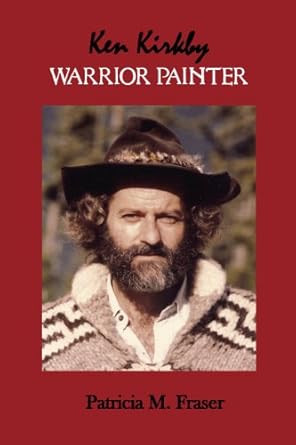
Ken Kirkby – Warrior Painter

excerpt

is this illusion…you and I can go for a walk wherever you choose and
I challenge you to show me where money grows. It is a man-made
convenience, but we have turned it into God and the almighty banks
into the churches.
Money in itself is a nonentity, a paper mirage. But if you understand
how it functions you realise currency can be artificially created—
MasterCard and Visa are good examples. It no longer needs to be
printed by the Mint. I wish people would realise it is only a tool, to be
used like any other implement, and no more mysterious.
As the two men worked, Harris proposed assorted schemes to make money.
These were discussed, dissected and for one reason or another, discarded
at the end of the workday. Perhaps, like crossword puzzles or Sudoku, they
served to keep the workers’ mental juices flowing.
~~
Ken Kirkby is a particularly fine cook and, having been raised in
Francisco’s kitchen, can turn the simplest ingredients into a dish to be
savoured and praised. As his circle of friends expanded, he resurrected his
long-dormant culinary skills.
Portuguese meals would not be complete without a bottle of fullbodied
red or crisp white on the table. When Ken left Portugal, he had been
selective as to what he took with him, but one of his prized possessions
then and now, is the family wine recipe dating back several centuries. He
continually has a batch on the go although he is a moderate drinker himself.
It was likely a day or so after a well-spiced supper of clams, shrimp and
prawns cooked in Kirkby’s special fish stock prepared from flounder, too
small in themselves to eat. While spreading topsoil for the eventual seeding
of the lawn, Harris says, “You know, Kenny, that’s a damn fine wine you
make. You could probably make a pile of money if you set yourself up to
produce and sell it.”
“Probably,” says Kirkby.
Harris does some mental calculations. “How much do you think you
could make?”
“Money, or wine?” Kirkby quips.
“You’ve got a few racks there—how much do you usually make?”

https://draft2digital.com/book/3562902

https://www.amazon.com/dp/B00CB8W4CG

Small Change

Excerpt

I started walking, away from the fence. After about fifty yards, I came to an apron of freshly cut grass that bordered a wide road and a neighbourhood of the largest, most beautiful houses I had ever seen. Brick and fieldstone, white clapboard and freshly oiled cedar, some of them three and four storeys high, with ample porches and verandas and sprawling lawns. I limped a bit, but managed to make some progress along the wide, grassy median in the centre of the street I immediately thought of as a thoroughfare. What is this place, I wondered, and who lives here?
They were oddly dressed. The boy wore a striped tee shirt, a white cap which I later learned was a Polo hat, and knickers that were tucked into black stockings just below the knees. Two of the girls wore summer dresses in soft pastels, yellow and sky blue, with puffed shoulders, matching socks, and matching bows in their hair. They had white shoes with ankle straps, not sandals, exactly, but something like, and the third, taller girl wore white court shoes, white shorts with a white leather belt, and a vee necked tee shirt. Her honey blond pony tail hung half way to her waist and was tied with a white band.
I was astonished, but drawn toward them as if by a huge magnet. They seemed like sky children, but were so recognizably earth-bound I wanted to talk with them, to know what their lives were like. Especially her, with the startling eyes.
I stood very still until they became aware that I was watching them. They stared back, then they looked at each other. They seemed puzzled. I crossed back to the sidewalk and started up the lawn that sloped down from their slate grey house. They seemed hypnotized, or stilled by bewilderment, alarmed, but unable to break the spell of my dirty, sweat streaked face, torn jeans and bloody shirt.
Except for her. She looked straight at me, so directly and with such an open stare it stopped me in my tracks. I felt something I’d never felt before. It seeped into my chest and throat from a place I never knew was in me. It was as if I had seen her before, or known her all my life. Her face – the smooth skin, deeply tanned like her arms and legs, the full mouth, high cheekbones, and green, green eyes – burned itself into my memory and what I read there was not fear, but curiosity, because I was strange to her, and concern, because it was clear that I was hurt. There was something else too, and it made my heart accelerate.

https://www.amazon.com/dp/1926763157

Swamped

excerpt

“Well, don’t make it. There’s no need. Ariana is a woman I enjoy
being with, and that’s that.”
“I can’t believe you’ve gotten yourself involved with someone and
are even bringing her to the house and…” She left the sentence unfinished.
Eteo felt hot and flushed at hearing these words.
“You might have thought of that before you left.”
There was silence for several seconds. Eteo listened to her rapid
breathing, expecting the other shoe to fall at any moment. Finally he
said, “I’ve got to go, Roula. I’m very busy.”
“Don’t go, wait,” she pleaded. “You are not serious about this
woman, are you? In any case, you shouldn’t have her around my
sons.”
“As I said, Roula, where I have her is none of your business. You
have no right to tell me who I can bring to the house.”
“Oh God, have you forgotten all the years we lived together? How
could you?”
“You’re the one who left. Now leave me alone,” Eteo said and put
the phone down.
Now he really needed to relax, but his mind wouldn’t let him. He
turned toward the eastern horizon again, feeling as gloomy as the
cloudy sky. His reflection in the glass looked as sullen as the darkening
horizon.
His bitter thoughts were interrupted by Helena buzzing to let
him know Bernard was there to see him.
“Hello, Bernard. What brings you here?” Eteo asked as the
shaggy-haired man strode into the office
“Your associate,” Bernard barked without any preamble. “I see a
dead market, and I wonder what kind of hole I’ve gotten myself into
with your help.”
“What do you mean? You made a deal with him and he looked
after you. Why are you complaining to me?”
“I placed those shares because he gave me his word that he’s got
the well. I only hope he hasn’t double-crossed me. If he lied to me,
he can kiss his market goodbye for a long time.”
“I can’t say one way or the other, Bernard. He told me the hole is…

https://draft2digital.com/book/3562976

https://www.amazon.com/dp/B08WP3LMPX

Jazz with Ella

excerpt

But David, there’s another thing and it’s a real mystery.” She described the telegram that had been sent from Kazan. “That was a dreadful day trying to avoid Chopyk’s sheep herding efforts, trying to see the Gorky Museum and not think about Paul, all at the same time. Did you…?” But David was shaking his head.
Jennifer felt a wave of fear again. “You were one of the few who broke away from the group so I thought it must have been you trying to surprise me. Please tell me it’s not someone else trying to pull a fast one. ”
“I didn’t send any telegram. If you think about it, it would have to be someone who knew Volodya’s address—and knew the code words.”
“No, it didn’t have the code words in it. He thought I’d forgotten them and came anyway.”
“Natasha? She would have quick access to telegrams…she knew his address from the telegram he sent you…”
“Natasha—it has to be her.” Jennifer was stunned. “But why? I don’t get it. You know I suspected her back when the other telegram came in. She’s from Leningrad, you know, and they might have known one another while he worked for Intourist.”
“I’ve thought there’s more to her than what we’re seeing. That’s gotta be it, but you won’t get a chance to ask her because we’re trying to avoid her like the plague right now.” David began to sort through the closet for the jacket and shoes. “Do you know if she caught up to us here at the hotel?”
“Oh, for sure, but I don’t think she knows what rooms we’re in. If you hadn’t told me your room number, I’m sure I couldn’t have got it from the desk clerk. They seemed terminally uninterested.”
“Listen, why don’t you ask Volodya if he knows Natasha? Let’s sleep on this matter,” he yawned politely, “and get you-know-who fixed up with clothes in the morning.”
But when she returned to her room, Volodya had fallen into a deep sleep sprawled across the utilitarian single bed. His pack was open, contents spilled onto the floor, with his clothes hanging neatly on the racks. Coaching would have to wait.

https://draft2digital.com/book/3562892

https://www.amazon.com/dp/1926763246

Arrows

excerpt

…didn’t address me. We ate in silence, and I contented myself with
what he offered me. I knew it was pointless to discuss Tamanoa, to
protest.
“Do you know why I have decided you will not die like your
servant?” he finally asked, breaking the silence, scowling at the fish
he was eating.
“I think God must have told you to let me live.”
He snorted.
“I am not to tell you why. It is for a reason for someone else to say.
But I know it took courage for you to come to us. And now I see the
way you have mourned your servant. Pariamanaco has told me. I
had never believed it possible that a white man could cry over an
Indian, as you call us, half-breed or not.”
“Tamanoa was my friend,” I said, feeling sadness and anger
welling within me. I dropped the bite of plantain I had pinched
between myfingers onto the plantain leaf. “Why did you kill him?”
“Half-breeds, they are traitors. They are not white, not one of us.
They learn our ways and betray us.”
“Tamanoa was good,” I said a bit more sharply than I had
intended.
He gave me a derogatory grimace.
“Why did you save her?” he asked, referring to his wife.
“I didn’t, God did.”
He glared at me briefly, but then turned his attention back to the
fish and cassava.
“I want what is good for you,” I continued. “I want you and your
people to see the Creator when you die.”
He gave me a fearsome scowl.
“I’ll see Mareoka. I am shaman, don’t need you for that.”
“Only born-again people can see him,” I paraphrased, for
understandably they did not have a word for baptism. “That is the
message I bring.”
“Born again? How can you be born again? That is crazy.”
“You are born again when I pour water over your head in the
name of the Father, the Son and the . . .”—suddenly it struck me …

https://draft2digital.com/book/3562848

https://www.amazon.com/dp/0981073522

Ken Kirkby, A Painter’s Quest for Canada

excerpt

A short while later, a tall man came to the kitchen door. Salvador
greeted him and the two men talked quietly together for a few minutes.
Then Salvador pointed, and Ken heard him say, “This is the man I told
you about. He is the man who has been sent.”
Albert waved Ken toward him. “If you’ve been sent, you’d better come in.”
Ken shook his hand and entered the kitchen.
“Who sent you?” Albert asked.
“It isn’t a who; it’s a what. An idea sent me and the idea starts with
one human being asking another human being for one hour of his life to
listen to a story, and the story is of a man you may have some familiarity
with. His name is Lorenzo de Medici. Are you familiar with him?”
“Yes I am.”
“I want one hour of your life.”
Albert sat at the kitchen table, quiet and composed. Even his eyes were
still. His hands rested motionlessly on the tabletop, his fingers curled
comfortably inward.
Ken sat, took off his watch, and placed it on the table where he could
see the time ticking away. He told Albert his understanding of Lorenzo
de Medici’s life. He drifted away on his words, just as he had when he had
made his speech at the Columbus Centre. He lost himself in the intensity
of the moment – rushing down the white water of ideas like a kayaker
tumbling down a raging river.
“There are parts of that story I wasn’t familiar with,” Albert said, when
Ken had finished. “Where did you get your information?”
He told Albert about his birthday trip to Florence to see the statue of
David and how on another birthday his father had given him a beautifully
bound book of Michelangelo’s letters to Popes, kings and princes.
The letters, he told him, described his relationship to the Medicis in his
own words.
“So you are an artist?”
“I am a painter. Michelangelo was a sculptor who was made to paint.
I am a politician who is made to paint. I have a job to do, and I have a
mission to carry out that has to do with the people of the Arctic and the
soul of a nation. We in Canada wander around very confused as to our
identity. Our subjects of conversation are the weather, Quebec, and our
identity. I have found the soul of this nation, and in the process, I found
many wonderful stories and many wonderful symbols. At the same time,
I discovered hell on earth – hell is what is happening to those people. I
have been asked by the grandmothers to please tell the world about this.
The first thing I want to do is tell you about it.”
“Why would you want to tell me about it?”
“In Michelangelo’s time there were Popes, queens, and princes. There
were people who could sponsor great ideas.

https://draft2digital.com/book/3562830

https://www.amazon.com/dp/0981073573

Poodie James

excerpt

Sam thought about the trajectory of his own career, the comfort
of his retirement, the adventure of his new work on the bench. He
wasn’t sure that he could trust words to say what he felt. He offered
his hand to the big man sitting in the coppery sunshine on the
stoop of Poodie’s cabin. Engine Fred grasped it and smiled.
“I talk too much,” he said.
As Sam backed his car around and headed down the lane,
Engine Fred shambled up the path through the bunch grass
toward the jungle. Poodie hefted the three boxes of reds into a
stack next to the cabin. He would put them on the wagon and take
them to Ralph Gritzinger at the market. With his apple money,
ten or twelve dollars a week from newspapers and bottles and what
he made stocking shelves and doing odd jobs for Gritzinger, he
was all right, he thought. He had a place to stay and people who
helped him. The YMCA let him swim laps in the indoor pool now
that the city pool was closed for the season. He wondered what
would happen to a man like him in another country, another time.
What would the Egyptians 4000 years ago have done with an
undersized deaf man whose talk was hard to understand, who
walked badly? Would the Pharaoh’s master builders have wanted
him to work on the pyramids? Maybe, he thought, if he was lucky.
Most likely, he would starve. He walked out into the field where
the orchard used to be and turned to face his cabin and trees. If he
was from a nice neighborhood in town, wouldn’t he think the
cabin was too small, too run down and dirty for anyone to live in,
with no running water and no bathroom? If he were an Egyptian
slave from 2680 BC, wouldn’t he think that living in such a place
would be a blessing?
He was blessed, he told himself; a lucky man. He would hate the
jobs the school for the deaf wanted him to take, fixing furniture,
repairing shoes, inside all the time, stuck in a routine. Poodie
thought about how hard most folks in the valley worked to pay for
their houses, buy their cars, raise their children. He thought about
Dan and Ruth Thorp losing their orchard and their house.

https://draft2digital.com/book/3562868

https://www.amazon.com/dp/B08W7SHCMV