“Those who left you on this shore caused you the pain you have had to suffer. I am sorry. The raiders were Pequat. By their law and our own law, we had to leave and let them take you or they could have destroyed our village and taken our children as well. A Pequat mother lost a daughter just as Brown Bear lost his Namid.” Bjorn stood up in anger, “How? Where?” Ari also rose, painfully. “Who did this murder?“ White Eagle raised his hand for silence. “Word has spread from further toward the warm lands that the serpent ship brought death among our neighbours. The Pequat travelled far to where they camped last night. They lost warriors and have the right to take the bravest from among you to replace lost sons and daughters. Your brave singing saved your lives. Now our people have bought you back so you belong to us.” Ari looked around to his companions, then he replied for all, “Thank you for our lives. We will be your people. Your people will be our people.” “Now,” said White Eagle, “you must eat and rest. You have done well.” He turned to Rordan and placed a hand on his shoulder. “You have honoured us with your bravery and with your music. We gave many gifts to have you back. The Pequat warriors have named you Hototo Nikamu, Warrior Spirit Who Sings. Now you are our Mountain Thrush, Hototo Nikamu, and you are free to fly as you will.” When White Eagle left to go to his lodge, Brother Keallach spoke to Rordan, “If we are to stay here forever, shouldn’t we talk to Father Finten, first?” “Not on your bloody life.” Ula was angry. “He wasn’t ransomed. Shit! He wasn’t even with us. He can go when he bloody well wishes. This is our decision. Rordan has spoken for all and his word stands.” Brother Ailan used his right hand to get to his feet. His left hand was heavily wrapped in moss and balsam fir sap. Brother Rordan had learned of the healing properties of balsam from Corn Mother and, having paused to gather sap and cones on the return journey, had already applied resin to everyone’s burns and to Ailan’s finger stump. Now Ailan stood to address his Brothers. “No matter what happens, do not forget we are tied to Father Finten by our vow of obedience.” “Maybe you are, if you choose to be. At least three of us are free to make our own decisions.” Ula stomped out of the lodge and Bjorn and Ari followed after her. Rordan looked at both Keallach and Ailan. “What do we do about Finten? Has anyone seen him?” For days, Finten roamed the headland, looking out to sea, afraid of what might appear on that vast expanse, afraid and ashamed of what White Eagle and the First Light People would think of him now. Why, when he knew he could be so brave, did his knees buckle whenever he was faced with danger? He regretted that he had not died with his Brothers. He was certain none of the companions had survived. He’d heard the bloodcurdling shrieks as he cowered in the lodge. He’d seen blood splattered on the ground outside the lodge. He’d seen the trails of blood where the savages had dragged bodies into the woods, probably to be eaten at a gruesome victory feast. When the villagers returned and he saw that none had been wounded, much less killed, he knew immediately he had been betrayed. The attack was not against the village but only to capture and kill him and his Brothers and the other three.
Two glasses on the table a stool at the corner the shadow of a hand cutting flowers shadow divided between bed and ceiling I don’t remember, didn’t see it on time only the shadow of the closed window on the white wall and the hand that didn’t cut flowers the hand that was cut at the first moon-second falling in the muddy waters middle of the road next to the broken wheel of the post office truck. A mandolin, an angry angel a glass of water, the cigarette the sound which takes both of us out of loneliness so we separate again without saying goodnight. Then, the eyes that open two holes in the wall. I planted a tree. I’ll make sure it grows. I won’t come back, no matter what.
Closet All night long, sleepless, you promised not to cry to empty the closet give his clothes to charity his red shirt you’re now holding tightly in your arms as if it is his body his hands hanging off the sleeves his fingers that touched your secret contours suddenly a lone tear flops on the side of his heart and you run to the washer impossible to give it away with such a teary stain
Pip: Manolis Aligizakis runs a site that could double as a library card catalog, if libraries had this much range — Greek exile poetry, Canadian prairie childhoods, Soviet-era blackmail, and a taxi ride you would not want to be on.
Mara: vequinox has been posting across all of that territory, and today we're moving through three areas: modern Greek poetry collections, literary and crime fiction, and the theme of identity, memory, and exile. Let's start with the poetry.
Greek Verse, Exile, and the Long Tradition
Pip: The question underneath all these poetry posts is what it means to translate and collect Greek verse — not just linguistically, but as an act of cultural preservation, pulling work from Ritsos, Seferis, and others into a form that travels.
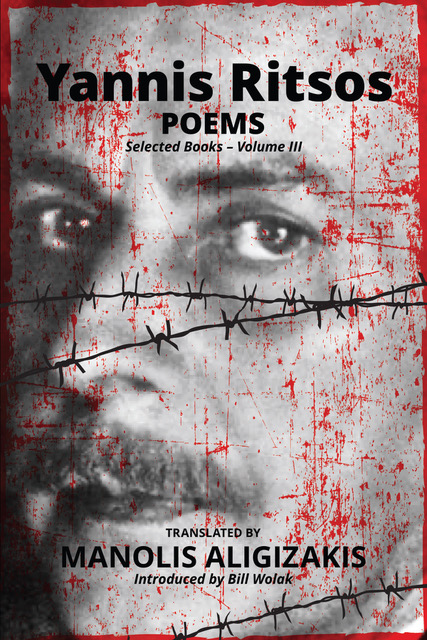
Mara: The Yannis Ritsos volume sets the tone early. From "The Exile Diaries," dated the fourth of December: "Moon, take off your shoes / I can't sleep on my back / if I'll turn to my side I'll hurt. / The door is open / I can't leave."
Pip: That last line does a lot of work. The door is open and he still can't leave — which is exile's specific cruelty: the constraint isn't always a lock, it's something internal, something the body carries.
Mara: George Seferis's collected poems push into similar territory with "The Sentence to Oblivion," and Tasos Livaditis, whose volume was longlisted for the 2023 Griffin Poetry Prize, writes of being "completely dishonest like this world that it belongs to you only when you promise it to someone." Titos Patrikios in his selected poems warns readers to "protect yourselves from the poets who steal verses from graves of the unknown."
Pip: There are also original collections here — Entropy, Ugga, Medusa, Troglodytes, Hours of the Stars — each posting a single poem as a window into the full book. Hours of the Stars centers on Ionia, lost in 1922, where "man tried to create the face of god and at last he created his own thoughtful face." The Neo-Hellene anthology rounds out the range, gathering voices across the modern Greek tradition into one place.
Mara: That breadth — from Ritsos's internment diary to an anthology spanning the whole tradition — is the argument these posts make together. The fiction excerpts are making their own kind of argument, and it runs across a very different set of landscapes.
Novels at the Edge — Fiction and Crime Excerpts
Pip: What connects this stretch of fiction posts is that nearly every excerpt drops you into a moment of pressure — someone is hiding something, someone is about to find out, and the social fabric is visibly straining at the seam.
Mara: Wellspring of Love opens in a hospital corridor. Tyne has just entered her aunt Millie's room and the excerpt lands here: "Tyne was conscious of two disturbing thoughts, the first that Dr. Dunston had seldom greeted her in any other way than with his usual cheery, 'Hi, sis.' Her second thought was that the woman in the bed, frail and ashen-faced, was hardly recognizable as her beloved aunt."
Pip: Two small observations, and suddenly the reader knows the diagnosis is bad and the relationship is complicated. That's efficient fiction — the weight is in what goes unsaid.
Mara: Jazz with Ella works the pressure from a completely different angle. Pavel, Vera, and Shukshin have cornered a Soviet bureaucrat named Pyotr — they have photographs of him with the police chief's wife, and they need forged documents. Pyotr sputters through a tantrum, and then Vera simply asks, "May I pour you another drink?" The coercion is wrapped in perfect politeness.
Pip: Nothing says "you have no leverage here" quite like being offered a refreshment mid-extortion.
Mara: In the Quiet After Slaughter takes a coming-of-age angle — two teenage brothers drawn into a scheme involving a mysterious receiver on a hill called Pork Chop, with a cast of characters that includes a man with a wart that "looked like a ladybug" above one eye. The Qliphoth is denser, set in a flat littered with occult paperbacks and failed technology, a woman piecing together who her missing lodger has become. Savages and Beasts puts a boy named Anton in possession of a dead priest's diary, paralyzed by what he should do with it.
Pip: He Rode Tall goes quieter — a maritime engineer named Joel, decades of city noise behind him, sitting on a horse in a pasture and feeling his heart come back online. In Turbulent Times is a social novel, a dinner table of doctors and their partners trading sharp observations about a young woman Clifford delivered as an infant under difficult conditions. The Unquiet Land sets its pressure in Ireland, where Mother Ross tells Padraig that "forgiveness is a rare commodity in Ireland — Irishmen never forgive and never forget." Redemption and Straits and Turns close the set — one a quiet departure from a Cretan village, the other a Vancouver taxi ride with a passenger whose presence is described with the kind of sensory detail that makes you grateful for fresh air.
Mara: What holds these excerpts together is that each one catches a character at a threshold — a decision, a revelation, or a departure. That threshold question carries straight into the next set of posts.
Where You Come From, Who You Are
Pip: The identity and memory posts are asking a version of the same question across very different geographies: what does a person carry when the place they came from is gone, or far, or changed beyond recognition?
Mara: Twelve Narratives of the Gypsy opens at the largest possible scale: "before we existed the Earth lived, before it spread its plains it was alive with its knowledge and wisdom." It's a cosmological frame for belonging — rootedness as something older than any single person's story.
Pip: Which makes the smaller, more personal accounts feel like they're answering that opening from the ground level.
Mara: Prairie Roots does exactly that — a childhood memoir of Saskatchewan winters, threshing season, geese in formation, paths worn single-file through snowdrifts toward a school facing a rising sun with no warmth in it. Red in Black brings it into the present tense, a poem about wilted supermarket vegetables and rotten tomatoes that pivots sharply to a man shot by a police officer. And Introspection's poem "Delta" traces a speaker who walked to the far ends of the world arguing for elegance and freedom, and was called a lunatic for it.
Mara: The thread running through all of it is that identity under pressure — exile, displacement, the refusal to forget — keeps finding its way back into the work, whether the form is a Greek lyric or a prairie memoir.
Pip: Exile poetry, coercive Soviet bureaucrats, a boy with a priest's diary, and a cosmological origin story for belonging — it's a wide orbit.
Mara: The site keeps returning to what people carry across distance and time. There's more of that to come.