Lamb, frosty lamb short poem take me by the hand; dawn has its thorn and its stool. Let us believe until evening comes. Moon, take off your shoes I can’t sleep on my back if I’ll turn to my side I’ll hurt. The door is open I can’t leave.
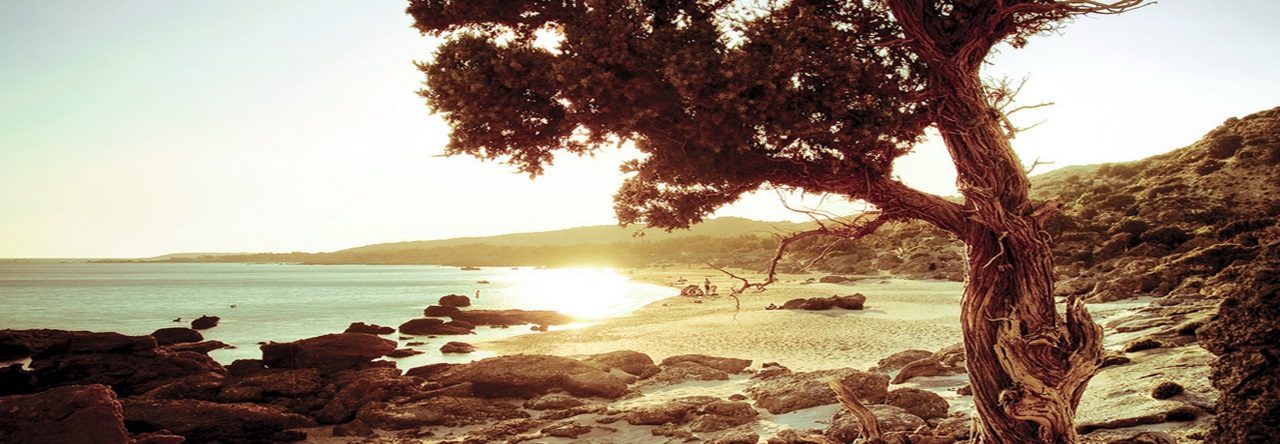
Unanswered Love That lonely tree on the mountaintop is an unanswered love it grows old ravaged by the wind and loneliness it never knows the rustle of the forest during the night it still insists to become a wave, a by-chance monogram, tattoo of the dream, it dives deep into the end of the horizon it transforms into a myth and distances itself flapping its wings to the voice that calls it while before the body departs it writes echoes of vibrations in the air heavenly contours of reflections
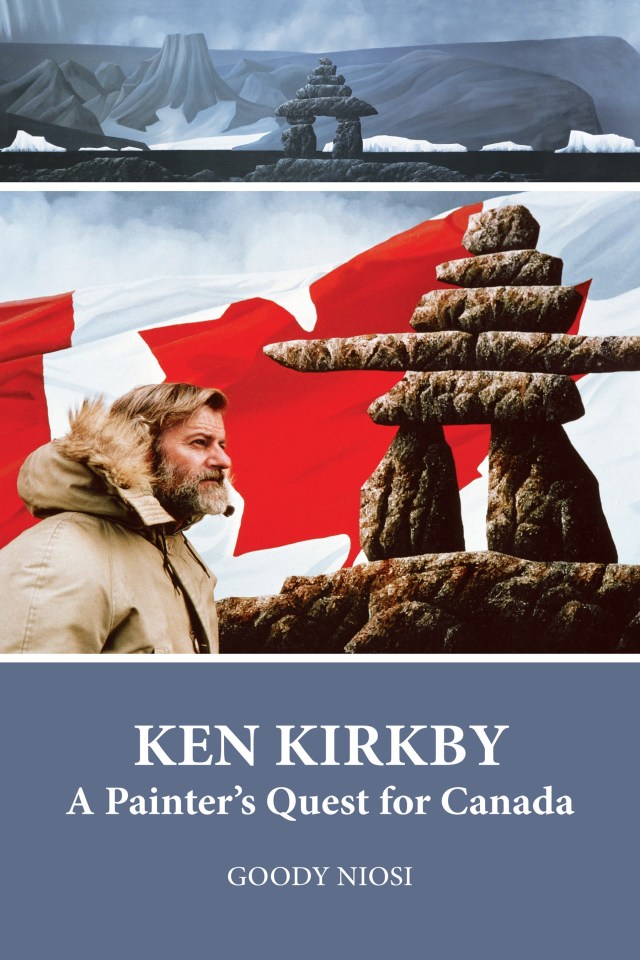
As they walked around the ramshackle town, whose only buildings of note were the grand churches of competing denominations, he described his first sight of the place and how he had come to buy food for the people who were to become his family. An Inuk man, named Amy Ahangona, asked them to have tea at his home. As they walked toward his house, people smiled and nodded. Amy explained that the people in the Arctic knew about Isumataq and about the spotlight of attention Ken had been focussing on the story of the Inuit. “What can we do to help?” he asked. Ken made one request. Could Amy take them out on the Coppermine River? They spent a day on Amy’s boat, motoring up the river to Copper Mountain where the natives had mined the yellow mineral and beaten it into knives, and had thus become known as the Yellow Knives. They went to Bloody Falls where Ken stood on the same boulder he had straddled when he first crossed from the western into the eastern Arctic. He saw again the boulder where Samuel Hearne had carved his name in the sixteen hundreds and felt the emotional rush of history overwhelm him. From Coppermine, they flew to Rankin Inlet where they discovered that Keith had asked Michael to spend the summer at his camp, working as a guide. They flew across Hudson’s Bay, east to Iqaluit (Frobisher Bay), another ramshackle settlement, except for the new high school in the shape of a giant igloo. They continued on to Pangirtung, an ancient settlement at the far end of Cumberland Sound on Baffin Island, where the Inuit had made camps for many centuries. But, it was also an old European whaling station and remains of the industry and skeletons of giant blue whales were still scattered on the shore. They visited the local high school, where Ken gave a talk. When one young student asked him what he would do with Isumataq when it was finished, he said he wanted not one opening as was common with works of art – he wanted many openings, all of them to take place across the Arctic. Yes, the student persisted, but where would he show it first. “Well, first I have to take it to Parliament,” he said. Afterwards, Karen said. “I’ve never heard you say that before. What’s this idea of going to Parliament?” “It was just a joke,” he said. “It just came off the top of my head.” “Some joke! It’s perfect.” “Maybe.” “Seriously – it’s perfect. That’s it!” “First I want to bring it here.” “Fine, but I tell you I love it – I love it a lot more than your crazy idea of going to Rome and unveiling it in the Colosseum with a pair of lions.
Knife In the talons of fear, all his life, a hell, a schism into which he hid his pride, an apostate in the rocky face of normality he promised to protect his body from darkness his imagination always created his psyche constantly on alert when fearful of all others he raised the knife to defend himself from the innocence of his victim in the body of who the knife dived proving the short truth that only evil can control a man, only the blood of innocent can justify the unnatural existence of the killer on earth he too settled on what his foul mind led him to spend his life imagining that he was human.
Pip: Manolis Aligizakis has been quietly building one of the more ambitious translation and publishing projects in contemporary poetry — and this week's posts from vequinox make that scope impossible to ignore.
Mara: We're covering two stretches of territory today: the Modern Greek poetry tradition, from Ritsos to Seferis to Patrikios, and the narrative fiction side of the site, with excerpts ranging from small-town drama to historical adventure.
Pip: Plus a short stop in the territory where longing and unrest do most of their best work — which, it turns out, overlaps with both.
Mara: Let's start with the poetry.
Greek Voices, From Guilt to Glory
Mara: This segment is about what Modern Greek poetry actually does — how it moves between the intimate and the historical, the personal guilt of a single speaker and the collective weight of a whole tradition.
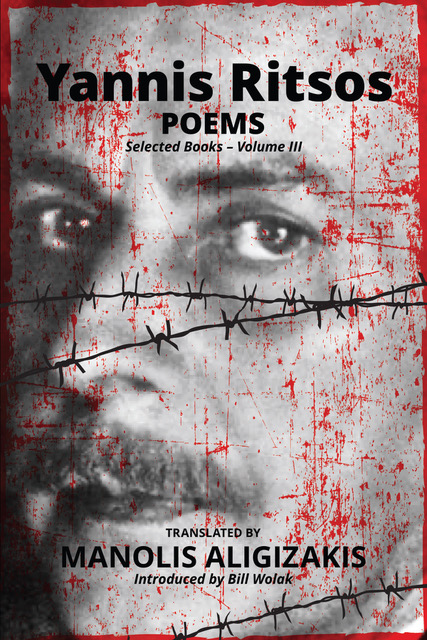
Pip: The Yannis Ritsos post, from Poems Volume II, opens with a poem called "Suspicious Sleep," and it sets that tone immediately. The setup is a small, almost domestic guilt — a star announcing happiness, a fruit seller's voice — and then the speaker turns inward: "You felt guilty because you didn't have the urge to respond. If you at least hadn't seen, hadn't understood. Guilty, not counting the guilt of others. You, all alone, put all the responsibility on your shoulders and you understood all your innocence."
Mara: The consequence there is the paradox at the heart of a lot of this poetry — that full awareness of your own innocence arrives only after you've already accepted total responsibility. That's not a comfortable place to rest.
Pip: Ritsos Volume IV, "Maturity," goes the other direction — outward, chaotic, guards running, flags lowered, and a crowd that can't decide whether it's laughing or crying. The intimacy is gone; what's left is noise and doubt.
Mara: The Tasos Livaditis post, Selected Poems, is warmer — a spring morning, flour on lips, a name written on steamed windows. The Kariotakis-Polydouri piece, "The Tragic Love Story," pulls the other way: bells that spread evil, a prayer to beauty, an untimely death. George Seferis's collected poems land somewhere between — "a great sun greater than light," the garden between equinoxes, but arrived at only after staring into a black cloth.
Pip: Titos Patrikios writes a love made of "bones of our dead comrades" and "a black wind that spreads its fiery metal on words, in jails and exile camps." That's a tradition that has earned its darkness.
Mara: The anthology post, Neo-Hellene Poets, gives the broader frame — voices across generations asking the same question: "Why does our joy, our little joy, to sadness only lead us?" Antony Fostieris, Katerina Anghelaki Rooke, the collections Impulses, Marginal, and Wheat Ears all circle that same tension between sensation and loss.
Pip: And then the fiction asks it differently — through plot.
Stories Under Pressure
Mara: The fiction excerpts this week span centuries and continents, but they share a structural pressure: characters navigating power, prejudice, and survival in confined spaces — a chair across a mayor's desk, a ship in plague, a monk tied to a stake.
Pip: Fury of the Wind opens that territory with a scene that looks domestic and turns out to be a confrontation about social standing. Will Andrews has put a woman named Sarah Fielding to work alongside the town women, and his wife Molly is furious. The exchange lands here: "Then it would be their loss, not mine. Anyway, none of you even know Sarah. What've you got against her except that she married Ben Fielding?" And Molly's answer — "She married Ben Fielding, and only a coarse woman or a slut would have considered doing that" — is the whole town's prejudice compressed into one line.
Mara: What this means in practice is that Will is fighting a social order that has already decided the verdict. His mild needling doesn't move it; Molly slams the door, and he's left muttering at his papers. The power isn't in the argument — it's in the silence that follows.
Pip: Poodie James runs a similar dynamic at higher stakes. Engine Fred sits across from a mayor named Torgerson and tells him, quietly, that he knows what Torgerson did twenty-one years ago. Torgerson's defense is pure contempt: "He's a freak, an unclean little freak. He contaminates the town." The machinery of official cruelty, dressed as civic concern.
Mara: In Turbulent Times opens differently — a birthday drive through the Irish countryside in a new Bentley, stories of drumlins and dolmens, a hotel dinner. The ease of that scene is doing work; it establishes exactly the kind of world that turbulence will later disrupt.
Pip: Blood, Feathers and Holy Men puts Brother Rordan tied to a pole, a burning bough at his scalp, a painted warrior demanding he sing. He chooses the Salve Regina. That's not a metaphor — it's a man deciding what he is in the worst moment available.
Mara: The two Arrows excerpts — posted on different days but from the same novel — follow a narrator navigating the Spanish Inquisition, protecting a plague-stricken captain and outwitting an inquisitor with a well-placed mention of the king. The stakes in both are life and death, and the tool is language used precisely under pressure.
Pip: Small Change is quieter — a boy sent home from choir practice for looking at stained glass windows, explaining to his mother that the other kids are slow. The Circle is quieter still: a retired admiral visiting his sister's vegetable garden, at peace with himself for reasons he can't yet explain aloud.
Mara: Swamped and Straits and Turns round out the range — one a business negotiation over wine, warrants, and commissions; the other a solitary traveler burying a wolf with stones and walking away smiling. Hours of the Stars adds a poem in the mix, a Roman galley caught in the Euroclydon wind, cargo thrown overboard, salvation uncertain.
Pip: Cloe and Alexandra sits at the edge of both fiction and lyric — a poem that asks what "I wish you the best" actually means, and answers: probably not much. Which is its own kind of pressure.
Mara: That question — what words mean when feeling has already left the building — is exactly where the longing segment picks up.
When Longing Outlasts Its Object
Pip: This is the territory where the poems aren't about a tradition or a history — they're about the specific ache of wanting something that has already shifted into absence.
Mara: Cloe and Alexandra frames it as a linguistic problem: "Would have been better if he wrote: 'Sorry that I couldn't?'" The polite farewell as evasion — the nine-headed monster of circumstance doing the work the speaker won't do.
Pip: Marginal puts the same absence in physical terms: "night laments her dark role in the photosynthesis of your absence." That's longing metabolized into the body's own chemistry.
Mara: Katerina Anghelaki Rooke's selected poems move through environmental grief into something stranger — horror at the destruction of forests that "strangely mixes with elation" when the ego finally releases its grip. Tasos Livaditis, Poems Volume II, carries a grief that leaves no footprints. Titos Patrikios turns it political. The Neo-Hellene anthology, Antony Fostieris, George Seferis, and Kariotakis-Polydouri all ask the same question from different angles: what do we do with what we cannot stop feeling?
Pip: Impulses answers with a sculptor making everything too large — hands big enough to embrace the world, legs to straddle the universe. Overcorrection as grief's own logic.
Mara: The fiction excerpts were asking the same thing. The ideas don't stop at genre lines.
Pip: What stays with me is how much of this — the poetry, the fiction, the longing — is about the gap between what language can carry and what it can't.
Mara: The next episode will likely push further into that same territory. There's more to cover.


 Manolis Aligizakis