Same Route A piece of red sail in the dark blue. Olive trees, posts, plastic bags, kisses of bathers, faces, hands, and bodies decayed in time, bitter, but interesting. Cicadas with voices floating in space, you haven’t paid attention to them, foreign. Whether you pay attention or not, whether you listened to them or not, whether you saw or not, nothing, he said. A bitter aroma, forgotten, made of mowed grass. Sit down, then, here on the warmed-up soil, untie, one by one, the knots of the napkin. Eat your bread, biting deep, beyond death. Then, the eggshells, so white and fragile, as evening comes, creak under the feet of the old blind man who walks serenely, led by a small turtle, toward the temple in Kolonos.
Evidence supporting this view lies in the fact that, by extension from the pater familias to the king, as long as this form of organisation endured, the king was simultaneously the high priest and, in certain cases, the god himself. This was the case, for example, in the pre-Hellenic Minoan civilisation of Crete, where the king was regarded as the embodiment of the deity, just as in domestic religion this function was attributed to the ancestor. Likewise, the existence of hereditary priestly families, such as the Eleusinian Eumolpidae and the Kerykes or the Lycomidae of Phlya, demonstrates that they preserved mysteries originally belonging to their own families, transmitted intact and without any interference from public authority. These constitute, to borrow the language of modern physics, merely singularities–that is, phenomena opposed to the existence of a common Greek religious doctrine–much like those logoi, or secret narratives, scattered throughout the thousands of sanctuaries spread across the Hellenic world. The complete absence of a priesthood, sacred books, and rigorously constituted religious dogmas gave rise both to a distinctive and unique Imaginative and to a distinctive understanding of the Greek human being in relation to the world. For this reason, Greece has been regarded, by comparison with other ancient civilisations, as the birthplace of the free spirit and of critical, investigative thought. Yet although liberated from religious dogma, Greek thought did not arise out of nothing through some miraculous event, as has too often been claimed ever since Burnet. Like every other spiritual manifestation of humanity, Greek thought likewise emerged from the religious determinations of the Hellenic spirit, and certainly not from the creations of Homer or Hesiod, whose works never possessed the character of sacred scriptures, despite occasional attempts to suggest otherwise.
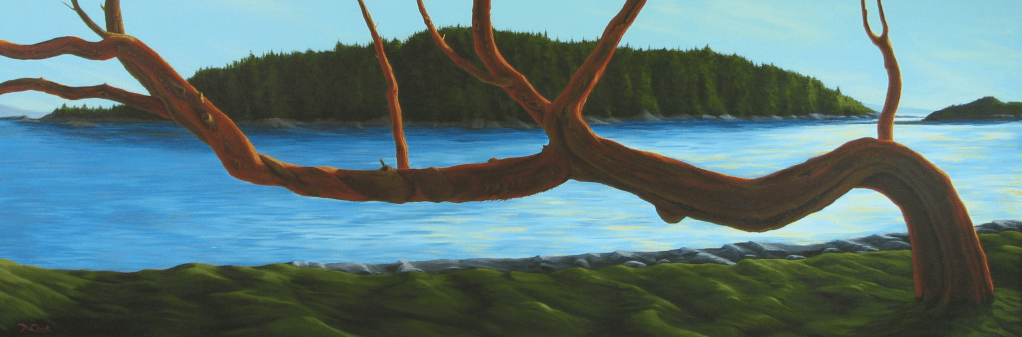
Slanting orange safely captured in meshing of the painter’s brush
Far away I shall reach in the wind taking flight over the painter’s brush that stops before completing length and strength of my body amicably mixing water and sky upheld by my arms perplexed eyes of visitors seeing peels of my skin strips of cinnamon bark revealing my new garment of greenish tanned epidermis taken for granted by lazy eyes under the sun’s benevolent heat