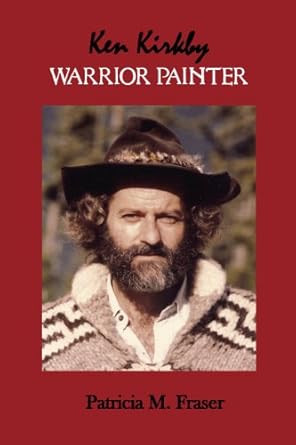
Ken Kirkby, Warrior Painter

excerpt

To have the warmth and companionship fade away now that he had time
to devote to her in the pursuit of her dreams seemed to be nothing short of
cruel. Whatever it took to appease Karen would be done.
~~
Now, in Bowser, Ken was faced with the sudden realisation that he had
been living life on autopilot. It was a severe jolt for the man who prided
himself on being attentive at all times to what was going on, both within
himself and in the world surrounding him. As a quicksilver dawn slipped
above the scattering of islands offshore, Ken made a fresh pot of coffee and
realized he’d made a breakthrough. It had been a long night coming to grips
with the situation. Self-awareness was a fundamental state of mind for him,
but as he replayed the recent years, he could identify countless occurrences
that had ultimately reduced him to this astonishing loss of control.
His elusive mind was stubborn in its refusal to follow an orderly chain
of thoughts, and he became aware that for months, perhaps even years,
his overloaded brain had taken refuge in the distractions provided by an
intelligent mind. No matter how vigorously he attempted to discipline it to
the process, it slid sideways into something less conflicting.
The act of thinking had become busy work, necessary in order to avoid
the bleak despair that filled him, most especially intensified when Karen had
withdrawn. But he now recognised it was an escape mechanism that needed
to be meticulously managed. For the first time in a long while, he was
looking with a clear eye at the core of his anguish rather than retreating from
it. Gradually he was being filled with certainty that, with this awakening, he
was exactly where he should be.
My real job now was to be painstaking in programming my healing,
much as I did in Portugal when my dad turned the problem of beating
my recurring childhood illness over to me.
Ken was frequently ill in his early years. Although no medical expense
was spared, the ailment remained unnamed. He had grown weaker, thinner
and yet more tired following relocation from Britain to Spain. However,
in his mother’s Spanish culture, weakness—whether physical or mental—
was never to be acknowledged. It was only after the family rejoined Ken’s
dad in Parede, Portugal that the six-year-old was permitted to articulate…

https://www.amazon.com/dp/B00CB8W4CG

https://draft2digital.com/book/3562902

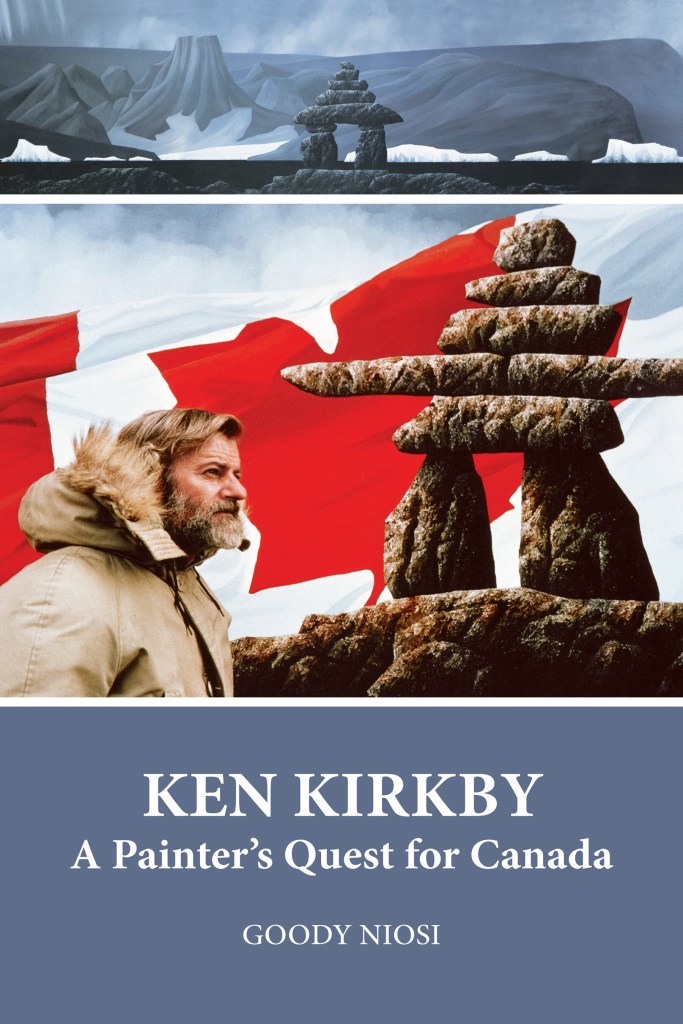
Ken Kirkby, A Painter’s Quest for Canada

excerpt

The day before the exhibit, he helped hang the paintings;
only one in each room of the gallery. Opening night resembled a Hollywood
premier. People gathered in the street and, when a chauffeur
driven limousine drew up to the curb, the media descended. Ken parted
the crowd and opened the door, guiding the Duchess into the gallery. The
crowd inside fell back as though God himself had made an entrance.
Ken led her through the rooms, telling the stories of the Canadian
North. She nodded, smiled, listened attentively, and left as quickly as she
had come. Forty-five minutes later every painting wore a sold sticker.
Ken extended his stay, in order to accept all the invitations he was besieged
with. He had been in Madrid for six weeks, when his father called.
“You must come home right away.”
“What happened?”
“Just, come home immediately. It looks like the trust company has
gone under.”
He flew home the next day and took a cab directly to his father’s apartment,
where he found him more agitated than Ken had ever known him
to be. “This is real trouble,” he said. “We tried to get into the office and it’s
locked – the locks have been changed and nobody is there.”
In his own office, he discovered several key files missing. He arranged
a meeting with other clients of the trust company. There were rumours.
Some said the company principal had moved to the Fraser Valley, where
he had set up an Arabian horse farm and purchased a Rolls-Royce. Others
said he had simply vanished without a trace.
Ken called the RCMP commercial crime division and drove to the station
with his father. The officer explained that the department was aware
of the issue. “It’s a complicated mess,” he said. “We’re going to have to
investigate you and your activities, the same as everyone else.”
The police found many of the missing files but not a trace of the company
president and CEO. Rumours continued to circulate. One claimed
that the head of the trust company had had nothing to do with the missing
funds. It was Ken Kirkby. He was crazy, and smart, and out of the
country when disaster struck. He was the one who had masterminded the
plot. The media ran with it and reporters parked their cars and vans in
front of his house waiting for one glimpse – to take just one picture with a
telephoto lens. Two professional hockey players, convinced that Ken had
taken their money, filed a lawsuit. The judge threw it out of court. Ken
threw himself into the investigation, working with the police day after
day to piece together what had happened.
The RCMP interviewed the victims of the fraud and examined the
documents. Sorting through his own papers became a full time job, and
there were many times he gave up all hope of making sense of them.
His greater despair was the loss of his friends.

https://www.amazon.com/dp/0981073573

Ken Kirkby, A Painter’s Quest for Canada

excerpt

While he studied, he periodically found himself distracted by the
thought of the one art gallery in Vancouver he had not approached with
his paintings – the Alex Fraser Gallery. Stories of Alex Fraser, and his
treatment of artists in his London and Vancouver galleries, had circulated
through the art community for years. Ken was angry with himself. He
was rarely afraid of anyone and had met no one in Canada yet who had
intimidated him. Alex Fraser’s reputation did.
He had heard that the man was irascible – so what? He had heard he
was powerful. Was it in his power to judge his work? What if he found it
wanting?
The only thing worse than his fear was the prospect of his disappointment
in himself if he refused to face it, so one day he screwed up his
courage, loaded his truck with paintings, and drove to 41st Avenue near
Boulevard in Kerrisdale.
He walked into the gallery, where an attractive middle-aged woman
asked if she could help him.
“Yes, I’m here to see Mr. Fraser if he’s about.”
“Mr. Fraser doesn’t see people without an appointment.”
“Oh, that’s a shame. I’m here and I have some paintings. Please, can
you ask if he’ll see me?”
She smiled and walked into a back room. A few minutes later, a small
man with slicked-back hair and icy, blue-green eyes walked out. He was
dressed in a perfectly fitted gray pinstriped suit, with knife pleats in the
trousers and shoes that shone like mirrors.
Exhaling a great puff of smoke, he lowered himself into a big armchair,
and placed two packages of Players unfiltered cigarettes and an ashtray
on the little gate-legged table beside it. Taking a fresh cigarette from one
of the packages, he lit it from the one in his yellowed fingers, and crushed
the stub in the ashtray.
Turning to the woman who had followed him out of the back room he
called, “Doreen! Doreen, I want you to tell the young man about manners.
Ask him does he understand the meaning of manners?”
“Mr. Fraser would like to know if you understand the meaning of manners,”
she said, turning to Ken.
“Indeed I do,” Ken said. “And I apologize for coming in without an appointment
but I was nervous and I managed to screw up all my courage
to come in – and here I am.”
“Doreen! Doreen, tell him he is quite right to be nervous in approaching
me. Ask him what it is that he wants.”
“I have some paintings and would like to show them to Mr. Fraser.”
“Tell the young man that I can’t bloody see his paintings, anywhere.
Where are his paintings?”

https://www.amazon.com/dp/0981073573

Ken Kirkby, A Painter’s Quest for Canada

Excerpt

Ken closed his eyes, his lids like coarse sandpaper scraping against
his eyeballs. Opening them was worse. The woman tied a piece of soft
hide over his eyes and all he could do was bear the agony and wait. For
days, he travelled as a blind man, in pain and nauseated from the gentle
rocking of the sleigh. When the pain eased, he took off the hide, and the
old woman gave him a pair of goggles with a small slit, explaining that he
would have to carve them to fit his face. He carved with great care so they
barely touched his skin. Close contact would freeze them to his pores.
They had been travelling a long time, when a golden glow appeared
on the horizon. As they drew nearer, the golden fire resolved into a large
group of igloos. The dogs heralded their approach, and people streamed
out of the igloos to welcome them. The first questions were about food.
The caribou had not crossed their path this season. Did the new people
have caribou? Yes, they had much caribou and it would be shared.
A feast was prepared for the newcomers, who entered the largest igloo
in the centre of the village. In the anteroom, they took off their parkas
and beat them vigorously before entering the main room, where layers of
caribou hides were spread on ice benches that circled the room. Kidney
shaped seal oil lamps provided warmth and light. When they had eaten
and told stories, people dispersed to their own igloos. Ken and his people
crawled under many layers of hides and slept. The old woman had told
the people that Ken was a quiet Kabluna. “He is a friend,” she had said.
“He is now Inuk.”
The next morning while the men built igloos, Ken pulled out his roll of
sketch paper and drew them, as they searched for the right sort of snow
by poking deep into it with a knife or a long sharpened piece of bone.
When they found the right spot, they drew a circle and began cutting out
uniform chunks of hard-packed snow, beginning at what would become
the entrance. They lifted the blocks into place, bevelling the edges, and
chinking the spaces between with loose snow.
Ken was invited to accompany the men on the next hunt. For the Inuit,
hunting is the essence of life. The animals must be revered and not offended.
Kablunat don’t understand this, the old woman told him, but Ken
was now Inuk – no longer a Kablunat. She convinced the hunters that
Ken was an exception. They set off onto the frozen sea that was covered
with a thin layer of transparent ice that moved in front of the sled teams
like a rubbery wave. Underneath them, thousands of air bubbles bounced
and rolled.
When they spotted a seal in the water beneath them they searched for
the beast’s breathing hole and waited. When the seal was forced up to
gasp for air one of the men heaved a long spear and the water stained
crimson.

https://www.amazon.com/dp/0981073573

Ken Kirkby, A Painter’s Quest for Canada

Excerpt

never been a connection between those people and the Inuit and yet here was
an original seminal idea being spoken by a woman in a completely different
time and space and place. All these things were like jolts hitting me. Here I
was living with an ancient people that were speaking to me directly. This was
not something being told to me by a teacher or a relative. I was getting the
original story and it affected me very profoundly.
When the old woman finished her story, silence enveloped the igloo like
a down blanket. Quietly, Ken stood and walked outside. The sky was filled
with as many stars as Ken’s mind was filled with thoughts. In one instant,
his life had changed. Knowingly or not, the old women had answered his
question about his role in this place, and in the lives of the Inuit.
She joined him, and he linked his arm through hers. Together they
stood gazing at the sky. Icy crystals of thought invaded his heart, while an
avalanche of ideas roared through his mind.
This was that crystal moment when everything that had happened before
made sense. I now had a clear purpose. I had gone to the Arctic because of
the stories that had been told to me in that cave in Portugal, but now, I felt
an urgency to gather as much information as possible – and to disseminate
it. It was clear to me how brilliantly I had been prepared. From this moment
on, I was no longer pursuing childhood dreams. I had a white-hot fire burning
inside me.
One day, the sun reappeared over the horizon and Ken felt as though
he was awakening from a dream. For a seemingly endless amount of time,
he had lived in darkness, listening to stories and legends, and the line between
waking and dreaming had blurred. And now the sun – a cause for
celebration – a reason for feasting!
Feasting also served to remind them of their great good fortune. They
had food, warmth, and clothing. Even more important, others had been
helped and they were grateful to have been able to help them. The young
man who had amputated his toes had survived, and that was even further
cause for thanksgiving.
As the days grew longer, the polar bears came out of hibernation. One
had been spotted nearby and men quickly prepared for the hunt. Once
again, grandmother prevailed upon the hunters to include Ken. When
the dogs picked up the scent they were released from their traces, and the
men followed their high-pitched howling.
When the dogs found their quarry they surrounded it, darting in close,
and then running back, staying out of reach of its lethal claws. Finally,
overheated and exhausted, the bear collapsed. The hunters fired at the
downed body until it lay still in a pool of blood, and then they began the
enormous task of skinning and butchering it. The oldest hunter stood
back. “In my day, that’s not how we hunted bears,” he said. “When we
hunted, it was one man with a spear and one bear with his claws.

https://www.amazon.com/dp/0981073573

Ken Kirkby, A Painter’s Quest for Canada

Excerpt

One day the dogs heralded the arrival of a new family. They staggered
into camp with barely enough dogs to pull the sleighs. The animals’ ribs
stood out through their fur, and they lay down exhausted, their eyes
glazed. The people had to be helped from their sleds. Inside the big igloo,
they explained that they had come from far away and had left most of
their people behind. They had not found caribou this season and had run
out of food. They had no seal oil for heat. They were dying.
One young man’s toes were badly frostbitten. The elders determined
that they would have to be removed to prevent gangrene, a common condition
in the North where blood circulation to the extremities slowed.
There was no hospital – not even a doctor. The old woman said she
would select the person to perform the operation, but the young man
said he would do it himself.
The old woman stopped Ken as he turned to leave. “No,” she said.
“Kabluna wants to go everywhere and experience everything. This is part
of everything.”
The young man honed a knife and with immense concentration and
deliberation, selected the correct place to amputate the toes. One by one,
he sawed through flesh, sinew, and bone. He did not complain, cry, or
moan, taking the same impassive, measured care that he would if he had
been skinning an animal.
It shocked me. How can someone do that in that way and not fall into
paroxysms of agony? And I knew I had something to learn. I had to investigate
what pain was and how it was dealt with. I knew these people were not
superhuman but their understanding of humanness was very different from
mine and it probably came from eons of living in that environment.
These things set me on a very different track in my own head. They led me
to deal with our concepts of possible/impossible, difficult/not difficult and
so on. Nature is neither good nor bad. Nature is neither kind nor unkind.
Nature simply is. Possible and impossible are things of the imagination –
just as the pain is in our imagination. And seeing as we don’t know enough
to make these judgments, we shouldn’t even consider worrying about them.
If there is something in you to be done that is powerful then you set about
doing it and you take out all the imaginings of the dark monsters you might
meet on the road ahead. They may, in fact, never materialize. These concepts
were the golden door through which I walked toward a completely different
understanding, an understanding that has made it much more difficult for
me to live in our culture.
A council was held to decide the fate of those who had been left behind
to starve to death. Four dog sleighs were loaded with food, blankets, and
other necessities, and when it seemed that Ken was to be left behind…

https://www.amazon.com/dp/0981073573

Ken Kirkby, A Painter’s Quest for Canada

Excerpt

The days and nights blended one into another, and long
periods of quiet contemplation were interspersed with intense bouts of
hunting. Ken learned to breathe differently. Taking in great gulps of the
frigid air would have burned his lungs, so he inhaled slowly and measurably
through his nostrils, calculating each breath.
One day another group of people arrived at their camp with several
dog teams. Among them was a boy in his early teens. He too had recently
come from a residential school and was sullen and spoke to no one.
The group brought word that the caribou had not come their way and
they were here to join Ken’s group and hopefully share in what they had.
Ken’s group agreed to travel together and to share their abundance. They
planned to move further east, to where they hoped to find enough seals
and walrus to provide meat for the long winter.
One day before setting out, the troubled youth was particularly disrespectful
to one of the elders and was quietly chastised. He walked away
from the camp and had gone only a short distance before several people
went in search of him. No one could survive long in this cold. The wind
began to howl picking up ice crystals and blowing them across the land
and the searchers hurried back to the tents. Within minutes the world
was white; taking even one step outside the tent was certain death.
They waited in silence and Ken found himself feeling both disconcerted
and exhilarated by their patience and lack of anxiety. He was unsettled
because he had lost all sense of reference and elated because each moment
was perfect. He was alive in the now and nothing else mattered. The
long hours of silence gave Ken only one point of focus – himself. He was
meeting himself for the first time and the self he was meeting was neither
good nor evil – he just was – and Ken embraced that self with his mind
and heart, quietly blessing every event that had led him on this journey
to this place.
The white storm lasted for several days and when it ended, the people
left their tents to resume the search. There was no sign of the dogs,
just small mounds of snow scattered around the tents. When the people
nudged the mounds, the dogs emerged from their igloos, shaking the
snow off and wagging their tails furiously. They untethered several of
them to assist in the search, and their acute sense of smell led them to
another mound of snow under which they found the frozen boy.
There was no crying or wailing. They wrapped him in caribou hide
and with great effort moved rocks, that the wind had swept bare, to form
an oval. Gently, they placed the boy in the oval, placing some of his possessions
with him. Then they walked away. They had eaten animals all
their lives; in death, they completed the circle and returned their bodies
to the beasts.

https://www.amazon.com/dp/0981073573

Ken Kirkby, A Painter’s Quest for Canada

Excerpt

On shore, Ken’s friend took out a sharp knife and slit open the belly of
one of the big fish exposing a white strip of pure fat. He peeled it off, put
the end in his mouth and cut it off with his ulu. He passed Ken a piece of
the precious fat that melted deliciously on one’s tongue.
Ken became mesmerized by the minutiae of Inuit life. Everything they
did was alien to his previous experience. He watched one of the men
make a drum from the hide of a young caribou. Only the skin of a young
animal would do, the man explained. It was shaved clean, soaked with
water and spread out in the hot sun where it bleached white. It was then
stretched over several pieces of wood that had also been soaked, bent to
make a circle and bound together with strips of leather. The skin was
sewn on to the hoop and left out in the sun again, this time to shrink.
Watching the process, Ken understood how important each piece of
wood was to these people. Where he came from people would have used
just one piece of wood to form the hoop. Here, the circle was made of
many small pieces of wood. Trees didn’t grow on the tundra. There might
be the occasional knee-high shrub and very rarely, willows that grew waist
high in protected gullies. Every scrap of wood was hoarded and used with
care and precision.
The Inuit had to obtain additional wood from the south where the
sub-Arctic Indians lived. The old woman told Ken that there had been
an uneasy truce between the Indians and the Inuit, which was often not
honoured. Raids and massacres had taken place for years.
When the woman told stories through her son, she often said words
that she asked Ken to repeat. When he learned a new Inuktitut word, she
smiled and when he began to put words together to form a sentence, she
beamed. It was the most difficult language he had ever learned, but then
the people were like no others he had ever encountered. They didn’t make
eye contact when they spoke and they had no word for me, mine or I.
Raising your voice, particularly to children, was taboo. Children were
expected to learn by the example others set. They ate when they were hungry,
slept when they were tired, and played when they wanted to. Adult
displeasure was shown in the smallest facial expressions – the wrinkling
of a nose or a slightly raised eyebrow.
One day a young man named John joined the camp. He was about
sixteen years old and he spoke excellent English. He told Ken that he was
on holiday from the residential school in the south but he had decided
not to return. They had cut off his hair and had beaten him for speaking
his language. The old woman was his grandmother, and John told Ken
that she and others were trying to get their children back. But this was not
easy. While they needed to be stationary so that they could be contacted,
they also needed to keep moving …

https://www.amazon.com/dp/0981073573

Ken Kirkby, A Painter’s Quest for Canada

Excerpt

“Grab a coffee and shut the door,” the manager said. When he was sure
no one could hear, he said, “I’ll hire you.”
“Sure,” Ken said. “That’s fine, but let’s sort this out first. I’ll keep your
offer as an ace in the hole.”
Later that day a small plane landed at the airstrip, disgorging the owner
of the company and his entourage, who commandeered an office and
closed the door. Ken slammed the door open and strode into the room.
One man jumped to his feet and tried to usher Ken out. “No,” he said,
shaking the man off. “If this is about me, I’m going to have my say. You
don’t hire an engineer. You don’t have one on the job, but you expect the
job to get done. I’ve learned how to do it. I’m doing it and what’s more,
ask yourself, is there any single thing wrong in the information provided?
Show me one thing that is incorrect – just one! I know you can’t. The
other question I have, is why am I doing the job of four to five men and
getting paid for one? I’m glad I’m fired. It feels good. Have a nice time!”
Ken slammed out of the room, as boldly as he had entered, got in the
truck, and drove back to Jessica’s house. He was nearing the gate when
he spotted the camp manager in his rear view mirror. Ken stopped and
waited for him to pull alongside.
“Are you fired?” he asked.
“I haven’t a damned clue and I don’t care. I’m having a good time.”
“Let me know immediately,” he said. “I’ll get you on the payroll right
away.”
“How much?” Ken asked.
“What are you making now?”
“That’s got nothing to do with it.”
“Well what do you want?”
“When I know what I want I’ll tell you. Right now I don’t want anything.”
Late that evening John came to the log house with the news that the
entire issue had been smoothed over. He had told the owner that he was
the one who had taught Ken how to use a slide rule, and that everything
had been done correctly. They had screwed up in head office, not Ken.
The camp manager had also spoken on his behalf. In fact, John said, it
was a lovefest. “Everyone’s in love with you. And the owner of the company
looks like a dummy. Of course, he’s not – he’s a smart guy but he had
no idea what was going on. He has a lot of other companies to look after.
But this is a big project with a lot of contracts. No one wants to look like
an idiot. But, everybody’s happy now!”
“Well, isn’t that wonderful!” Ken said. “I’m not happy!”
“But it’s okay – you’re supposed to come back,” John said.
“I’m not going anywhere,” Ken said. “I’ve been fired.”
“So what do we do?”

https://www.amazon.com/dp/0981073573

Ken Kirkby, A Painter’s Quest for Canada

Excerpt

The bush pilot told Ken that there was no such place as the Arctic – it
was an arbitrary dotted line drawn on a map, by people who had never
been there. The Arctic was a hundred thousand million places, he said,
with an enormous variety of climates and vast distances between small
communities. You might find a few people on the land, he said, but not
many. Most of them had been rounded up and put into camps built like
villages. The idea of the Eskimo as one homogenous group of people was
as big a myth as to say that all Europeans were one race.
Nevertheless, the government had decided that the Eskimos had to be
gathered together – regardless of tribe or dialect – and placed in communities,
which they would use as a base to go out and trap fur animals
for the Hudson’s Bay Company. Then they depended on the company for
their survival and were, in fact, essentially owned by it. Each Eskimo had
been given a number and a letter. Those west of Coppermine River were
assigned the letter W and a number. Those East of the area were given an
E and a number, and in some cases, those letters and numbers were tattooed
on their arms.
Ken was horrified. He repeated to Jessica, Patrick, and Long John what
the pilot had told him. John was furious, not at the government, but at
Ken and his wild dreams. “You’re on a wild goose chase! You’re mad!” he
shouted. “There’s nothing to go to – thousands of square miles of absolutely
nothing but ice, wind, and rocks – lots of frozen rocks and no
people. I tell you, there are no people there. The place is a bloody, frozen
desert. You’re made of flesh and blood – you’re not a god! What is it with
you English and your half-baked need to go to desolate places? As if life
isn’t difficult enough without going looking for trouble!”
“For someone who’s never been to the Arctic you seem to have a helluva
lot of knowledge about it,” Ken said. “How do you know there’s nothing
there?”
“I don’t need to go there,” John said. “I can read. There’s a place called
“The Barrens” and I imagine it’s called that for a good reason, don’t you
think?” John pulled out a map and pointed to the place. “Read it – it’s
right there. The Barrens – there’s nothing there. When he first looked at
the place, one of the explorers wrote in his diary, ‘This is the place that
God gave to Cain’. All I can see is that the place is going to kill you – not
much different from every other Englishman who’s gone up there. I can
see a small headline in some small newspaper somewhere, ‘The Arctic
wastes claim another Englishman.’”
“It didn’t kill Francisco,” Ken argued.

https://www.amazon.com/dp/0981073573