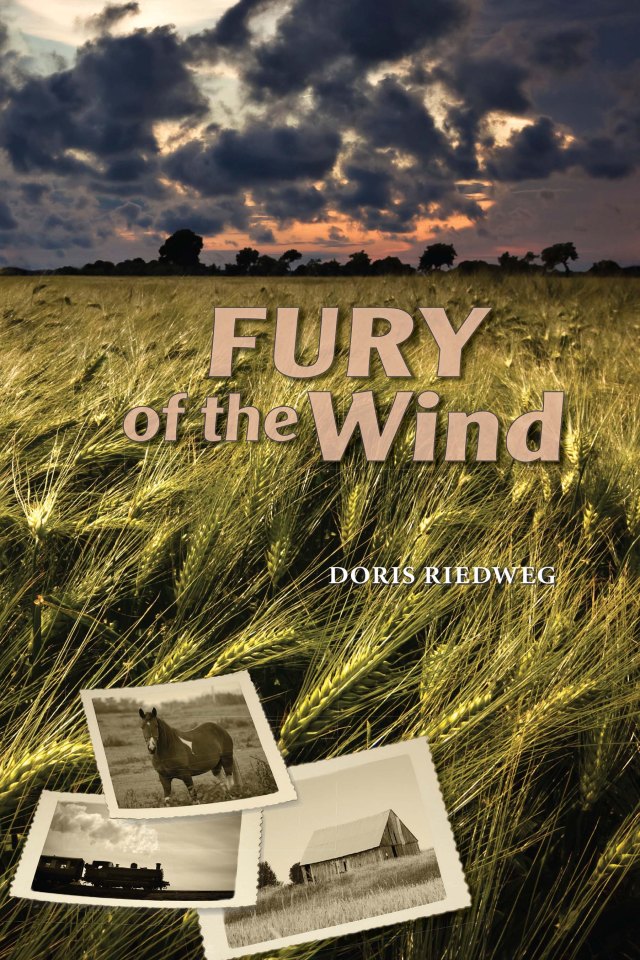

Fury of the Wind

excerpt

Sarah smiled. “Oh surely, Ben, they wouldn’t ban movies in Nimkus
because they thought they were sinful. I think you’re exaggerating.”
“Yeah? Well, you don’t know them yet, do you?”
She shrugged and got up to clear the table. “Can we go to a movie
in Bradshaw sometime, Ben?”
“Maybe. We’ll see.” He got up to fill his pipe.
She could hardly wait until he went back to work. Finishing up
the dishes quickly, she shoved her feet into a pair of old runners and
went to find him.
In the yard, almost bare of vegetation between the house and the
horse stable, the dust swirled and danced in the incessant wind.
What few patches of grass remained were being uprooted by the
chickens that scratched happily in the earth all day long. She paused
for a moment when she passed the chicken house, a building as
dilapidated as the others around it. There had once been some sort
of wire mesh fence to contain the fowl, but it had long since rusted
and fallen apart. Now the chickens had free range of the yard. No
wonder the coyotes came so close to the house, especially with no
dog to run them off.
A grey tabby cat, sunning itself in front of the cow stable, looked
up at Sarah’s approach then skittered through the door which hung
on one hinge. Inside the stable a calf bawled, but she resisted the
urge to go in to see it. She wanted to find Ben before he got too far
away.
She found him behind the buildings, hitching an old tractor to
a sickle mower. She stood and watched for a few minutes before he
glanced up and saw her.
Sarah shouted above the roar of the motor, “I’d like to see Flicka.
Can you tell me where she is?”
“I haven’t time to be bothered now. I want to start cutting hay
over yonder.” He nodded towards what Dave McNeill had called
the north pasture.
“I don’t want to take you from your work, Ben. If you’ll tell me
where she is, I’ll find her.”
“Over there in the field.”
She followed his gaze to where three horses were standing near a
small dry slough bed in the shade of a stand of poplar trees.

https://www.amazon.com/dp/0981073530

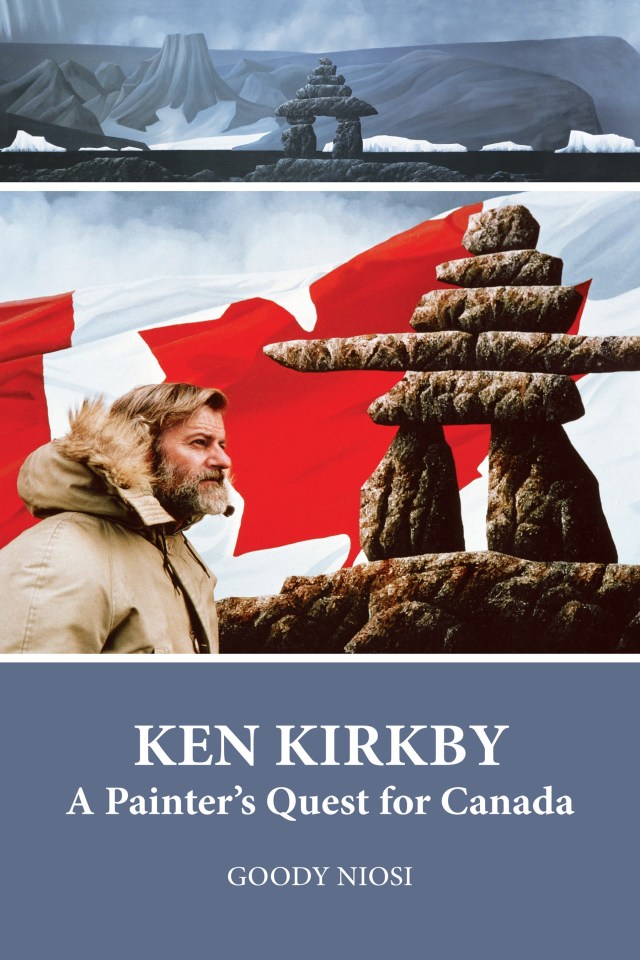
Ken Kirkby, A Painter’s Quest for Canada

excerpt

“Do you like it there?”
“No. It’s not where my heart wants to be but it is where I have to be.”
“I was in Toronto once. I married Hilu’s father and he was from Ottawa,
so I’ve been to Ottawa too.”
“What happened?”
“I don’t know how you people can live in a place like that. It’s soulless.
It’s like people living in caves up in the air. It’s just not human. How is it
that someone who isn’t born here, who doesn’t live here, and only spent a
few years here, can love this place and these people so much?”
“I don’t know,” Ken said. “I don’t know how that happened. We can
have a lot of ideas and we can say a lot of things, but the reality is that we
don’t know these things. We don’t know the first thing about love – we
haven’t a clue. We have all sorts of feelings and all sorts of passions. We
call it love and hate, but that’s just a lazy way of expressing something
we know nothing about. I think love is something that is lived. It doesn’t
have very much to do with the other person although we focus the idea
on one person. I think it’s a life lived in a particular way. It encompasses
all the things that are in that life and it depends on how that life is lived,
whether the invitation to love will be heard and accepted. I don’t think
there is any language, including Inuktitut, that truly expresses what that’s
all about. The only conclusion I can come to is the one I’ve given you.”
Joan let a long silence hang between them. Ken finally asked her again,
how she knew this was the place where he had witnessed so much death.
“It’s not just you knowing,” he said. “There’s something more concrete to
it. This is a specific place where a specific thing happened.”
“I know this is the place because my mother knew these people and
knows their story and she knows about you,” Joan said. “This was the
time of my grandmother, and my grandmother knew you. My grandmother
found you very interesting. They called you the quiet Kabluna
– the mysterious white man who had the capacity of silence. That’s how
I know about you.”
“Would it be possible to visit them in Baker Lake?” Ken asked.
“Yes.”
“Could we visit now?”
“They’re away.”
“Away?”
“Visiting.”
“Family and friends?”
“Yes – very far away.”
“So we can’t go and see them?”
“No.”

https://draft2digital.com/book/3562830

https://www.amazon.com/dp/0981073573

Ken Kirkby – Warrior Painter

excerpt

I took my rowboat and paddled out from shore to start the process of
familiarization. I observed the mouth of the creeks, the curve of the
beaches, the blend of driftwood and rock, the colour of the sky. I met
people with aircraft and begged rides off them. And, do you know?
This vast island is totally different than you might think. At one time the
bulk of the land between the seashore and the mountains was actively
farmed. The climate was favourable, and after clearing, the land was
fertile.
If you walk through it—there are still roads in the process of being
reclaimed by nature—you’d be amazed at how much of it had been
cultivated. Some of the parcels were very large, others just enough
to maintain a family or two. Then along came the Boer War, which
consumed a bunch of the young men, and then World Wars I & II
finished the job. Without the next generation to continue what had been
started, the forest grew back, roofs caved in, machinery rusted.
Once I got the feel of it, I decided I’d try to tell the story of this part
of the country—not the history, not the ‘big’ story, but the sense I had
of the size and shape of the island. The wind wracked trees and snowcrusted
mountains stirred my blood. And I found I was once again a
painter.
By the end of 2002, Ken was producing paintings to his satisfaction
and was pleased to find the attitude of the island galleries more amenable
than he’d experienced when he first returned to Vancouver. He came across
galleries dealing in second-market sales where a Kirkby oil of a solitary
Inukshuk standing proud on the tundra, or a parade of Inuksuit backed with
Arctic snows would be on display. He’d introduce himself and was pleased
to see that his name was recognised. He’d tell them that he was now in
business on the west coast. Might they be interested in fresh pieces?
The reaction was always positive. But when he laid out his canvases of
coppery grasses, water-worn granite boulders, wind-bowed trees or perhaps
a lonely lighthouse blinking eerily behind a rising ocean fog, he was met
with consternation.
“What’s this? Where are the icebergs? The Inuksuit? We can’t sell
these. That’s not you.”

https://draft2digital.com/book/3562902

https://www.amazon.com/dp/B00CB8W4CG

Ken Kirkby, A Painter’s Quest for Canada

excerpt

Keith nodded. “Well, that’s something I want to talk to you about. I can
help you and I want you to help me.” His room bookings for the following
year, when the lodge would be completed, were with Americans and
a handful of Europeans – not a single Canadian on the reservation list.
“You seem to have a great capacity for publicity and getting media attention,
and I’d like you to help me. In return, you can come and stay here,
have the use of airplanes – anything you want. But I need you to help me
to get people to come.”
Ken thought about the problem and suggested a slide show in his studio
with multiple projectors. He enlisted the help of Avril and Roberto;
they commandeered Tergey, the young Norwegian pilot who worked for
the lodge.
As Keith had predicted it wasn’t long before they heard the sound of
an approaching float plane that glided to a landing on the lake. It pulled
up to the dock and two men stepped out. They shook hands and asked
Ken what he was doing at the lodge. “Fishing with my son,” he said, and
excused himself, explaining that it had been a long trip and they were
tired.
They crawled into their sleeping bags, pulled caribou hides over them,
and drifted blissfully off to sleep. Too soon, a hand shaking his arm woke
him. “There’s someone I want you to meet,” Keith said.
Joan Scottie, a reserved and beautiful Inuk woman, had been born
about two miles down Ferguson Lake. “Joan has been a friend for years,”
Keith said. “She’s here to help us finish building the lodge. She is the most
capable human being you will ever encounter. There isn’t anything she
can’t do. She was born in an igloo and is a computer expert. She is also
the finest hunter and fisher you will ever meet.”
Joan was also a photography buff. She took Ken to her hut near Keith’s
home and showed him a collection of photographs. Her Scot and Inuk,
father, Basil Scottie, who was almost totally deaf and dumb, glared fiercely
at the camera. Another photo showed her family, two men, and seven
women, standing formally in a row, dressed in bleached white hides with
intricate designs.
“I think I have been where these pictures were taken,” Ken said, studying
them. “But I can’t be sure.”
“Yes,” she said. “They were taken near here and you were there.”
“How do you know?”
“I heard.”
“Who told you?”
“Old folks.”
“I had an incredible experience – a horrible experience that never left
me. It was somewhere in this region – a lot of people died.”
“Yes, I know.”

https://draft2digital.com/book/3562830

https://www.amazon.com/dp/0981073573

Water in the Wilderness

excerpt

“Coffee, soup and ham sandwiches,” she announced as she laid the tray down on the table in front of them. She handed a paper napkin and a bowl of soup to Tyne. “Now eat. I don’t plan to take any of this back to the cafeteria.”
Tyne grinned at her aunt, and told herself she would do her best to comply.
Their lunch finished, they waited for Moe to come from the ward to tell them they could go in again. When Tyne looked at her watch, she realized that little more than an hour had passed. Then suddenly Moe, in her crisp white uniform, appeared at the door.
“Okay kiddo, you can see Bobby again. He’s rousing, and his vital signs are stabilizing.”
Tyne jumped to her feet and turned to her aunt. But Millie shook her head. “You go ahead, Tyne. I’ll see him tomorrow. He doesn’t know me well, and he doesn’t need to see a strange face staring at him when he wakes up. And take your time, dear. I’m fine here.”
Tyne reached down to pat Aunt Millie’s hand before she followed Moe through the door and towards the childrens’ ward.
“How about Ronald? Has he settled? He was upset when I saw him.”
Moe opened the door and motioned Tyne to go ahead of her. “He had a sleep, and he ate something when he woke up. He’s going to be all right … except for the frostbitten parts. Those are still a question mark, I’m afraid.”
Tyne stepped through the door, but stopped when she saw Dr. Bryce Baldwin speaking to a white-clad nun near Bobby’s bed. Moe left her side and walked towards them, and the three of them conversed for several minutes. The sister was making notes on a chart – Bobby’s chart, presumably. Then she turned her head slightly in Tyne’s direction. Dark lively eyes below her wimple highlighted a pretty face as she spoke to the two people with whom she consulted. Moe said something, and nodded in Tyne’s direction. The sister turned towards her, a smile lighting her eyes. She handed the chart to Moe and started towards the door where Tyne stood.

https://draft2digital.com/book/3562884

https://www.amazon.com/dp/192676319X

Ken Kirkby, A Painter’s Quest for Canada

excerpt

“I mean no disrespect, whatsoever,” Ken said. “I know the symbol well.
But that is the wall.”
Albert exchanged a few words with Leon and then nodded. The painting
would go on that wall. Then Ken and Leon tackled the problem of
hanging the massive painting on a marble wall. The maintenance staff
concluded they would have to drill into the ceiling beams and suspend
the painting from thin stainless steel wires.
They hung the painting after business hours. Ken invited the media.
He had the panels delivered to the lobby where he bolted them together.
Salvador and his staff came along to help. Many members of the young
professionals group also arrived on the scene. The media asked how much
the painting had sold for. “No comment,” Ken said.
“Was it a lot of money?”
“No comment.”
“How did you contact Mr. Reichmann?”
“No comment.”
“You’re an artist,” one of them said. “How do you know how to do
all these other things? Artists don’t know how to be entrepreneurs. Who
helps you?”
“That’s a big question,” Ken said. “It’s a spiritual matter. I don’t wish
to discuss it.”
“What do you mean it’s a spiritual matter?”
“Just that. I get my knowledge, inspiration, and advice from a higher
authority and beyond that, I don’t want to discuss it. But, I will say one
thing – my advisor is Mr. Albert Reichmann.”
“Yes,” Albert said, when a reporter asked. “I am honoured to be Mr.
Kirkby’s advisor. He is doing wonderful work.”
Those few words gave Ken the credibility he’d been looking for. He had
achieved what his father had always had – the power to command respect
and attention wherever he went.
Later that night, when he was one of the last to leave, he paused to look
at the painting that he had envisioned hanging in that space so many
times. It looked exactly as he had imagined. It was in perfect proportion
to the immense lobby. It wasn’t until one walked closer to it that one felt
the full impact of its size.
His greatest debt was to Salvador, who had arranged the meeting, but
when he told him that he wanted to give him several paintings, he refused.
Ken painted several canvases regardless and delivered them to his home.
Before getting back to the task of Isumataq, Ken returned to the Arctic.
Keith Sharp, the burly Englishman, had moved to a parcel of land near
Rankin Inlet and extended an invitation. Ken included Michael as well as
Avril the photographer, and Roberto and Egidio, the filmmakers, in his
entourage; in mid-July, the somewhat motley crew – loaded down with…

https://draft2digital.com/book/3562830

https://www.amazon.com/dp/0981073573

Ken Kirkby – Warrior Painter

excerpt

is this illusion…you and I can go for a walk wherever you choose and
I challenge you to show me where money grows. It is a man-made
convenience, but we have turned it into God and the almighty banks
into the churches.
Money in itself is a nonentity, a paper mirage. But if you understand
how it functions you realise currency can be artificially created—
MasterCard and Visa are good examples. It no longer needs to be
printed by the Mint. I wish people would realise it is only a tool, to be
used like any other implement, and no more mysterious.
As the two men worked, Harris proposed assorted schemes to make money.
These were discussed, dissected and for one reason or another, discarded
at the end of the workday. Perhaps, like crossword puzzles or Sudoku, they
served to keep the workers’ mental juices flowing.
~~
Ken Kirkby is a particularly fine cook and, having been raised in
Francisco’s kitchen, can turn the simplest ingredients into a dish to be
savoured and praised. As his circle of friends expanded, he resurrected his
long-dormant culinary skills.
Portuguese meals would not be complete without a bottle of fullbodied
red or crisp white on the table. When Ken left Portugal, he had been
selective as to what he took with him, but one of his prized possessions
then and now, is the family wine recipe dating back several centuries. He
continually has a batch on the go although he is a moderate drinker himself.
It was likely a day or so after a well-spiced supper of clams, shrimp and
prawns cooked in Kirkby’s special fish stock prepared from flounder, too
small in themselves to eat. While spreading topsoil for the eventual seeding
of the lawn, Harris says, “You know, Kenny, that’s a damn fine wine you
make. You could probably make a pile of money if you set yourself up to
produce and sell it.”
“Probably,” says Kirkby.
Harris does some mental calculations. “How much do you think you
could make?”
“Money, or wine?” Kirkby quips.
“You’ve got a few racks there—how much do you usually make?”

https://draft2digital.com/book/3562902

https://www.amazon.com/dp/B00CB8W4CG

Ken Kirkby, A Painter’s Quest for Canada

excerpt

A short while later, a tall man came to the kitchen door. Salvador
greeted him and the two men talked quietly together for a few minutes.
Then Salvador pointed, and Ken heard him say, “This is the man I told
you about. He is the man who has been sent.”
Albert waved Ken toward him. “If you’ve been sent, you’d better come in.”
Ken shook his hand and entered the kitchen.
“Who sent you?” Albert asked.
“It isn’t a who; it’s a what. An idea sent me and the idea starts with
one human being asking another human being for one hour of his life to
listen to a story, and the story is of a man you may have some familiarity
with. His name is Lorenzo de Medici. Are you familiar with him?”
“Yes I am.”
“I want one hour of your life.”
Albert sat at the kitchen table, quiet and composed. Even his eyes were
still. His hands rested motionlessly on the tabletop, his fingers curled
comfortably inward.
Ken sat, took off his watch, and placed it on the table where he could
see the time ticking away. He told Albert his understanding of Lorenzo
de Medici’s life. He drifted away on his words, just as he had when he had
made his speech at the Columbus Centre. He lost himself in the intensity
of the moment – rushing down the white water of ideas like a kayaker
tumbling down a raging river.
“There are parts of that story I wasn’t familiar with,” Albert said, when
Ken had finished. “Where did you get your information?”
He told Albert about his birthday trip to Florence to see the statue of
David and how on another birthday his father had given him a beautifully
bound book of Michelangelo’s letters to Popes, kings and princes.
The letters, he told him, described his relationship to the Medicis in his
own words.
“So you are an artist?”
“I am a painter. Michelangelo was a sculptor who was made to paint.
I am a politician who is made to paint. I have a job to do, and I have a
mission to carry out that has to do with the people of the Arctic and the
soul of a nation. We in Canada wander around very confused as to our
identity. Our subjects of conversation are the weather, Quebec, and our
identity. I have found the soul of this nation, and in the process, I found
many wonderful stories and many wonderful symbols. At the same time,
I discovered hell on earth – hell is what is happening to those people. I
have been asked by the grandmothers to please tell the world about this.
The first thing I want to do is tell you about it.”
“Why would you want to tell me about it?”
“In Michelangelo’s time there were Popes, queens, and princes. There
were people who could sponsor great ideas.

https://draft2digital.com/book/3562830

https://www.amazon.com/dp/0981073573

Still Waters

excerpt

“I don’t feel comfortable talking to Mrs. Shaughnessy. I think she
pushed Curly into doing something she didn’t want to do.”
Nevertheless, the two nurses took the bus to the Shaughnessy
home on Saturday afternoon. Curly’s mother greeted them at the
door and ushered them into the sitting room.
“You both look wonderful,” she said as they made themselves
comfortable on the sofa across from her. “And Maureen, it’s so nice
to see you again. Where have you been hiding?”
Moe cast her eyes down and fidgeted with the crease in her slacks.
“I haven’t been hiding, Mrs. Shaughnessy. I just haven’t felt comfortable
coming around to see you.”
Tyne glanced at their hostess and saw her eyes open wide. “Why
ever not?”
Tyne held her breath as she felt her cheeks grow warm with embarrassment.
What did Moe intend to say next? Maybe they should
not have come. Oh God, don’t let her make a scene.
Moe leaned slightly forward. “I’m sorry to say this, and forgive me
if I’m wrong, but I thought you held it against us for what happened
to Curl … Carol Ann.”
The shock on Mrs. Shaughnessy’s face was evident. For a moment
she stared at Moe, then she seemed to struggle to find her voice. “Oh,
my dear girl, I did not hold anything against you … either one of you.
Why should I? Carol Ann acted on her own, I knew that.”
She looked down, fumbled for a handkerchief from her sleeve and
brought it to her suddenly moist eyes. “I’m sorry if I treated you
badly. I was embarrassed and ashamed. Such a thing had never happened
in our family, and it was so dreadful in the eyes of the church.”
She looked up, and Tyne saw that her lips were trembling. “Please
forgive me for the way I acted. You were always such good friends to
Carol Ann.”
Tyne felt helpless in her compassion for the woman. She wanted
to go to her and hug her, but she didn’t know how the older woman
would react to such a display of emotion. Moe, however, had no
such inhibitions. To Tyne’s surprise, she rose from the sofa and, going
quickly to Curly’s mother, bent down and enveloped her in a full
embrace. They clung together while Tyne watched through her tears.
She dried her eyes and squeezed Moe’s hand as her friend resumed
her seat. She hoped Moe knew how grateful she felt.

https://www.amazon.com/dp/1926763068

Prairie Roots

excerpt

…watched her eat all the things that “were good for us”. Thank
goodness he liked perohy or we may not have acquired the fondness
for them that we did.
In fact, every Friday morning was perohy-making time, since,
as Ukrainian Catholics, we observed the meatless Friday rule.We
were roped into the perohy-making assembly line whenever we
were home from school. It was usually fun, invariably initiated
one or two squabbles about who was or was not doing how much
of what, but also included listening to Mom telling a story or singing
us songs. When she ladled those delicious little creations out
of the hot water into the cooling pot and then onto our platters,
and covered them with melted butter and crisply fried onions, a
morning’s work was known to disappear in short minutes! They
were so good!
I certainly well remember mother’s songs and stories that she
had brought with her from “the old country”. As she worked
away in the kitchen she forever sang those wonderfully sad
Ukrainian soul songs or told us stories of her early life. So many
times the tears would gather in her eyes and we would feel sad
with her, not really knowing what had made her sad in the first
instance. We must have been a comfort to her though, she being
so far from her family and almost certain that she would not see
any of them again. She at least had us to occupy herself with, leaving
her precious little time for self-pity.
I also recall the concerned exchanges between my parents as
World War II ravaged their birth areas and then as communism under
Stalin’s fist tightened its’ vicious grip throughout eastern Europe,
I wonder now what conflicting thoughts they had to endure. Their
life was not easy; however, what little news came through, devastating
as it must have been, would certainly have made them feel
thankful for getting away from that tormented region.

https://draft2digital.com/book/3562900

https://www.amazon.com/dp/0980897920