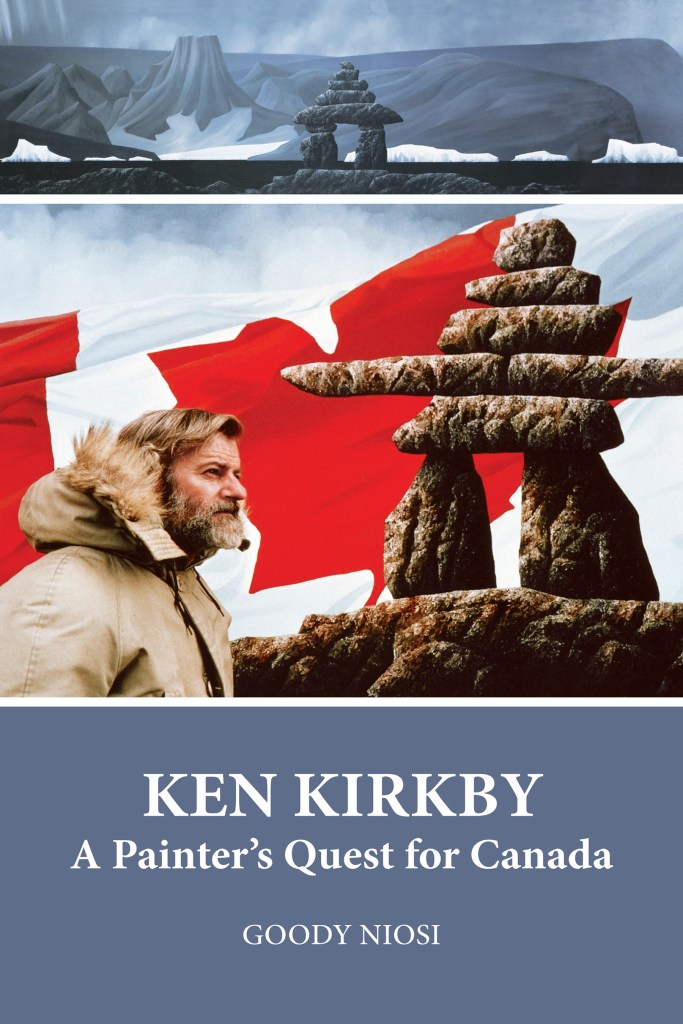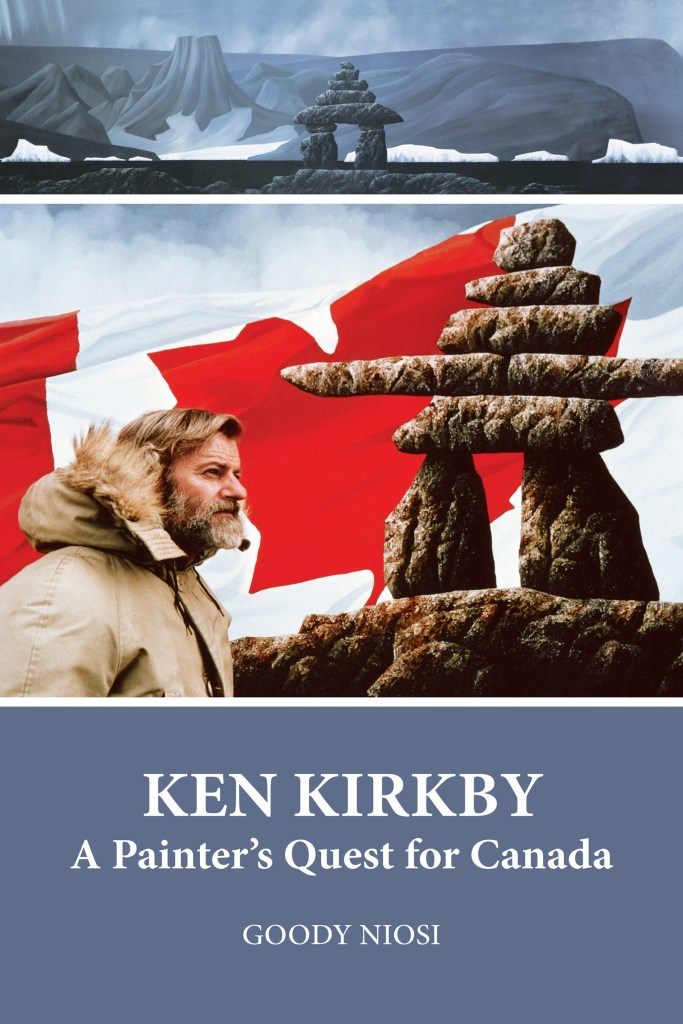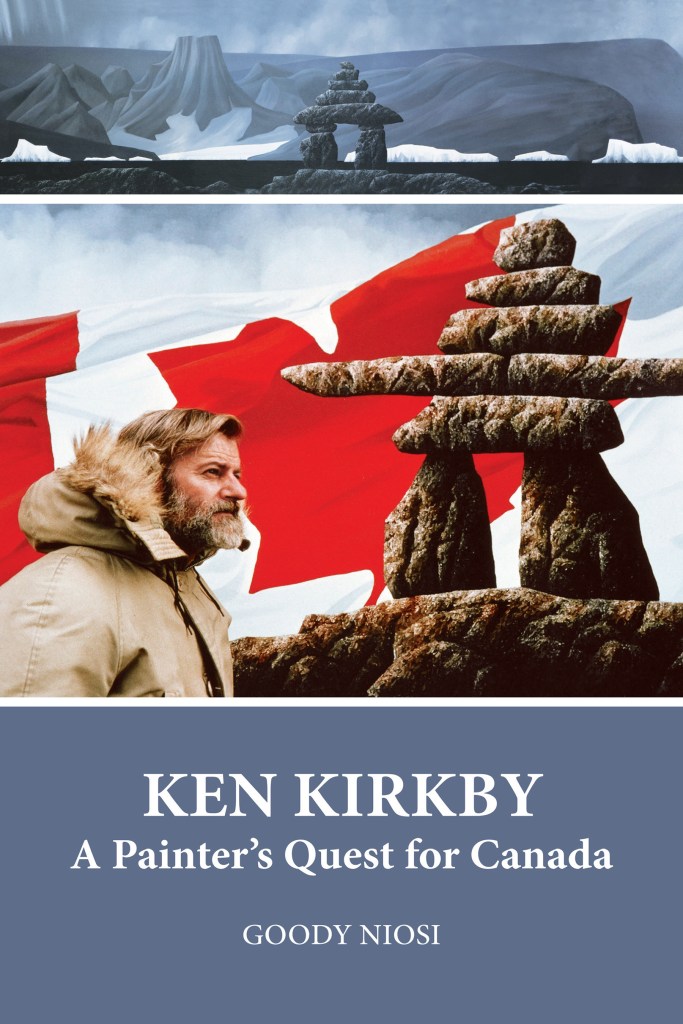
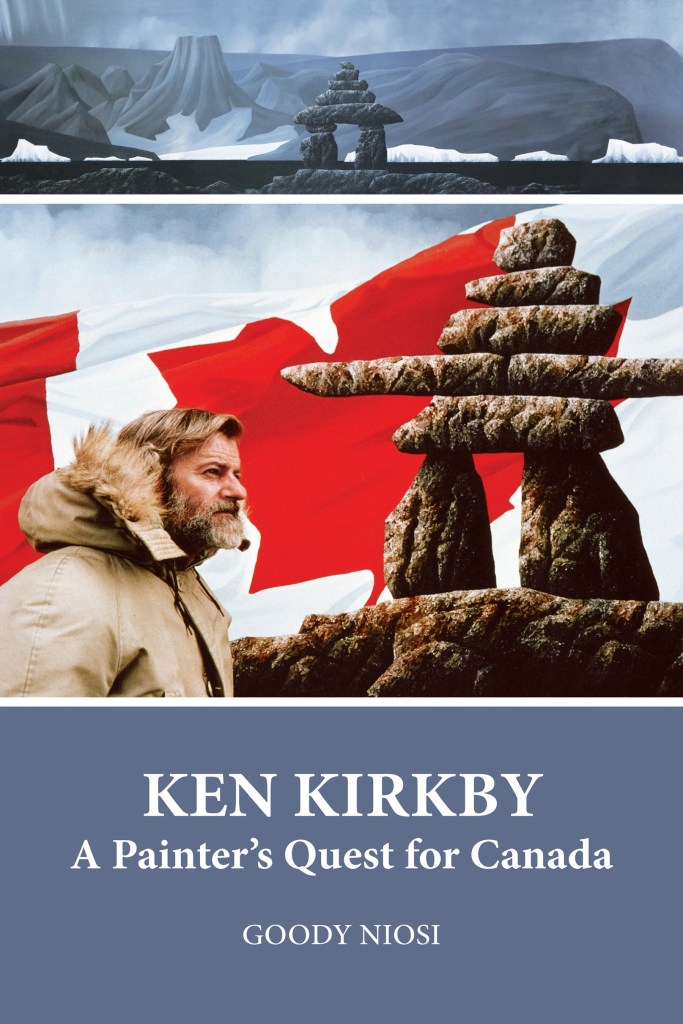
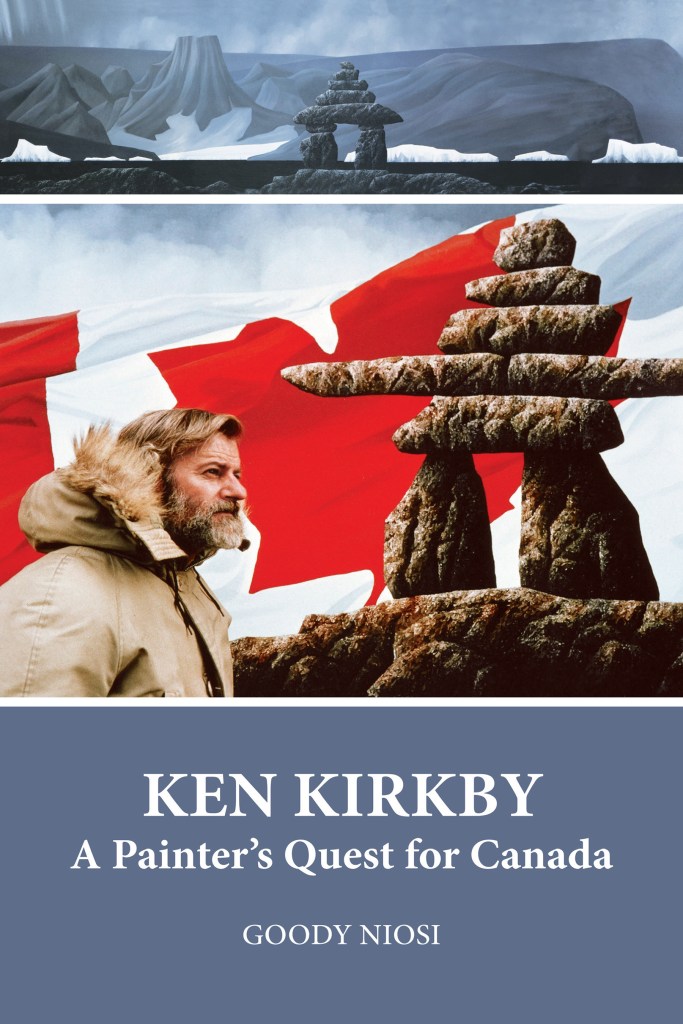
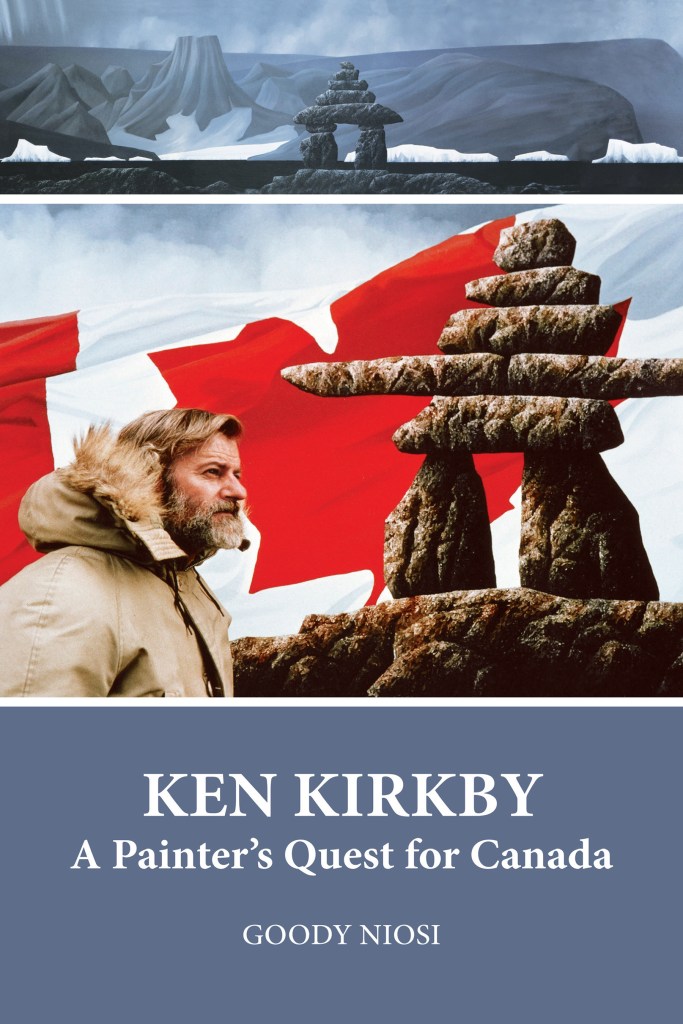
Ken Kirkby, A Painter’s Quest for Canada

Excerpt

never been a connection between those people and the Inuit and yet here was
an original seminal idea being spoken by a woman in a completely different
time and space and place. All these things were like jolts hitting me. Here I
was living with an ancient people that were speaking to me directly. This was
not something being told to me by a teacher or a relative. I was getting the
original story and it affected me very profoundly.
When the old woman finished her story, silence enveloped the igloo like
a down blanket. Quietly, Ken stood and walked outside. The sky was filled
with as many stars as Ken’s mind was filled with thoughts. In one instant,
his life had changed. Knowingly or not, the old women had answered his
question about his role in this place, and in the lives of the Inuit.
She joined him, and he linked his arm through hers. Together they
stood gazing at the sky. Icy crystals of thought invaded his heart, while an
avalanche of ideas roared through his mind.
This was that crystal moment when everything that had happened before
made sense. I now had a clear purpose. I had gone to the Arctic because of
the stories that had been told to me in that cave in Portugal, but now, I felt
an urgency to gather as much information as possible – and to disseminate
it. It was clear to me how brilliantly I had been prepared. From this moment
on, I was no longer pursuing childhood dreams. I had a white-hot fire burning
inside me.
One day, the sun reappeared over the horizon and Ken felt as though
he was awakening from a dream. For a seemingly endless amount of time,
he had lived in darkness, listening to stories and legends, and the line between
waking and dreaming had blurred. And now the sun – a cause for
celebration – a reason for feasting!
Feasting also served to remind them of their great good fortune. They
had food, warmth, and clothing. Even more important, others had been
helped and they were grateful to have been able to help them. The young
man who had amputated his toes had survived, and that was even further
cause for thanksgiving.
As the days grew longer, the polar bears came out of hibernation. One
had been spotted nearby and men quickly prepared for the hunt. Once
again, grandmother prevailed upon the hunters to include Ken. When
the dogs picked up the scent they were released from their traces, and the
men followed their high-pitched howling.
When the dogs found their quarry they surrounded it, darting in close,
and then running back, staying out of reach of its lethal claws. Finally,
overheated and exhausted, the bear collapsed. The hunters fired at the
downed body until it lay still in a pool of blood, and then they began the
enormous task of skinning and butchering it. The oldest hunter stood
back. “In my day, that’s not how we hunted bears,” he said. “When we
hunted, it was one man with a spear and one bear with his claws.
https://www.amazon.com/dp/0981073573

Ken Kirkby, A Painter’s Quest for Canada

Excerpt

One day the dogs heralded the arrival of a new family. They staggered
into camp with barely enough dogs to pull the sleighs. The animals’ ribs
stood out through their fur, and they lay down exhausted, their eyes
glazed. The people had to be helped from their sleds. Inside the big igloo,
they explained that they had come from far away and had left most of
their people behind. They had not found caribou this season and had run
out of food. They had no seal oil for heat. They were dying.
One young man’s toes were badly frostbitten. The elders determined
that they would have to be removed to prevent gangrene, a common condition
in the North where blood circulation to the extremities slowed.
There was no hospital – not even a doctor. The old woman said she
would select the person to perform the operation, but the young man
said he would do it himself.
The old woman stopped Ken as he turned to leave. “No,” she said.
“Kabluna wants to go everywhere and experience everything. This is part
of everything.”
The young man honed a knife and with immense concentration and
deliberation, selected the correct place to amputate the toes. One by one,
he sawed through flesh, sinew, and bone. He did not complain, cry, or
moan, taking the same impassive, measured care that he would if he had
been skinning an animal.
It shocked me. How can someone do that in that way and not fall into
paroxysms of agony? And I knew I had something to learn. I had to investigate
what pain was and how it was dealt with. I knew these people were not
superhuman but their understanding of humanness was very different from
mine and it probably came from eons of living in that environment.
These things set me on a very different track in my own head. They led me
to deal with our concepts of possible/impossible, difficult/not difficult and
so on. Nature is neither good nor bad. Nature is neither kind nor unkind.
Nature simply is. Possible and impossible are things of the imagination –
just as the pain is in our imagination. And seeing as we don’t know enough
to make these judgments, we shouldn’t even consider worrying about them.
If there is something in you to be done that is powerful then you set about
doing it and you take out all the imaginings of the dark monsters you might
meet on the road ahead. They may, in fact, never materialize. These concepts
were the golden door through which I walked toward a completely different
understanding, an understanding that has made it much more difficult for
me to live in our culture.
A council was held to decide the fate of those who had been left behind
to starve to death. Four dog sleighs were loaded with food, blankets, and
other necessities, and when it seemed that Ken was to be left behind…

https://www.amazon.com/dp/0981073573

Ken Kirkby, A Painter’s Quest for Canada

Excerpt

The days and nights blended one into another, and long
periods of quiet contemplation were interspersed with intense bouts of
hunting. Ken learned to breathe differently. Taking in great gulps of the
frigid air would have burned his lungs, so he inhaled slowly and measurably
through his nostrils, calculating each breath.
One day another group of people arrived at their camp with several
dog teams. Among them was a boy in his early teens. He too had recently
come from a residential school and was sullen and spoke to no one.
The group brought word that the caribou had not come their way and
they were here to join Ken’s group and hopefully share in what they had.
Ken’s group agreed to travel together and to share their abundance. They
planned to move further east, to where they hoped to find enough seals
and walrus to provide meat for the long winter.
One day before setting out, the troubled youth was particularly disrespectful
to one of the elders and was quietly chastised. He walked away
from the camp and had gone only a short distance before several people
went in search of him. No one could survive long in this cold. The wind
began to howl picking up ice crystals and blowing them across the land
and the searchers hurried back to the tents. Within minutes the world
was white; taking even one step outside the tent was certain death.
They waited in silence and Ken found himself feeling both disconcerted
and exhilarated by their patience and lack of anxiety. He was unsettled
because he had lost all sense of reference and elated because each moment
was perfect. He was alive in the now and nothing else mattered. The
long hours of silence gave Ken only one point of focus – himself. He was
meeting himself for the first time and the self he was meeting was neither
good nor evil – he just was – and Ken embraced that self with his mind
and heart, quietly blessing every event that had led him on this journey
to this place.
The white storm lasted for several days and when it ended, the people
left their tents to resume the search. There was no sign of the dogs,
just small mounds of snow scattered around the tents. When the people
nudged the mounds, the dogs emerged from their igloos, shaking the
snow off and wagging their tails furiously. They untethered several of
them to assist in the search, and their acute sense of smell led them to
another mound of snow under which they found the frozen boy.
There was no crying or wailing. They wrapped him in caribou hide
and with great effort moved rocks, that the wind had swept bare, to form
an oval. Gently, they placed the boy in the oval, placing some of his possessions
with him. Then they walked away. They had eaten animals all
their lives; in death, they completed the circle and returned their bodies
to the beasts.

https://www.amazon.com/dp/0981073573

Ken Kirkby, A Painter’s Quest for Canada

Excerpt

On shore, Ken’s friend took out a sharp knife and slit open the belly of
one of the big fish exposing a white strip of pure fat. He peeled it off, put
the end in his mouth and cut it off with his ulu. He passed Ken a piece of
the precious fat that melted deliciously on one’s tongue.
Ken became mesmerized by the minutiae of Inuit life. Everything they
did was alien to his previous experience. He watched one of the men
make a drum from the hide of a young caribou. Only the skin of a young
animal would do, the man explained. It was shaved clean, soaked with
water and spread out in the hot sun where it bleached white. It was then
stretched over several pieces of wood that had also been soaked, bent to
make a circle and bound together with strips of leather. The skin was
sewn on to the hoop and left out in the sun again, this time to shrink.
Watching the process, Ken understood how important each piece of
wood was to these people. Where he came from people would have used
just one piece of wood to form the hoop. Here, the circle was made of
many small pieces of wood. Trees didn’t grow on the tundra. There might
be the occasional knee-high shrub and very rarely, willows that grew waist
high in protected gullies. Every scrap of wood was hoarded and used with
care and precision.
The Inuit had to obtain additional wood from the south where the
sub-Arctic Indians lived. The old woman told Ken that there had been
an uneasy truce between the Indians and the Inuit, which was often not
honoured. Raids and massacres had taken place for years.
When the woman told stories through her son, she often said words
that she asked Ken to repeat. When he learned a new Inuktitut word, she
smiled and when he began to put words together to form a sentence, she
beamed. It was the most difficult language he had ever learned, but then
the people were like no others he had ever encountered. They didn’t make
eye contact when they spoke and they had no word for me, mine or I.
Raising your voice, particularly to children, was taboo. Children were
expected to learn by the example others set. They ate when they were hungry,
slept when they were tired, and played when they wanted to. Adult
displeasure was shown in the smallest facial expressions – the wrinkling
of a nose or a slightly raised eyebrow.
One day a young man named John joined the camp. He was about
sixteen years old and he spoke excellent English. He told Ken that he was
on holiday from the residential school in the south but he had decided
not to return. They had cut off his hair and had beaten him for speaking
his language. The old woman was his grandmother, and John told Ken
that she and others were trying to get their children back. But this was not
easy. While they needed to be stationary so that they could be contacted,
they also needed to keep moving …

https://www.amazon.com/dp/0981073573

Ken Kirkby, A Painter’s Quest for Canada

Excerpt

distance away observing him. When they saw that he had noticed them,
they came to sit beside him. The man said, “My mother says you are a
very quiet Kabluna.”
“Maybe all Kablunat are quiet,” he said.
The man translated for his mother and said, “She says that all other
Kablunat that she has known are noisy. They talk a lot.”
“Maybe I don’t have much to say,” he replied. “Maybe I don’t know
very much.”
When Ken questioned the old woman about the Inuksuit she told him
a story that began a long, long time ago when there were very few human
beings. They travelled over the vast land in small family groups, following
the herds of caribou that were the source of their food, their tents,
their clothing, and their utensils. They could not afford to deplete their
energy by chasing the food. Instead, they made stone human beings and
called them Inukshuk, which means, like a person or acting in the place
of a person.
The people placed the Inuksuit in V-shaped formations. The caribou
with their poor eyesight, thought the Inuksuit were hunters and so it required
only a very few people to herd them into a trap. The closer they
came to the end of the V, the closer together the Inuksuit were placed.
At the point of the V, hunters hid behind boulders while women
and children lay on the ground beside the Inuksuit. As the caribou approached,
the women and children jumped up, waved their arms, and
danced about, to give the appearance of many, many hunters. The caribou
would then stampede to the end of the V, which was usually at the
junction of a lake and a river. When the caribou plunged into the lake,
the hunters hidden behind the boulders would jump into their kayaks
and paddle after them, spearing them in the water. Then they would haul
them back to shore where the entire family, even the children, would
clean and gut the animals.
Inuksuit also took on many other shapes, the old woman said. The one
on the river’s edge where they were sitting was a fishing Inukshuk. She
knew this because it was topped with a smooth stone taken from the riverbed.
It indicted that the fishing was good here. Other shapes had other
meanings and the configurations of Inuksuit had meaning also.
To my mind, what I was hearing sounded like language but they didn’t
write the language on a piece of paper – they wrote it directly on the land.
And I was beginning to get the picture of absolute practicality. Here you
could live with minimum technology if you knew how. To think that you
could direct an entire way of life by putting a few stones together just so,
so that other people coming would be able to read the significance of these
things. The degree of sophistication of this began to seep into me and I realized
there was much to learn here. And this way of life was like the people

https://www.amazon.com/dp/0981073573

Ken Kirkby, A Painter’s Quest for Canada

Excerpt

back to camp, where he presented them to the old woman. She nodded
and smiled, laying them out in a row and then producing a half-moon
shaped object made of iron. Pointing to it she said, “Ulu.”
“Ulu,” Ken repeated.
Deftly, she skinned the animals with the homemade knife and cut
them into sections. Another woman shuffled over carrying a large pot
into which they placed the meat.
And everything was unspoken. This was a world in which each person
knew what to do. You didn’t; have to chatter about it. It seemed you only
talked if there was something really important that needed to be said. There
was something very appealing about that. I wondered how much of what we
talked about was utter nonsense.
Ken asked the hunter about the silence.
“No, we don’t talk much,” he said.
“How did you learn English?” Ken asked.
“Hospital.”
“Hospital?”
“TB. I was in the hospital.”
After a long silence he said. “Good rifle.”
Ken nodded.
“Too expensive,” he said. “The bullets – too expensive.”
“Twenty-twos are cheaper?”
“Yes.”
“Where do you get them?”
“It’s very hard to get them.”
“Do they sell them in the village across the river?”
“Yes.”
“So why don’t we go over there?”
The man didn’t answer.
“I can go over there,” Ken suggested.
“Good idea,” the man said.
“Would you like me to go over there?”
“Yes.”
“How do I cross the river?”
The man walked to a clump of willows, growing waist high on the
riverbank, where a big freighter canoe was hidden. Ken shouldered his
backpack, tucked a wad of money into his pocket, and climbed into the
canoe. The current carried them swiftly downriver. The man steered with
the tiller and his paddle, angling them toward the opposite shore. On the
bank, they pulled the canoe ashore and dragged it into another clump of
willows. Ken shouldered his pack and walked into town.
The village was a ramshackle collection of caribou hide tents, canvas
tents, and buildings cobbled together from the flotsam and jetsam

https://www.amazon.com/dp/0981073573

Ken Kirkby, A Painter’s Quest for Canada

Excerpt

Ken circled around the stone people, which he later learned were called
Inuksuit. Around and around he walked, occasionally reaching out a hand
to touch them in a dazed kind of wonderment and awe. For the first time
in many weeks, his spirit began to lift.
I thought I was quite a well-informed person on a variety of subjects,
given that in my upbringing, acquiring general knowledge was considered
important. General knowledge led you to being a generalist and it’s the generalists
that run the world so you want to have vast amounts of knowledge
in a variety of areas. So, you learn about the pyramids and the sphinx and
Stonehenge and Easter Island and all of that. But here were these strange
human-like figures made of stone that I had never heard of – and at that
point, I started to come out of my stupor. These figures got a hold of me. This
was something that captured my attention in a major way.
He set up his tent some distance from them, thinking perhaps they
were sacred symbols and while he struggled with his tent, he kept glancing
at the stone men, reluctant to look away even for a moment lest he
lose the magic. With his little tent tamed, and his camp set up on the
windy plain, he dug out one of his rolls of paper – from the depths of
his backpack – and began drawing. He rolled the paper farther after each
drawing and began another. He couldn’t stop; he was infused with the
same energy he had felt when he first began drawing, in Portugal, as a
young boy.
When his stomach let him know he was hungry, he walked down to
the river and caught a fish. Cooking was a challenge because there was so
little wood of any kind to burn. He had learned to start a fire with dried
moss and then add bits of shrubbery to get an intense blaze that lasted
mere minutes. He usually managed to cook one side of the fish over the
flame. Then he had to start a fresh fire to cook the other side. In time, he
learned to eat and enjoy raw fish because it was so much simpler.
While camped near the Inuksuit for several days, making drawing after
drawing, he noticed a group of people setting up camp some distance
from him near the river. The people on the west side of the river didn’t
acknowledge these people on the east side, and they in turn did not speak
to the people on the west bank. Ken concluded that these were Eskimos,
the people he had been searching for.
The Eskimos paid no attention to Ken and he did not try to make
contact. Instead, he continued to draw, fish and cook his meals. He was
consciously becoming a silent person and the deeper he fell into the stillness,
the greater the solace he found.
One day a woman with a deeply lined and weathered face carried some
fish and bannock on a flat stone to Ken’s tent, placed it on the ground and
walked back to her camp. Ken ate gratefully. “How shall I respond?” he
wondered.

https://www.amazon.com/dp/0981073573

Ken Kirkby, A Painter’s Quest for Canada

Excerpt

He ran to the first aid clinic next door. “What’s going on?” he asked.
“There’s been an accident on the road,” the medic said.
“What sort of accident?”
“A tractor-trailer jackknifed and went off the road.”
“Anyone else involved?”
“A pickup truck. There’s other help coming from town.”
Ken’s skin crawled. He forced the bile in his throat back down into his
gut and ran back to the lab, yelling through the door to John that he was
going to check on Jessica and her family. He cranked up the truck, his
heart pounding, an unnameable fear rising in his chest. He put his foot to
the floor, the truck careening around potholes and over the rutted washboard
road. About thirty miles down the road he saw the flashing lights.
He pulled up, got out of the truck and ran to the RCMP car parked at the
edge of the road. Below him, at the bottom of the embankment, amid the
jagged broken-up pieces of the semi, the pickup burned. Shaking beyond
control, Ken ran, stumbling and sliding down the steep slope. The young
RCMP officer he had met previously was struggling back up toward him.
He held up his hand. “Don’t go down there!” he shouted to Ken.
Ken stumbled toward him.
“Don’t go down there!” He yelled, again.
The officer grabbed at Ken’s shirt. Ken spun away. “Is the pickup blue?”
he shouted.
“I don’t know.” The officer said.
“How many people are in the truck?”
“I don’t know.”
“How many people in the god damned truck?” Ken screamed.
“Three, I think.”
“What do you mean, you think?”
“Don’t go down there, the officer pleaded. “Please don’t go down there.”
Ken ran down; tripped, fell, rolled, picked himself up and scrambled
down. He stopped when he hit the wall of heat bursting from the truck.
The flames were dying; the truck was gutted. But what he saw was a vision
he would spend the rest of his life trying to erase from his mind – a scene
that would come to him in nightmares over and over, until sleep meant
nothing but reliving the carnage – pieces of charred bodies inside the truck
– one of them still wearing a piece of fringed and beaded leather jacket.
I have spent so much of my life trying to contain these feelings – to deal
with these things. For a person of that age I had seen far too much death. I
was born to it – born in it. Anyone looking at me – coming from the right
side of the tracks, from a privileged family – anyone who would imagine the
sort of life a person like that would have would be completely off the mark.
So, I have to deal with these feelings very severely because I can’t make the
pictures go away. They don’t go away.

https://www.amazon.com/dp/0981073573

Ken Kirkby, A Painter’s Quest for Canada

Excerpt

“Grab a coffee and shut the door,” the manager said. When he was sure
no one could hear, he said, “I’ll hire you.”
“Sure,” Ken said. “That’s fine, but let’s sort this out first. I’ll keep your
offer as an ace in the hole.”
Later that day a small plane landed at the airstrip, disgorging the owner
of the company and his entourage, who commandeered an office and
closed the door. Ken slammed the door open and strode into the room.
One man jumped to his feet and tried to usher Ken out. “No,” he said,
shaking the man off. “If this is about me, I’m going to have my say. You
don’t hire an engineer. You don’t have one on the job, but you expect the
job to get done. I’ve learned how to do it. I’m doing it and what’s more,
ask yourself, is there any single thing wrong in the information provided?
Show me one thing that is incorrect – just one! I know you can’t. The
other question I have, is why am I doing the job of four to five men and
getting paid for one? I’m glad I’m fired. It feels good. Have a nice time!”
Ken slammed out of the room, as boldly as he had entered, got in the
truck, and drove back to Jessica’s house. He was nearing the gate when
he spotted the camp manager in his rear view mirror. Ken stopped and
waited for him to pull alongside.
“Are you fired?” he asked.
“I haven’t a damned clue and I don’t care. I’m having a good time.”
“Let me know immediately,” he said. “I’ll get you on the payroll right
away.”
“How much?” Ken asked.
“What are you making now?”
“That’s got nothing to do with it.”
“Well what do you want?”
“When I know what I want I’ll tell you. Right now I don’t want anything.”
Late that evening John came to the log house with the news that the
entire issue had been smoothed over. He had told the owner that he was
the one who had taught Ken how to use a slide rule, and that everything
had been done correctly. They had screwed up in head office, not Ken.
The camp manager had also spoken on his behalf. In fact, John said, it
was a lovefest. “Everyone’s in love with you. And the owner of the company
looks like a dummy. Of course, he’s not – he’s a smart guy but he had
no idea what was going on. He has a lot of other companies to look after.
But this is a big project with a lot of contracts. No one wants to look like
an idiot. But, everybody’s happy now!”
“Well, isn’t that wonderful!” Ken said. “I’m not happy!”
“But it’s okay – you’re supposed to come back,” John said.
“I’m not going anywhere,” Ken said. “I’ve been fired.”
“So what do we do?”

https://www.amazon.com/dp/0981073573

Ken Kirkby, A Painter’s Quest for Canada

Excerpt

“Like physical punishment?” Ken asked.
“Yes, but of a horrible kind.”
“Well, I decided to take them on and use myself as the whipping boy.”
“That’s one of the things that interests me about your story and about
you,” Patrick said. “Are you sure you aren’t an Indian? That’s the kind of
thing we do.”
“No, it was just a way of achieving a goal I wanted. It was a mixture
of vengeance and proving myself smarter. What were the other horrible
things that were done to you?”
Patrick looked away. “I really don’t want to talk about it.”
On his trips with Patrick, Ken discovered a new world, so far removed
from the one he had grown up in, it might have been on a different planet.
I began to have the sense that I had left the shadow of my own people
and of my own world. I was not in that world and I was not in this world
and that has been a familiar place my whole life. In fact when I look at the
paintings that I make, they are actually portraits of that. I’m incredibly interested
in the places in between. I remember painting an old barn when I
was going through the barn phase, as everyone does. I noticed at one point
that the barn itself was not it. The barn was there so that I could paint the
cracks in it. I began to get the idea that time is short and the journey is long
and there is only one way to go in the journey. Imagine a giant sitting on a
beach surrounded by huge boulders and he has picked up two of them and
he’s banging them together. Every time he bangs them together a grain of
sand is created. If he goes on for long enough, at some point, there will be
a beach. That concept pleased me no end – that there was no quick way of
creating a beach. Consequently, there could be no quick way of getting anything.
Whatever it is that I was doing was going to take a very long time and
that was okay. There was something very pleasing about the fact that it was
going to take a very long time. The times in my life when I have been in some
form of contentment are when I have been immersed in a project, the end of
which I cannot see. And my mind stops worrying or considering what I will
do next. I have paddled from one giant project to the next.
He absorbed Patrick’s stories and tried to fit them into a logical context.
There had to be a reason for the actions the Europeans had taken.
One day while they were motoring on the river he asked Patrick, “Why
do you think the newcomers tried to deal with the native population this
way? The residential schools seem to be a complexly bizarre notion. We
know that if you say to someone, ‘This is my castle and you can’t come in’,
they’re going to bash the door down to gain entrance.”
“Yes. It’s bizarre,” Patrick said.
“When you force people to do anything – well we know what the reaction
to that is going to be.”

https://www.amazon.com/dp/0981073573