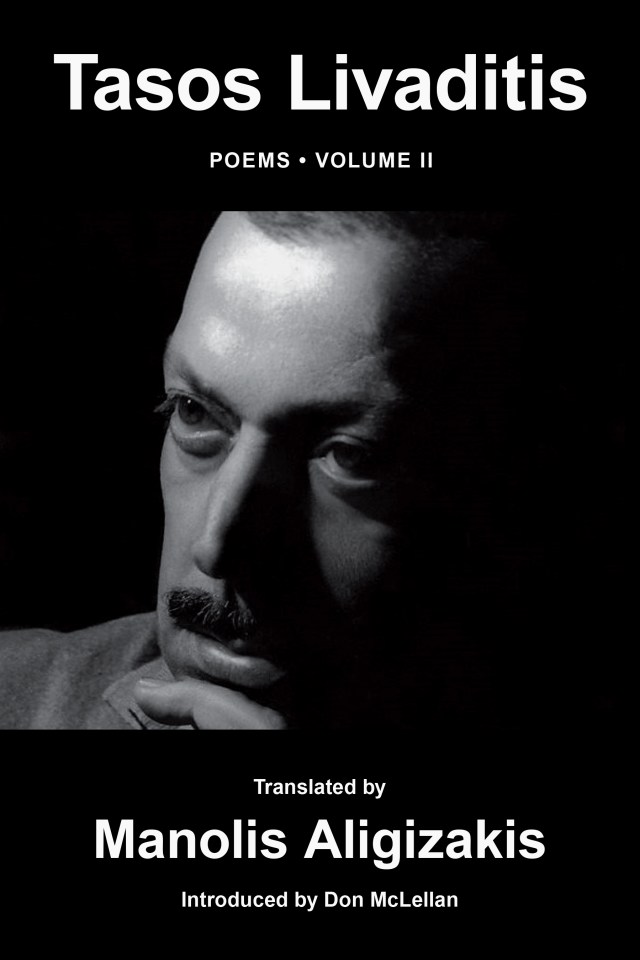
Tasos Livaditis was a man and a poet who knew how to be likable. Not only because he was handsome both in his youth and later on in his senior years, not because he was the center of attention in various gatherings of his days, but also because of his poetry. But why was it so? His creative life could be easily divided into three periods, first being the period of beliefs, second the period of the crisis and third the period of recovery and in all three periods Tasos Livaditis was a very likable man to everyone he met, dealt with, associated with, made friends with, shared his hours in exile with. And Livaditis was a likeable man also because of his goals. During the first period, his goal was the struggle, something that spoke on behalf of everyone and also talked of a better future. In the second period, he tried to conceal the crisis he faced and kept away from his poetry by turning his attention to the people around him. During the third period of his creative life, his most important, if you like, he’s the poet everyone liked because of his ability to select the unexpected. Evident in the first book of this period, when he dealt with the issue of defeat, he encountered: He kneeled and laid his forehead on the floor. It was a difficult time. When he got up, his embarrassed face that we all knew well had stayed there on the planks like a useless inverted helmet. The same man returned home without face — like God That like God and the face on the planks are the unexpected images that put this poet apart from others. Tasos Livaditis could minimize his importance, to lessen the size of his stature, to present himself as haunted, as prey, as one who is punished; he never liked the pompous and unnecessary verbalisms:
For years, I’ve prepared myself for that big moment the miracle of the century, on the other hand you must admit I’m one of a kind in my field. But, God, what happened, who betrayed me, where they find all the proof? The procedure was quick. The district attorney, to the point, “Are you him?” he asked me, “him,” I answered is there any worse charge? ~ Kostas Kouloufakos
Pip: Manolis Aligizakis publishes the kind of site where you can move from a Cretan Renaissance epic to a teenager breaking his ankle during an accidental wrestling match with an older girl — and somehow both feel like they belong.
Mara: vequinox has been putting out a steady run of posts that touch on modern Greek poetry, the textures of desire and longing, rural and domestic life, and the weight of historical conflict. Let's start with the poetry.
Voices from the Greek Tradition
Pip: What this cluster of posts is doing is presenting modern Greek poetry as a living tradition — not a museum piece, but a body of work that moves between sensuality, political witness, and lyric restraint.
Mara: The post titled "Wheat Ears" anchors that range cleanly. The poem opens on a heat wave and builds toward pure physical longing: "come close to me, I beg you / let me touch your skin / the day is fiery / and unbearable like / the body's conflagration."
Pip: That last word — conflagration — does a lot of work. The body isn't just warm; it's an event. The poem earns that escalation.
Mara: The anthology post, "Neo-Hellene Poets," shows the other register entirely — a poem called "Kiss" that ends, "My soul that never learned to kiss / then knows immaculate ecstasy." Longing held at a distance, not consummated.
Pip: And then Yannis Ritsos, in "Poems Volume VI," goes somewhere stranger — a fox in a chicken pen, old men lying on yard tiles, a thin woman threading a ring of smoke as "the only one who believed him." Ritsos makes the surreal feel like documentary.
Mara: The Constantine Cavafy post gives you the political register — a poem about Alexander Jannaeus and Alexandra, Jewish monarchs who are "equal to the Seleucids in every way," the irony landing quietly in that final line.
Pip: Cavafy's irony is so dry it practically needs a humidity warning.
Mara: "Kariotakis-Polydouri, The Tragic Love Story" contributes a poem called "Modesty" — interior beauty as something fragile and untouchable, "a rose that balances on its own flame." Titos Patrikios, in his "Selected Poems," cuts even shorter: the speaker says experience earns him the right to go crazy, but he won't, because that would be a concession. And "Impulses" closes the range with imagistic compression — grief and erosion rendered through silver clouds and a carved heart.
Mara: All of it maps a tradition that moves fluidly between the erotic, the civic, and the elegiac — which is exactly the territory the next segment enters from a different angle.
The Body Remembers
Pip: Desire in this group of posts is rarely clean — it arrives tangled with anxiety, absence, and the particular ache of things that almost happened or already ended.
Mara: The excerpt from "Small Change" puts you directly inside a charged, disorienting encounter. The narrator, a boy, wrestles an older girl on a deserted street; they fall, and the prose captures the collision of arousal and confusion precisely: "her face looked shocked and she tried to twist away and we fell, and my ankle caught on the curb and she landed on top of me, both of us breathing hard, and I heard a dull crack, and a stab of pain like an electric current that shot up my left leg."
Pip: The body keeps score — and here the score is a broken ankle and a girl sprinting away down the street.
Mara: What the passage gets right is the simultaneity: wonder and pain and panic arriving in the same breath, no clean separation between them.
Pip: The poem "Message," from the "Medusa" post, is the compressed version of that same dynamic — someone sending a text three times, editing it, not knowing the person they're reaching for has already fallen asleep holding someone else's laughter.
Mara: "HEAR ME OUT" works in the same emotional space but from further along the timeline — a speaker alone in winter, pulling out fleece bed-sheets from a former shared life. The post reads: "Last night I went to bed in those fleece sheets after a long time I discovered something of our smell has remained in the fabric."
Pip: Scent as the last archive. That detail is doing real work.
Mara: "Blood, Feathers and Holy Men" takes a longer route to the same territory — Rordan and Ula, a medieval Irish monk and a Native woman, building toward love through shared song, each afraid to speak first. The restraint there mirrors the Kariotakis poems from the previous segment.
Mara: "Cloe and Alexandra" asks where poets go at night and answers in images — bloodied hands, a bandage over the heart, a swan writing its last verse. And "Wellspring of Love" grounds desire in the domestic and the anxious — a woman gardening before a prairie storm, worrying about the people she loves, trusting a child to be responsible.
Pip: From wrestling matches to fleece sheets to medieval monks — desire here keeps finding new containers. What the rural posts do is give those containers a landscape.
Land, Kin, and the Work of Staying
Pip: This segment is about what it costs and what it means to be rooted somewhere — a farm, a country hospital, a village, a horse arena — and what happens when those roots are tested or handed on.
Mara: The "Still Waters" excerpt sets the tone. A nurse named Tyne is being walked through an unfinished country hospital, and the exchange lands a quiet irony: when she questions the windows in the operating room, the doctor grins and says, "An air-conditioned operating room, of course." The passage ends on her honest uncertainty — "it would certainly take some getting used to."
Pip: A surgical suite with opening windows in a prairie winter. Rustic is one word for it.
Mara: "Fury of the Wind" gives you the farm side of that same world — a Scottish family's homestead passed through three generations, a daughter-in-law who has "become a regular country girl" with garden produce and homemade bread, planning for the fall fair months in advance. The continuity there is deliberate and warm.
Mara: "He Rode Tall" moves into the horse arena — a competition scene where a young rider named Tanya finishes Reserve World Champion, and the emotional peak is the older horseman Joel leaning over to whisper two words: "She's yours." The filly, the title, the whole arc handed forward.
Pip: That handoff is the whole story in two words.
Mara: "The Circle" widens the geography — phone calls coordinating airport pickups, a sick uncle in Iraq who can't speak freely over the phone, families dispersed but still pulling toward each other. The domestic instinct travels.
Mara: "Ken Kirkby, A Painter's Quest for Canada" takes rootedness into the Arctic — Kirkby describing the tundra as a place of simultaneous sensory deprivation and overload, where "the prairies by comparison are claustrophobic." "Straits and Turns" grounds things differently, in the very specific worry of a pet's health — a dog named Elvis, bladder stones, a second veterinary opinion. And "The Unquiet Land" puts a young Irish farmhand in front of a girl who hires him partly because his uncle is known to her family, the connection between land and kin made literal in a handshake over yellow-man candy.
Pip: Roots and conflict are harder to separate than the segment headings suggest — which is exactly where the next posts go.
History as Wound and Ceremony
Pip: The posts here are about conflict that has been institutionalized — turned into parade, into poem, into the long aftermath of war — and what it means to live inside that.
Mara: "In Turbulent Times" opens on the Twelfth of July in Belfast — the Orange parades, the bunting, the elaborate banners. The post quotes the poet Louis MacNeice on "the voodoo of the Orange bands / Drawing an iron net through darkest Ulster." A Protestant character named Robert Hanlon, married to a Catholic, simply leaves the city every year to escape it.
Pip: An iron net drawn through a province, and the most honest response is to go find a quiet field.
Mara: "In the Quiet After Slaughter" puts you in a different kind of threat — a Yukon bar, a one-eyed man with a machete, a protagonist who talks his way out by claiming to be someone useful. The violence is immediate and physical, not ceremonial.
Mara: "Hours of the Stars" pulls back to the lyric register — a poem that opens "After the death of authority / we waited for the king's celebrations / messengers of the lost war." The weight of collective defeat carried in the body, wrapped "like an ivy." "Erotokritos" reaches further back still — the scholarly post traces the Cretan Renaissance epic to refugees fleeing the Ottoman fall of Crete, a poem preserved and carried by people in flight. And "Wheat Ears" contributes a poem called "Visitor" — an unknown soldier who arrives in a small town, touches one woman's life, and is found dead in the street the next morning, his name never spoken.
Pip: History here keeps finding the same shape: ceremony over wounds that haven't closed.
Mara: What holds all of this together is the insistence that the personal and the historical are the same material — a broken ankle and a battle, a fleece sheet and a refugee poem.
Pip: Next time, presumably, more of the same — which is to say, more of everything.
Pip: Manolis Aligizakis publishes the way some people breathe — steadily, in verse and prose, across centuries of Greek tradition and continents of lived experience, and apparently without pause.
Mara: That range is exactly what this episode covers. vequinox brings us poetry rooted in the Modern Greek tradition, fiction set in the rhythms of family and rural life, and prose that tracks what happens when people collide with systems, borders, and each other.
Pip: Let's start with the poetry.
Voices Out of the Greek Tradition
Mara: The Modern Greek poetry segment raises a real question: what does it mean to translate and present a tradition this deep — from ancient myth to twentieth-century masters — and keep it alive on the page?
Pip: The excerpt from Twelve Narratives of the Gypsy puts that question in mythic terms. The setup is a figure who outlasts every riddler sent to challenge her: "all the mouths which uttered the riddles were swallowed by the hungry Hades and she walked over their bodies."
Mara: So survival here is the answer to every riddle. The Sphinx-like figure doesn't solve the questions — she simply endures them, which is its own kind of mastery.
Pip: The Yannis Ritsos volumes — both Volume V and Volume VI — work in that same register of weight and endurance. Volume VI's "The Sick Man" watches darkness move toward naked figures and statues until it "lights the whole house" and transforms ordinary objects into something luminous. Volume V gives us a messenger announcing victory amid thousands of deaths, the king returning with "a wound between his eyes" through which death itself could see.
Mara: Introspection closes on a similar note of earned return — "from which I have come and to which I'll ultimately arrive at my destined hour." And the anthology Neo-Hellene Poets anchors that continuity in something smaller: a poplar tree that once answered laughter and now answers only tears.
Pip: Antony Fostieris offers the most compressed version of this whole project — a poem that defines a poem as simply "rhythmically contemplating emotion." Three words doing the work of a manifesto.
Mara: Opera Bufa, Nikos Engonopoulos, Orange, Entropy, Medusa, Yannis Ritsos Volume II, Tasos Livaditis, Cloe and Alexandra, Troglodytes, Wheat Ears — all of them circle the same territory: desire, mortality, the weight of history pressing into the present moment.
Pip: Which is also, it turns out, the territory of the fiction — just told in longer sentences.
Seasons, Soil, and the People Who Stay
Mara: The fiction gathered here under family and rural life isn't nostalgic so much as precise — these posts ask what it costs to belong somewhere, and what it feels like when belonging is about to change.
Pip: Still Waters sets that up in a single anxious domestic moment. Tyne has just accepted a marriage proposal, and the evening should be simple joy — but the excerpt catches her mid-hesitation: "I'm tired, that's all. Tomorrow, I'll be fine. Just let me go to bed now, and I'll be fresh as a daisy to take Cam to church tomorrow."
Mara: The gap between what she says and what she feels is where the whole novel lives. She watches her father take Cam's arm through the doorway and thinks "no more worries" — but the narration keeps undercutting her.
Pip: He Rode Tall trades domestic interiors for the arena. Joel and Tanya are in the finals, twenty horses, thousands watching, and the warm-up pen is almost meditative — he doesn't want nerves to make him overwork his horse before the performance even starts.
Mara: Swamped goes further back — two boys in a Cretan summer, watering tomato rows by hand, stealing a watermelon from a neighboring field, counting swims at the end of each day. Anthony selects the ripest melon by the sound it makes when tapped.
Pip: Prairie Roots does the same work in a Canadian winter register — stubble turned over, fences repaired, straw hauled to the barn, the first snow arriving before every chore is finished.
Mara: Jazz with Ella shifts the stakes entirely. The rural quiet is gone — the scene is an airport, a man named Volodya terrified at a security line, his companions forming a quiet circle around him. The question "what are they looking for" carries a completely different weight here than it does in a tomato field.
Pip: And then there's Wheat Ears, which compresses all of this into a short poem about a person who keeps urging change while never leaving the recliner.
Mara: The tension between staying and moving runs through every one of these — which is also what the next set of posts is made of.
When the System Pushes Back
Mara: The fiction in this segment puts characters directly against institutions, communities, and the small frictions that reveal larger fault lines — the question is how people hold themselves together when the pressure is social and the rules keep shifting.
Pip: In Turbulent Times sets that up through what isn't said. Caitlin learns that Connie has stayed behind at the cottage after Robert left, and Michael never mentioned it. The scene plays out in careful domestic choreography: "If Caitlin had had any suspicions about Michael and Connie Hanlon, remembering how Connie had come on to him in the square in Corrymore on Tuesday, she did not show them."
Mara: The restraint is the point. The whole excerpt is about watching and not speaking, suspecting and not asking — the farmhouse kitchen as a pressure vessel.
Pip: Small Change runs a different kind of social friction — street-level, adolescent, transactional. A kid who gets straight A's in a neighborhood of C-minuses rents out a Stilson wrench to Paulie, the local legend, for a buck an hour or any fraction thereof.
Mara: The negotiation is sharp and funny, but the stakes are real — belonging in that world means knowing how to do business without losing standing on either side.
Pip: Straits and Turns moves that immigrant-workplace dynamic into a Vancouver factory, where Mike writes a poem on folded toilet paper while waiting for Luigi to finish his shift tasks, and the Italian-Greek solidarity is summarized in a single phrase: "una fatcha una ratsa."
Mara: The Qliphoth takes the friction into something stranger — Lucas, trapped in what reads like a nightmare transit terminal, punches an iron pillar to test whether the world is real, and the guards and bystanders laugh in unison while a security conference crackles around him.
Pip: All four of these are about the same thing: what a person does when the system looks back and doesn't recognize them.
Mara: From mythic riddles to tomato fields to airport security lines — the thread connecting all of it is people trying to locate themselves inside something larger.
Pip: And the poetry keeps asking whether language is the map or the territory. Next time, we'll see where that question leads.
The grin left his mouth and he began to look wary. I was the one who got straight A’s, the only one in this pack of D’s and C minuses. “Ten bucks, Paulie. You can read, can’t you? Go look it up. A British blue cheese. And if you lose, you also gotta buy a pound of the shit, and eat it with a pair of chopsticks.” That did him in. He waved me off. “So what. You know cheese. But you don‘t know shit about tools. Thought yer ol’ man was a engineer.” “Yeah, well, what you think you’re talkin about here is a Stilson, a Stilson Wrench. Adjustable, with teeth and a long handle. A plumber’s tool, fool. What you want one of those things for?” He tried to look like a poker player holding a pocket pair. “Get me one and I’ll show ya.” I thought about that for a second. I knew where I could get one, but the sure bet had bit the dust and here was another chance to do business. “Cost ya a buck an hour.” “Don’t need an hour.” “Buck an hour or any fraction there-fuckin-of. Final offer.” Paulie laughed. “Some altuh boy, wid a mout like dat …” but he dug into his pocket and came up with a coin that looked like it had been dipped in chocolate and dusted with tobacco bits. “Heah’s fifty cent. The rest when you delivuh.” Paulie had achieved heroic status when he organized the now famous watermelon raid earlier in the summer. A boxcar had been left for several hours on the spur track behind number five park and Paulie had picked the padlock, releasing hundreds of tubby fruits into the city. Kids from as far away as Railroad Avenue were toting melons on their shoulders, or sitting in small groups, slicing them up with kitchen knives, their faces and hands drenched with sticky juice. It was a hard act to follow, but whatever plan he’d hatched for the Stilson, it was designed to maintain his legendary, outlaw image. And as supplier of the necessary technology, I would earn a small slice of his notoriety pie. But I needed help with this enterprise, and I knew who I could count on. Anthony Morga was the smallest but scrappiest member of our tribe at Holy Rosary School, and I could get him on board for a tithe of the buck I’d make from the rental. He was a wary kid, always kind of skittish about promissory contracts, and as we made our way down the unpaved alley that ran like a neglected country
Pip: Manolis Aligizakis runs a site that could double as a library card catalog for the Mediterranean soul — except the catalog keeps writing back.
Mara: Today we're in the territory of Greek and Mediterranean poetry, translations that carry grief and habit and beauty across languages, and fiction excerpts that range from colonial frontiers to Cold War escapes. vequinox is behind all of it.
Pip: A lot of ground, a lot of voices. Let's start with the poetry.
Translations, Memory, and the Weight of Greek Verse
Mara: The anchor here is the work of translation — bringing Greek poets like Tasos Livaditis, Yannis Ritsos, Katerina Anghelaki Rooke, Constantine Cavafy, and others into English, and what gets carried across and what gets left in the original silence.
Pip: Livaditis sets the terms pretty early. The poem "November Wind" opens with a door being closed and a reckoning beginning, and then it lands this: "I think music is the grief of those who never found the time to love."
Mara: That line does a lot of work. It takes the whole poem's accumulation of lost letters, absent friends, and unanswered words and names the feeling underneath — not sorrow exactly, but grief as an art form practiced by people who ran out of time.
Pip: Ritsos shows up twice, and both poems are about absence made physical. "Emptiness" is a house stripped bare where the mirror refuses to reflect the void, and the nails left in the wall after pictures fall still catch the last light — still expecting something to hang on them. "The Sick Man" is quieter, a man returning from some interior collapse, speaking in a detached voice while making a gesture of strange tenderness with an imaginary handkerchief.
Mara: Katerina Anghelaki Rooke's "The Goddess Habit" works a different register entirely. The poem personifies routine as a protective deity, and it earns its ending: "Yes, goddess Habit, I believe in you and I serve you. You too, stay loyal to me until I get tired of you." That's a prayer and a negotiation at the same time.
Pip: Cavafy appears twice, and both poems are portraits of performance. "Leader from Western Libya" is a quietly devastating sketch of a man who learns to dress and speak Greek to impress Alexandria, and ends up so terrified of making a grammatical error that he says almost nothing — all those unspoken words piling up inside him. The later Cavafy piece, "Days of 1909, 1910, and 1911," is a young blacksmith's elegy: beautiful, unrecorded, wasted.
Mara: Titos Patrikios's "Final Defeat" is brief and brutal — a man who stuttered wanted to say something, and the speaker was always in a hurry. Antony Fostieris's "Five Painters" turns that inward: an aging artist who has just finished his most important work sits quietly at a restaurant corner, contemplating the thorny crown of the critics, while his companions talk about nothing.
Pip: The remaining poems spread the emotional range. "Impulses" holds a mastectomy at its center — the word repeated twice at the close, once as descriptor, once as fact. "Hours of the Stars" moves through water and myrtle and skylarks with a ceremonial lightness. "Introspection" names its destination plainly: the word "arts" appearing like a destination on the climb toward a destined Ithaca.
Mara: "Wheat Ears" and "Entropy" and "The Incidentals" and "Ugga" fill out the edges — a man reading the morning paper's catalog of violence before going to war again with his coffee pot, a coal seller sweating through summer to sell winter, primeval souls climbing from pages of books, and the twentieth century's art movements battling while Dali embraces Lorca timidly.
Pip: All of it circles the same question: what survives the passing of time, and who gets remembered. The fiction asks something similar, just with more people in the room.
Voices Across Frontiers: The Fiction Excerpts
Mara: The fiction segment covers a wide range of settings and genres, but the posts share a preoccupation with people navigating systems — political, social, colonial — that are larger and less trustworthy than they appear.
Pip: "Arrows" is the sharpest example. Friar Salvador is caught in a military council where the power dynamics are shifting in real time, and the excerpt ends with a sentence that earns its weight: "Not one day among the Spaniards, and already I smelled unshed blood."
Mara: The tension in that scene is precise — Infante's insubordination is theatrical, Losada's tolerance of it is suspicious, and Salvador reads the whole room correctly while being unable to do anything about it. The approval that follows Infante's suggestion to interrogate the caciques is described as mockery rather than respect.
Pip: "Jazz with Ella" has a completely different energy — a group smuggling a Soviet musician out of the USSR, the airplane cabin full of people pretending not to know each other, and Jennifer barely containing her relief while picturing Volodya hearing live gospel music for the first time in Vancouver. It's one of the warmer excerpts here.
Mara: "Water in the Wilderness" is quieter tension — Tyne waking up and walking into a kitchen where Moe and Ken are already dressed and waiting, and the whole scene turns on whether she can read their faces before she sits down. The line "Have you heard anything?" comes out as little more than a whisper.
Pip: "Blood, Feathers and Holy Men" is the most expansive excerpt — a Celtic woman named Ula, sold to a convent for six chickens and a pig, who has ended up among Indigenous people in what reads as early North America, and is slowly being reached by a monk named Rordan through the shared medium of song. The detail about the children calling him Mountain Thrush for his happy laugh is the kind of thing that earns a reader's trust.
Mara: "Redemption" follows a young man named Hermes preparing for a meeting with a university dean, coached by his aunt to find out the conditions before agreeing to anything, because nobody offers something without expecting something in return. "Poodie James" puts a lawyer for the Great Northern Railway in front of a civic hearing about hobos, and the exchange between the committee chair and the railway counsel is drily procedural — the shortest speech ever heard from a lawyer.
Pip: "Wellspring of Love" is a quieter domestic register — a girl named Rachael sitting by a stream, overhearing herself described as running with someone fast, and trying to figure out who she could ask about it without causing more trouble than the question is worth.
Mara: "Ken Kirkby — Warrior Painter" is a biographical excerpt tracking how Kirkby's Arctic paintings became nationally recognized, and how the Inukshuk eventually became the symbol of the 2010 Vancouver Olympics — a consequence that started with a single ministerial meeting and a well-timed exhibition in Spain.
Pip: "In the Quiet After Slaughter" closes on a man who spots someone he may or may not recognize — a face with a distinctive mark — returning to a place that once meant something. He could verify it, but he chooses not to. "I preferred to believe it was him," the narrator says, "because it's what I did. It's who I had become."
Mara: "Straits and Turns" is a travel piece set in Madrid, a narrator exchanging an imperceptible kiss with a Minoan-featured stranger across a restaurant, and "Twelve Narratives of the Gypsy" is a scroll and a water well and a horse riding toward a country of castles that threaten the wide open skies. "Red in Black" ends the range — a love poem about texting instead of writing a letter, and being called a student of the old school, and sending a kiss from the other side of the planet.
Pip: What stays with me is how much of this — the poetry and the fiction both — is about the gap between what people mean to say and what actually gets said.
Mara: The stuttering man in Patrikios, the unspoken words piling up in Cavafy's Libyan prince, Salvador reading the room and leaving afraid. The gap is the subject.
Pip: Next time, we'll see what else is waiting in the archive.
…the moment if they didn’t interfere with his driving them to their destination. On the other hand, could he ask them to stop? Why, could they answer, and what could he say to such a question? Strange beast, the human mind, as it went from one thing to another, like a crazy monkey who jumped from one branch of a tree to another, just like Costa’s which ran to his good trip back at the Four Seasons to which he was eager to reach on time, so his customer wouldn’t get impatient and take a different cab to the airport. He looked at his watch: his time was just fine; finally, he arrived at the Cypress Bowl, and he realized that his customers in the back were half dressed and half not, such was their erotic oestrus during the trip… upon realizing that they had arrived at their place they quickly fixed their clothes, the man paid the driver and taking his half-dressed sweetheart by the waist they walked to the front door of their place. The driver said goodbye to them and started his return to the city of Vancouver and to the Hotel where he arrived earlier than the time we had agreed with the smoker. However, Costa saw his customer waiting in the lobby. Costa walked over, grabbed his bag, put it in the trunk, opened the back door for him, and started the trip to the airport. Around the sixteenth and Granville, they started the usual little talk, “Where are you from? How long have you been here? Etc. Costa informed his customer that he came from Hellas and had lived here for six years. The customer mentioned that he was a Turk, from Ankara, on his way to Los Angeles for business. Oh, God, what just happened? The earth started swirling around like a wind vane, like a top on a flat surface. And all this buzzing noise was like a swarm of bees in Costa’s head, as if desperately looking for honey. Endless pounding against his two temples turned that buzzing noise into a thundering hatred. In which school have they taught him to hate this man so much? In which church have they turned him into such a fanatic? How many eons of anger and hatred has he lived, and why is he in such a dreadful condition? How was it possible that all his ancestors had resurrected and stood before him demanding revenge? Why all this hatred today, and why have all his ancestral parents, brothers, and sisters awakened…
If and Since He Had Died “Where did he retire? Where did the Sage disappear to? After his countless miracles, and the fame of his teaching that spread over so many nations he suddenly hid, and no one learned with certainty what happened to him (nor has anyone ever seen his grave). Some said that he died in Ephesus. But Damis didn’t record it; nothing was written by Damis about the death of Apollonios. Others said that he vanished in Lindos. Or perhaps the story that he ascended in Crete is true, at the sacred temple of Dictynna. However, we have his exquisite, supernatural appearance to a young student in Tyana. Perhaps the time has not come for him to return and appear to the world again, or perhaps he is roaming among us incognito. But he will reappear as he was, teaching the right things, and then of course he will reestablish the worship of our gods, and our refined Hellenic ceremonies.” This was the way he mused in his poor house, one of a few pagans, one of the very few who remained after reading Philostratos’ On Apollonios of Tyana— In any case, an insignificant and timid man, on the surface he played the Christian, and he, too, went to church. It was the era when in utmost piety the king who reigned was the aged Ioustinos, and Alexandria, a god-fearing city, abhorred the miserable idolaters. On the Ship Certainly, this small sketch, in pencil resembles him. Done rather fast, on the deck of the ship, one enchanting afternoon. The Ionian Pelagos all around us. It resembles him. However, I recall him as handsome. He was sensitive to the point of suffering, and this lit his expression. He appears even handsome to me now that my soul recalls him out of Time. Out of Time. All these things are old, the drawing, the ship, and the afternoon.
“One day you will remember of me”, he said “but you won’t be able to cry;” what did he mean and what was the meaning of words? Women stood at the crossroad, dark faced, holding the half open pomegranate like thousand faces of nothing. The prostitute, returning home, went to the kitchen and warmed the food and I, hell, failed between two evening songs. When Rosa had a john she used to place a carton on the corner so the memory of her father wouldn’t see her; someone, with an axe, came out in the night and started striking blindly. The whole city was panicking, searches, interrogations, occasionally someone would come, kneel before the icons and confess to everything since the beginning of the world — thus perhaps seeking a purpose or two lines in the newspaper and a small rose at the edge of the road; the stupid child would go by and pick the rose, he’d look at it and then as if he understood something he’d leave it in its place and only the gambler could guess that movement such as those that save you. Thus one by one they all got lost and I was the only survivor playing, at the critical moment, with the fringes of the tablecloth. I truly wonder why all these since one can be lost with a lot less things. I remember one who’s hunger pushed him to desire a street organ, which he sat down and ate, there, at the corner only spitting out the crutch of the soldier, and the fat ugly woman had revealed her big breasts over the balcony “don’t feel sorry for me” she said “I’m very clever” and she was staring at the end of the road; then we sat on the grass of the dark cemetery and helped the dead child.
…shrinking, yet unable to vanish completely. I don’t know what I have to say or what I have to do. Sometimes this obstacle appears to me as though a tear drop flopped on a music composition that will keep it silent until it dissolves. And I have the unbearable feeling that all the rest of my life won’t be sufficient to dissolve this tear drop in my soul. And a thought haunts me that if I were to be burned alive this obstinate moment would be the last to surrender. Who would help us? Once, when I was still a seaman, one July noon, I found myself alone on an island, crippled in the sun. A soothing breeze brought to my mind tender thoughts, it was then when a young woman with a diaphanous dress revealing her body lines slender and willing like a gazelle’s and a somber man who stared in her eyes from a yard away, came and sat not far from where I was. They spoke a language I couldn’t understand. She called him Jim. But their words had no weight and their glances, mingled and motionless, left their eyes blind. I always think of them, because they were the only people I saw that didn’t have the grasping or haunted look that I noticed on everybody else. That look that makes them resemble either a pack of wolves or a flock of sheep. I met them again the same day in one of those island chapels that one finds as he goes by and loses them as he walks out. They still kept the same distance from each other, then they came together and kissed. The woman turned into a cloudy image that disappeared as she was of small stature. I asked myself whether they knew that they escaped from the world’s nets… It is time for me to go. I know of a pine tree that leans near the sea. At noon, it bestows a shade upon a tired body and at night, as the wind passes through its needles it starts a strange song, like souls that have abolished death at the moment when they start becoming lips and skin. Once I spent a night under such a tree. At dawn I was as fresh as if they’d just cut me off the quarry. Ah, if one could live like this, irrelevant.
Reality The ship entered the αρεα of the thick fog. A bell echoes desperately at prow: the route is full of innumerable dangers now. On the bridge, however, the sleepless and bewildered captain watches and drives the ship safely. The captain … his eyes, his glance. Yes, indeed, his glance is everything, like now that his glance, straight, strong, mercilessly pierces through the thick layers of grey pleats of fog and inside the dark paths of the human psyche, into the dark sanctuary of Fate, it calms the wildest and roughest seas, it enters and stands like a guard into the hovel of the poor fisherman, it saunters tenderly around the anchors, the sleeping baby, the spread nets and finally, it comes, settles and serenely rests, next to the quiet light of the lamp. Certainly, the captain’s profession isn’t captain. He has different choices, different longings, and specialties. Different things attract him and in different things he’s involved. Yet, when the ship is in danger, they all run to him, who although they don’t see him as a man, they allot to him and he accepts the responsibility of many souls. He, who has no joy but knows of it, who isn’t free, yet yearns for freedom and struggles while he hopes. Let it be known: if the Fates never visited his baby cradle, Fates, Witches and pure Fairies would come next to his deathbed. The figurehead of the ship knows all this and loves him. She’s, his lover. This wild and hot girl with her undone black hair, fiery red lips and the light-blue belt goes and finds him secretly every night and they make love ‘together’ and chit-chat erotically for hours. One moonlit night: “Don’t forget me”, she says to him, “because I’ll die” One day when he was in a thick forest, rain caught up with him. He sheltered himself in the tree hollow and waited. The rain intensified. Among all the rain he noticed a few tree trunks burned by the fires of wayfarers and many pinecones scattered around the soil. Another time, a summer noon, he stood by a water well. Further away was a tower. A girl came, like Rebeckah to get some water. She puts the pitcher down, goes close to him, uncovers her voluptuous breasts and says, “Don’t touch them, they are roses and drop their petals; only caress them” Then again, “No, do as you wish with them, they are yours, my sweet man, I gift them to you.” This woman, who he fell in love with passionately, one night as the winds were blowing, he waited for her and he saw her going down to the harbour. She ran and cried along the deserted quay. She had tied her raincoat around her waist with a leather strap and the strong wind sometimes glued it on her body and other times it whipped her apron wildly and took away along with her voice, her long hair too.