
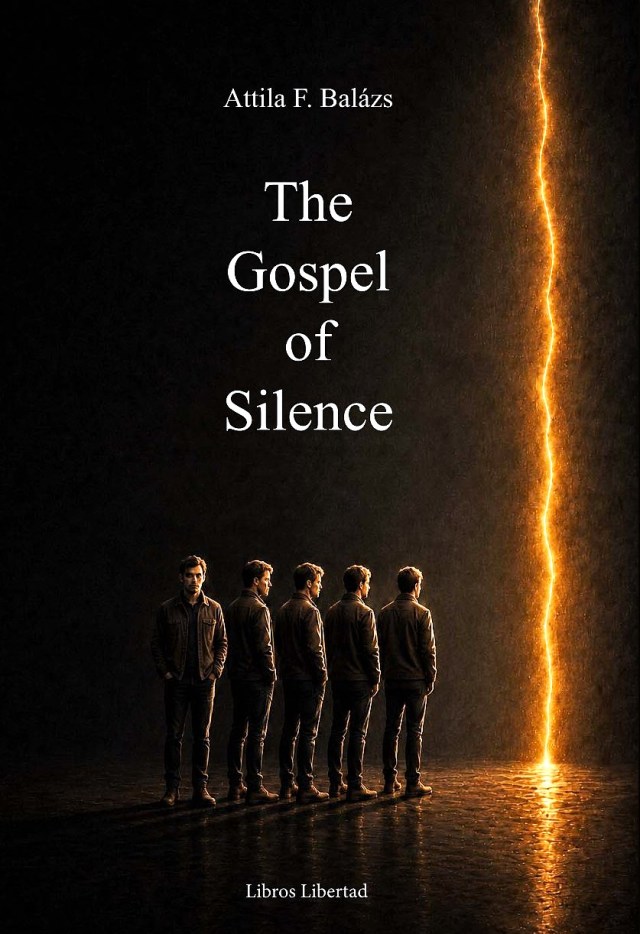
The Gospel of Silence

Excerpt

…unimaginable—slipped like a cold draft between the ancient walls,
disturbing the settled kingdom of silence scented with incense, centuries-
old furniture, glue and leather-bound books, and reached us,
first-year theology students, whom the authorities had ordered—for
the first time in the country’s history—to report for shortened military
service. Standing there, looking at one another in confusion,
with bitterness thickening inside us, we felt that a new will, a new
blind and impersonal force, was sliding into our lives.
We packed. Then each of us set out for home by bus, train, whatever
he could find, so that the next day he could report to the draft
board corresponding to his place of residence. There we underwent
the examinations. Naked, we had to stand before the officers seated
at a long table and the military doctor, who declared every recruit
fit for service. Afterwards, hundreds of young men lined up in the
courtyard, waiting for their names to be called and for the slip of paper
to be placed into their hands, before setting off toward the station
with their wooden suitcases under the supervision of a corporal.
I was sent to Sfântu Gheorghe. The barracks we entered resembled
nothing I had known before. There was no sense of home within
it, but neither was there outright cruelty—something even worse
filled the place: walls built out of a peculiar indifference, a world in
which suffering was not punishment, but a natural condition.
The company assembled from Orthodox, Catholic and Protestant
seminarians seemed like some grotesque metaphor, as though the
many stories, ideas and hopes hidden behind different religions had
all been stripped bare at once, only to freeze together into a single
common experience: subjugation.
Among the officers there were some who treated the whole thing
as an amusing game; for others it seemed almost a ceremonial duty
to show us—those who spoke about God, prayed to Him, followed
His commandments—what it was like when not heaven commanded,
but they did. And we, who until then had believed the suffering
of the body to be only temporary, now discovered that the suffering
of the soul was far slower, far more insidious and enduring.
https://www.amazon.com/dp/1926763874

Gospel of Silence

Excerpt

At first, the face of love for me was the humiliated, broken,
rejected barefoot beggar. Later a quiet rebellion nested itself in my
heart; by then I had grown irritated by helpless love that endured
everything, by the sour stench of passivity, by the endless swallowing
of humiliation. Instead of the hermits’ Christ who resigned
himself to everything, I chose the rebellious Christ.
When I arrived home on the day of the awards ceremony, I found
my mother crying. My father was delivering one of his endless
monologues in a pitch far higher than natural, intoxicated with
himself, circling endlessly around his own words.
“Where were you?” my mother asked.
Silently I handed her the certificate.
“What’s this?” my father tossed out indifferently. “Be first in
your studies!” Then he threw it aside.
That same day, when I was supposed to leave for the reward excursion,
my father attacked me with the long wooden ruler for some
reason — today I no longer remember why, perhaps there was no
reason at all. He beat me until the ruler shattered into pieces. I had
only one aim: to keep the blows from reaching my face. I endured
it without a sound. I looked at him with cold hatred and with a cruel
kind of pity, watching the shameful, helpless rage pouring out of
him. That only enraged him further. He could not bear that I never
humbled myself before him, never begged forgiveness the way my
siblings did. I could not ask forgiveness for something I did not feel
was a sin.
It was around then that the desire to escape awakened within me.
I stepped outside my body, and from then on observed the entire
inner and outer chaos from a distance, the world struggling with
its external and internal laws, and within it my own self, stripped
of meaning. Instinctively I kept away from artificial intoxication
— alcohol, drugs, anything of the sort — not out of virtue but out
of self-defense: I was terrified of losing sight of myself even for a
moment.
Later I tried to direct both myself and my surroundings through
carefully planned or improvised scenarios. At first it was a game;

https://www.amazon.com/dp/1926763874

The Gospel of Silence

excerpt

The sandy stretch beneath the Mureş River embankment served
as the beach. In summer we went there every day on foot, enjoying
the water, the sunlight, watching the girls and women as though
the order of the world might remain unchanged forever. Back then
the watermill still functioned for a while, the one that had once
belonged to my maternal grandparents. And the Rákóczi-Kornis
castle had not yet collapsed into ruin — it operated as an agricultural
school.
At school we committed every prank imaginable. Teachers were
still permitted to use corporal punishment. We received hard slaps.
Șerban’s method was the cruelest: he grabbed the hair beside one’s
ear and lifted until the tuft remained in his hand. Others struck our
palms with rulers. If we jerked our hand away, we had to stretch it
out again until the blow landed properly. Our hands throbbed for
days afterward. That was why the favorite punishment was being
thrown out of class. Then at least we could find something to occupy
ourselves with.
It was a mixed-language school, with Romanian and Hungarian
classes. Back then the balance was still more or less even. Later the
proportions shifted; the Hungarian secondary school disappeared,
and even in the elementary school fewer and fewer Hungarian
pupils remained. At that time there were no dramatic ethnic tensions.
It amounted to little more than the strongest Hungarian boy,
Józsi Türke — who later became my brother-in-law — testing his
strength against Grecu, the Romanians’ muscular champion. The
children circled around them, each camp proclaiming its own warrior
the victor.
Church holidays meant something slightly different to us children
than to the devout believers. At Christmas we went caroling.
For weeks beforehand we practiced Christmas songs, sometimes at
our house, sometimes at my friend István’s. Amid the many false,
whining voices filling the streets, our singing was beautiful, and
those who welcomed our carols praised us for it.

https://www.amazon.com/dp/1926763874

The Gospel of Silence

For a long time, I believed one stays alive by understanding
everything. Now I know there are things one must simply endure,
survive.
Children love excitement, challenges, danger. Often they fail
to perceive risks, or else they underestimate them. They do not
avoid danger; they examine it like some mechanism full of secrets
whose moment of activation they do not yet understand. We were
the same. In winter we ventured out onto the barely frozen lake,
whose ice cracked beneath every step as if warning us — or perhaps
luring us onward. We knew it was dangerous, but knowledge
alone was never enough reason to turn back. If the ice gave way
beneath one of us, we pulled him out however we could, then ran
home racing time itself before his wet clothes froze onto his body.
Now it seems as though it was not we who ran, but earlier versions
of ourselves whom no one can ever catch again.
In summer we waded into the murky marsh with its black waters.
I do not know what drew us there; perhaps the fact that it had no
boundaries, only density. We pushed through it waist-deep, later
picking leeches off ourselves on the shore — though we simply
called them bloodsuckers, as if the name alone could strip them of
all strangeness. We felt no disgust toward them; we counted them
instead, as though they were proof we had gone where we should
not have gone.
Stealing melons and fruit from the collective farm fields was almost
a ritual. It was not hunger that drove us, but prohibition. The
appearance of the field guard always set the same scene in motion:
waving his stick, he charged after us while we fled, as though some
ancient story wished to retell itself again and again. The older boys
escaped easily; the younger ones cried because the guard had come
too close. Now I know the fear did not come from the stick, but
from the realization that the world was capable of hunting us down.
I remember other runs as well. “Korea” — that was what they
called the two new streets built after the flood. In the house beside
the lake lived a Romani family. Their eldest boy was violent and
cruel — or rather, unavoidable.

https://www.amazon.com/dp/1926763874

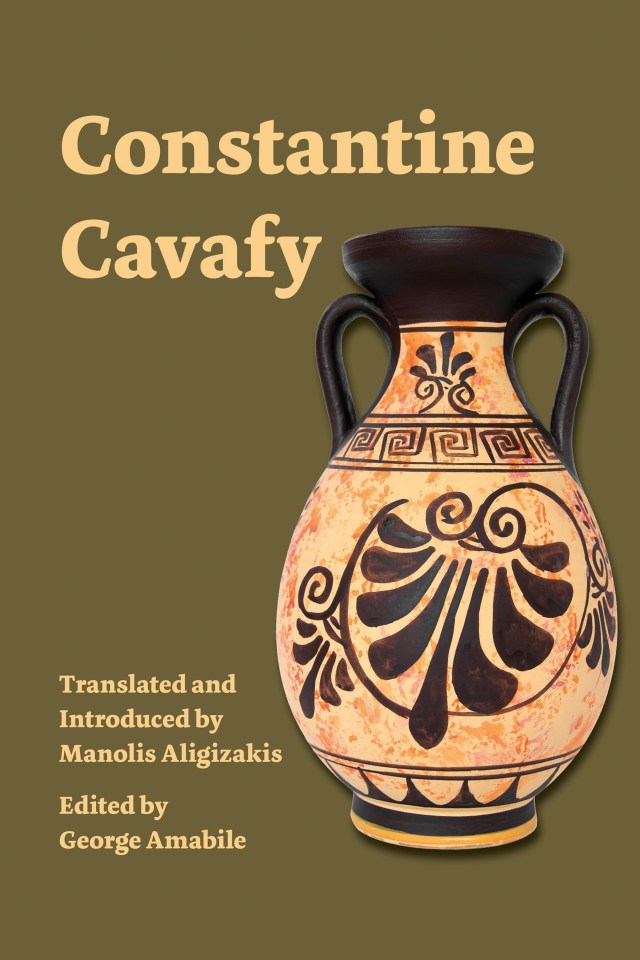
Constantine Cavafy

If and Since He Had Died
“Where did he retire? Where did the Sage disappear to?
After his countless miracles,
and the fame of his teaching
that spread over so many nations
he suddenly hid, and no one learned
with certainty what happened to him
(nor has anyone ever seen his grave).
Some said that he died in Ephesus.
But Damis didn’t record it; nothing was written
by Damis about the death of Apollonios.
Others said that he vanished in Lindos.
Or perhaps the story
that he ascended in Crete is true,
at the sacred temple of Dictynna.
However, we have his exquisite,
supernatural appearance
to a young student in Tyana.
Perhaps the time has not come for him to return
and appear to the world again,
or perhaps he is roaming among us
incognito. But he will reappear
as he was, teaching the right things, and then of course
he will reestablish the worship of our gods,
and our refined Hellenic ceremonies.”
This was the way he mused in his poor house,
one of a few pagans,
one of the very few who remained
after reading Philostratos’
On Apollonios of Tyana—
In any case, an insignificant
and timid man, on the surface
he played the Christian, and he, too, went to church.
It was the era when in utmost piety
the king who reigned was the aged Ioustinos,
and Alexandria, a god-fearing city,
abhorred the miserable idolaters. On the Ship
Certainly, this small sketch,
in pencil resembles him.
Done rather fast, on the deck of the ship,
one enchanting afternoon.
The Ionian Pelagos all around us.
It resembles him. However, I recall him as handsome.
He was sensitive to the point of suffering,
and this lit his expression.
He appears even handsome to me
now that my soul recalls him out of Time.
Out of Time. All these things are old,
the drawing, the ship, and the afternoon.

https://draft2digital.com/book/3562856

https://www.amazon.com/dp/1926763823