Marginal: A Review by AI

Excerpt

At the Margins of Existence: Love, Exile and Mortality in Marginal

        This seasonal structure is fundamental. Autumn and winter repeatedly signify ageing, loneliness and approaching death; spring signals erotic renewal, resurrection and possibility. This poet’s universe therefore remains tragic without becoming nihilistic. The later sequence “Longing,” consisting of fourteen numbered poems, concentrates these concerns into a more intimate and meditative form. Its recurring invitation “Come, sit next to me” changes the relationship between the poet and the addressee. The voice becomes conversational, almost testamentary. The speaker wishes to remember love, political dreams, failures, friends, unnamed victims, forgotten workers, soldiers and the people whose history exists outside its official narrative. Here the connection with The Incidentals becomes explicit. One poem recalls the revolution that was never begun and the world that was never changed, then sings for those “incidentals” who never raised banners or became heroes. Another goes further and demands that these anonymous people finally be made heroic, because they lived so that others could receive glory.

        This is perhaps one of the most important developments in Aligizakis’s recent poetry. The marginal and the incidental become related categories. Both designate those excluded from the centre of historical narration. Poetry becomes an act of restitution: it gives them the page they were denied. Stylistically, Marginal moves between short lyrical poems and expansive free-verse meditations. Aligizakis often relies on accumulation rather than conventional narrative development. Image follows image through associative logic: flower, flesh, sunbeam, mythological figure, household object, political allusion, death, memory. Punctuation is frequently minimized, creating long currents of thought in which perception seems to precede grammatical organization. At its strongest, this technique creates remarkable fluidity. The poems appear to move as memory itself moves—suddenly, irrationally, sensually. A flower may open onto childhood; a body onto mythology; a window onto mortality; an abandoned house onto the mystery of origin.

       “Pilgrimage” is among the volume’s finest examples. The speaker returns to the family home, not simply as a visitor but as someone searching for the place where his existence began. Four walls, rocks, wind, the location of the childhood crib and the orientation of the door become coordinates of personal mythology. The house is a finite space placed inside infinity. Biography becomes metaphysics. This exploration continues in “Wisdom of the Nude,” where the abandoned family home becomes associated with an abandoned body, and absence itself becomes a form of knowledge. Such poems reveal Aligizakis at his most compelling: personal memory is neither memoir nor nostalgia but material for ontological inquiry. The volume is not without excess. Aligizakis frequently returns to the same constellation of images—flowers, irises, Eros, death, light, statues, female beauty, loneliness, ancient Greek mythology—and some poems state philosophically what their imagery has already conveyed more effectively. Erotic rhetoric can likewise become so insistent that individual images lose some of their uniqueness. Yet repetition in Marginal also functions almost musically. These motifs return like themes in a long composition, altered slightly by age, memory and context. And repetition is appropriate to a book about ageing.

       The older consciousness does not simply advance. It circles. It revisits. It asks again. It remembers differently. The final movement of Longing therefore offers an appropriate culmination. The lovers sit together at dawn and look toward the first rays of light. Their love becomes “blessing,” “endurance,” and “eternity,” and the concluding vision imagines them giving birth metaphorically to a new generation of immortals. This is not naïve immortality. Aligizakis knows too much about death for that. The immortality envisioned by Marginal is the human refusal to let death possess the whole meaning of life.

       We die, but we have loved. We disappear, but someone remembers our voice.     The homeland changes, but the landscape survives in language. The house becomes empty, but the first cry of the child remains somewhere between its walls. The lover vanishes, but her shadow continues to occupy the arms of memory. The immigrant may remain marginal, yet the very margin from which he speaks allows him to see what those standing comfortably at the centre often cannot. And perhaps this is the central achievement of Marginal. Manolis Aligizakis transforms marginality from a condition of deprivation into a privileged poetic perspective. From the edge, the structures of the centre become visible. From exile, homeland can be questioned. From old age, youth can be understood differently. From loneliness, love acquires its full weight. From the proximity of death, the body becomes luminous. Marginal is therefore a book of boundaries, but also of their transgression. Its poetry continually inhabits the narrow strip between the temporary and the eternal. And in that uncertain territory, among flowers, bodies, memories, myths, empty rooms and returning light, the poet finds what poetry has always sought: not an escape from mortality, but a language capable of standing before it.

https://draft2digital.com/book/3747032#print

https://www.amazon.com/dp/1771715987

The Circle

Excerpt

…whatever it takes to reach that point. He wants to make sure Emily understands
that right now he has to play along and do as Hakim says. The old man and
Talal’s promise to him hold him to that resolve; he has to follow this path for a
while yet, but things are going to change soon. Things will change as soon as they
get to Iraq and Talal has his own personal group of men to work with.
“No Emily, no, he answers her, but leave that to me for now. However, I
promise you that over there we’ll be respected by a lot of people. We’ll be listened
to a lot more than we are here; we’re going to be treated like royalty when we are
there, and you’ll be next to me when I command a lot of people to do as I please,
you’ll see. Leave this to me; our time is on its way. I won’t have to obey Hakim or
do whatever he wants me to do every time.”
Emily gets up and puts her robe on, feeling somewhat skeptical and
disheartened. From one point of view, she understands Talal has to do things for
Hakim; he has promised that to Ibrahim and a man’s promise is like gold when
the man is a man, as this man is in her eyes. However, she would like him to have
some independence and do as he pleases. She doesn’t know how to address this
at this time, so she leaves it alone for now. But, she is sure of one thing—Talal is
her man and her man won’t be a follower the way Matthew was his entire life.
Talal kisses her at the door and leaves.
He meets Hakim at the park entrance; finds him agitated and asks why.
“What is it? You look upset.”
“Ibrahim is not well. I’m afraid I may have to go for a while. It all depends on
how his biopsies turn out. I’ll find out soon.What’s new with you?”
“Ahmed has got the package; I’ll bring it for the Admiral on Saturday.”
“Excellent; what else do you know?”
“Nothing much. We need George Pappas to show up and list the house; have
you talked to him?”
Hakim takes his mobile phone and dials George’s number.
“George, this is Hakim; I have some more business for you. Jennifer’s mother
wants to list her house for sale; can you go by there tonight and get the
paperwork done?”
George agrees.
“It’s done; seven o’clock at Emily’s house.”
Hakim is pleased.
“Good, now we can start getting ready to go. I’m going to let go of a few
shares in the next couple of days to finance our next trip.” Talal says.
“Just give it a few days. I had a conversation with my broker in New York and
he’s looking for a potential buyer. If we are lucky, we may see the price of stock
improve a lot in a short while.”

https://draft2digital.com/book/3562817

https://www.amazon.com/dp/0978186524

Podcast Episode: Poetry, Fiction, And Memory

Pip: Manolis Aligizakis runs a site where Greek modernist poetry, frontier fiction, and poems about desire share the same digital neighborhood — which is either a very ambitious curatorial vision or the world's most eclectic bookshelf.

Mara: vequinox has been posting across all of that territory this week — translations of major Greek poets, a wide range of fiction excerpts, and poetry collections that sit somewhere between the surreal and the visceral. Let's start with the Greek poetry translations.

Greek Poets, Translated and Alive

Pip: The question underneath all these translations is whether a poem can survive the crossing — from modern Greek into English, from one cultural world into another, without losing whatever made it matter in the first place.

Mara: The Tasos Livaditis volume, long-listed for the 2023 Griffin Poetry Prize, gives you a direct answer in the verse itself: "and it's strange how untrue the most real things look sometimes — ah mother when you gave birth to me you should had given birth to a rock."

Pip: That line does something interesting — it frames grief as a structural flaw in the person, not a wound from outside. The rock wouldn't feel any of this. The human does, and that's the problem.

Mara: The Yannis Ritsos volumes — both Volume IV and Volume V — push into similar territory from different angles. The Volume IV poem "Method of Optimism" describes a man whose face stays sunlit even as everything around him is almost black, furniture, faces, time, windows. Volume V is starker: "Come on, let's finish it, he said, continuance is boring."

Pip: Ritsos apparently had no patience for the long goodbye.

Mara: Titos Patrikios takes a different approach in his Selected Poems — the poem "Monument" builds an image of everyday inertia, "without a bang, without pleasure, with inert touch deep in your viscera," which is a very specific kind of monument to build.

Pip: The Nikos Engonopoulos collection moves through myth and desire, tracing a line from ancient phallic dances to "these black eyes that look at me." And the George Seferis Collected Poems lands somewhere more desolate — "High mountains, you can't hear us! Help! Help!" — a cry that expects no answer.

Mara: What holds all of these together is the translation work itself, carrying voices across decades and languages. That same labor of rendering inner life legible shows up differently in the fiction excerpts.

Fiction's Pressures: Family, Land, and Conflict

Pip: The fiction this week keeps returning to one question — what happens when the world outside a family is in crisis and the world inside it is already broken?

Mara: The excerpt from He Rode Tall sets the frame clearly: seventeen-year-old Joel is riding the high ridges on July 20, 1969, and the narration notes that "the Circle H was not a healthy place for this seventeen-year-old boy to be; and really, not a healthy place for anyone, and certainly not a place with a future."

Pip: That date is doing quiet work. The moon landing is happening on a radio somewhere while this kid is counting cattle and absorbing his father's cruelty. History as backdrop to a family that has no room for it.

Mara: Jazz with Ella moves the coordinates entirely — Moscow, a young woman named Jennifer discovering she has family in the Soviet Union, and a conversation that keeps circling a family accident nobody names directly. She says, "Everything about my family is to do with the accident." And then she decides to send a telegram rather than call, because withholding, as the narrator puts it, ran in the family.

Pip: Withholding as inheritance. That is a very compact way to describe a very large problem.

Mara: In Turbulent Times and The Unquiet Land both place their characters inside Irish political fractures — the latter featuring a long pub argument about partition, two nations, two parliaments, and a Council of Ireland that one character calls "two sham parliaments and a Council that can't raise a single tax." The tension is constitutional, but it's also personal.

Pip: Wellspring of Love and Water in the Wilderness share a quieter register — a nurse named Tyne appears in both, at a patient's bedside in one, tending her aunt in the other, prayer and practicality running side by side.

Mara: Blood, Feathers and Holy Men takes the widest historical lens — a traveling company of Norse, Irish, and Indigenous characters crossing a continent, with a Mandan chief named Fire Maker telling stories by campfire, and a monk determined to make converts.

Pip: Poodie James and Straits and Turns close out the range — one a tense small-town confrontation between a reporter and a sweating councilman who would very much like the past to stay in the past, the other a Greek-diaspora social scene where desire and social performance are basically the same activity.

Mara: Across all of it, characters are navigating what they've inherited — land, silence, conflict, family damage. The poetry collections make that inheritance lyric rather than narrative.

Desire, Dread, and the Surreal Interior

Pip: The poetry here isn't interested in resolved emotion — it's interested in the moment before resolution, or the moment when resolution turns out to be impossible.

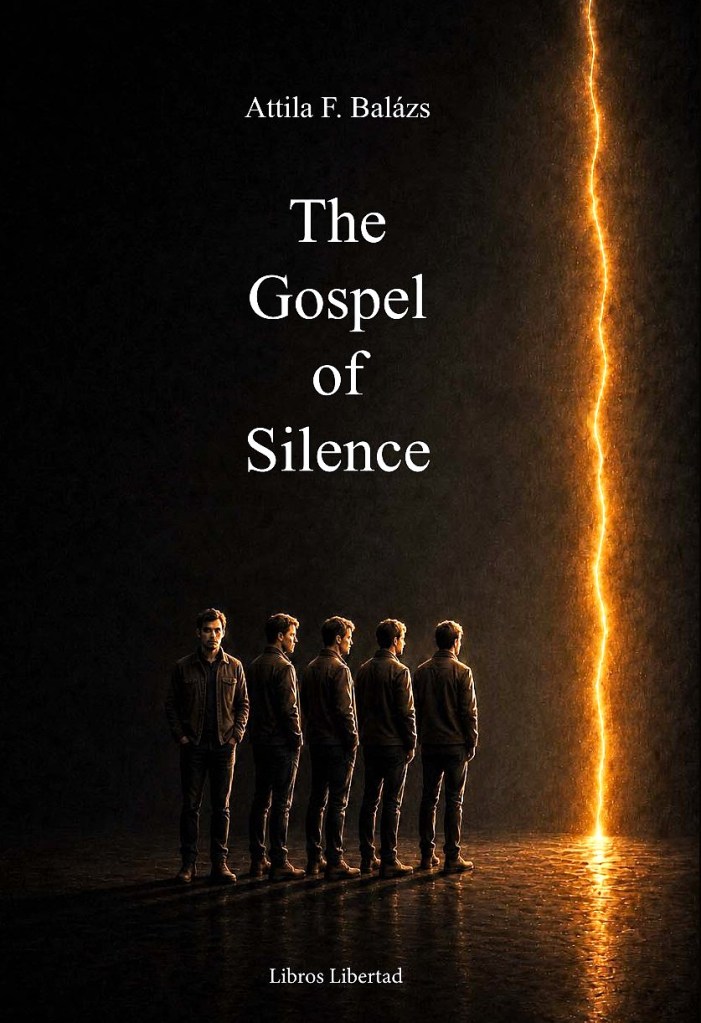
Mara: The Gospel of Silence opens this territory with a prose-poem voice that is unusually direct: "For a long time, I believed one stays alive by understanding everything. Now I know there are things one must simply endure, survive."

Pip: That's a significant revision to make about your own operating assumptions. And the childhood scenes that follow — ice cracking underfoot, wading into black marsh water, counting leeches as proof of having gone somewhere forbidden — all enact it physically.

Mara: Medusa frames desire as interruption — grand mythic language about "an apocalyptic prophecy" and "the parabolic myth of my oppressed life" cut through by italicized domestic voices: "Get up and help me do the dishes." The sublime and the mundane are arguing in the same stanza.

Pip: The mundane wins on points, as it usually does.

Mara: Nuances and Impulses work in shorter, more compressed registers — whispered desire in the first, dancers and an old man lost in reverie in the second. Twelve Narratives of the Gypsy gives the speaker a different kind of motion: "I was a river passer, a mule rider, an engraving on the rock — mule and man, the same flesh."

Pip: Entropy, Troglodytes, and Ugga push toward something more abstract — cells dying without noticing, troglodytes dividing the first earthly ownership while fireflies drift through cave air, and a sequence of compressed philosophical fragments about thought, logos, and the concept of the infinite reduced to "tiny concept for first-grade school."

Mara: What runs through all of it is a refusal to separate the body from the idea — desire is always also dread, survival is always also endurance, and the inner life keeps finding the outer world waiting for it.


Pip: Greek modernism, frontier families, diaspora parties, ice cracking under children's feet — it's a wide map.

Mara: What connects it is the pressure of inheritance — what gets passed down, what gets translated, what gets endured. More of that territory next time.

The Gospel of Silence

For a long time, I believed one stays alive by understanding
everything. Now I know there are things one must simply endure,
survive.
Children love excitement, challenges, danger. Often they fail
to perceive risks, or else they underestimate them. They do not
avoid danger; they examine it like some mechanism full of secrets
whose moment of activation they do not yet understand. We were
the same. In winter we ventured out onto the barely frozen lake,
whose ice cracked beneath every step as if warning us — or perhaps
luring us onward. We knew it was dangerous, but knowledge
alone was never enough reason to turn back. If the ice gave way
beneath one of us, we pulled him out however we could, then ran
home racing time itself before his wet clothes froze onto his body.
Now it seems as though it was not we who ran, but earlier versions
of ourselves whom no one can ever catch again.
In summer we waded into the murky marsh with its black waters.
I do not know what drew us there; perhaps the fact that it had no
boundaries, only density. We pushed through it waist-deep, later
picking leeches off ourselves on the shore — though we simply
called them bloodsuckers, as if the name alone could strip them of
all strangeness. We felt no disgust toward them; we counted them
instead, as though they were proof we had gone where we should
not have gone.
Stealing melons and fruit from the collective farm fields was almost
a ritual. It was not hunger that drove us, but prohibition. The
appearance of the field guard always set the same scene in motion:
waving his stick, he charged after us while we fled, as though some
ancient story wished to retell itself again and again. The older boys
escaped easily; the younger ones cried because the guard had come
too close. Now I know the fear did not come from the stick, but
from the realization that the world was capable of hunting us down.
I remember other runs as well. “Korea” — that was what they
called the two new streets built after the flood. In the house beside
the lake lived a Romani family. Their eldest boy was violent and
cruel — or rather, unavoidable.

https://www.amazon.com/dp/1926763874

Blood, Feathers and Holy Men

Excerpt

As the companions travelled, Keallach, Bjorn and Ari hunted small game and
sometimes they fished. Rordan, Ula and Yamka gathered edible mushrooms and dug
for roots and, following a full day’s trek, prepared the evening meal. Rordan was
quite happy to join the girls in a task normally left to women.
Bjorn, Ari, and Fire Maker emerged from a forest of alder, maple and birch, between
two mountain slopes, into a flat river valley partially shrouded in scatterings
of early morning mist. In the foreground was a wide meadow rich with new grasses
and spring flowers in yellows, purples and whites. Beyond the meadow, a reed-filled
marsh partially surrounded a sparkling lake.
The three had set out ahead of the others with lines and a net to catch trout for
breakfast. In the distance, Finten rattled off morning prayers with Keallach and Ailan
while Rordan, Ula and Yamka sent joyful laughter echoing through the boulders
of the steep mountainsides. Fire Maker walked in silence and didn’t seem to mind
that Bjorn and Ari conversed in the language of the Norse.
“She is wonderful,” Ari said. “If I were to spend the rest of my life with one person
… What I am trying to say is …”
Bjorn didn’t wait for Ari to finish his sentence. “Maybe, when we arrive at Fire
Maker’s homeland, you should ask Ula to marry you. Have you asked her if she feels
the same?”
“She is always with Rordan.”
“Why would he mind? His kind do not marry; they have a vow.”
“I know that, but I do not think Rordan is bound to that vow.”
Fire Maker signalled a silent pause. A cow moose lifted its gigantic head from the
morass of bulrushes, trailing a steamy clump of dripping swamp grass. Slowly chewing
her mouthful, the animal was content to observe the interlopers.
“If you really want to be with her,” Bjorn continued, “take her by the arm and lead
her away from Rordan, then tell her how you feel about her.”
The conversation was over as Fire Maker, who had walked a little way ahead, came
to a stream wide enough for good fishing. Bjorn and Ari hurried over to join him
with lines in the water.
Whenever the sun crossed the hills and mountains to set in the west, Fire Maker
and Finten became the campfire storytellers. With an apparent knack for language,
Father Finten was already fluent in the Mandan tongue. He related his stories from
the Old and New Testaments in ways both monks and laymen could relate to. He was
determined to make many converts when they reached the Mandan Nation. It was
his sacred mission.
The best stories belonged to Fire Maker. Everyone listened carefully when the
chief spread his hands to begin a story. In his deep, soft voice, he wove his tales with
expressive hands that cast wild animal shadows in the flickering light of the campfire.
“Long ago and long ago and long ago, the gods who made this land fought a
mighty battle to see who was strongest. Spirit of the North covered the land with
snow and ice. All the plant life went to sleep. The living creatures travelled many
moons south along the edge of the great salt water.

https://draft2digital.com/book/3562826

https://www.amazon.com/dp/1926763106

Straits and Turns

Excerpt

The predictable phrases came and went, and the warmth of the
wine, combined with the body heat of the people in the room, made
the atmosphere cozy. Even the conversation grew softer and fluffier as
the wine flowed. When Paula got up to visit the powder room, one of
the guests, Kostas, found the courage to lean in and ask, “Hey, Costa,
is she hot?”
Costa flashed his widest smile at the poor man, but before he
could reply, Vangelis butted in. “Don’t worry about Costa. He’s got it
right. He can pick and choose.”
Costa could almost see the man salivating at the concept.
He laughed out loud, but now the doorbell interrupted them, and
as their host went to greet the new arrivals, Costa saw Anna, the
airy, sexy, pretty, and ethereal Anna, enter the foyer, her husband
close behind. Anna was always perfectly dressed, always trendy and
sexy. She walked gracefully, elegantly, through the living room, and
Costa’s expert nose picked up her light lilac perfume. He fixated his
eyes on her, and he sensed that Anna knew he had been watching
her as soon as their eyes met. Somewhere between her sexy walk and
her faint, provocative smile, Costa saw the prettiest female of the
evening.
How do women always know when a man is looking at them?
Costa had often wondered about this but had never found an answer
that satisfied him. But they always know. And they almost always
smile back. It must be the same knowledge Costa always had when, in
a gathering of women, one, that special one, would be looking at him
with desire amid others who didn’t give a damn. It was knowledge
acquired from experience, and a womanizer like Costa had plenty of
that. Anna surely must have heard all the stories of Costa’s escapades
and misadventures. After all, the whole Greek community had heard
of them. As Anna joined the other women, Costa watched all the hugs
and kisses coming and going, each woman hugging and loudly saying,
“Hi, how are you?” while murmuring to herself, “bitch,” a word every
woman used when a prettier one entered the room and the eyes of all
the men glued themselves to her like limpets on a rock.

https://draft2digital.com/book/4250839#print

https://www.amazon.com/dp/1926763866

He Rode Tall

Excerpt

…those comments, the meeting blew up. Joel could understand that
all Mr. Johansson was trying to do was help, but if there were two
things you wouldn’t want to be telling Edward Hooper, it would be
suggesting government help and calling his child underprivileged.
There was no doubt that the Hoopers could sure use some help to
finance Joel’s education, but the last thing that was going to happen
in the hills that night was for Edward to admit it to any fancy
dressed school teacher.
Later, the school year came to an end. Joel graduated from high
school, and Mr. Johansson, after once again encouraging Joel to
consider the possibility of going further with his education, left
town for wherever he went every summer. Joel spent the next few
weeks working for his father, riding the high ridges, checking the
cattle, counting cows and calves, and making sure that all was
well in the pasture.
Back then, on July 20, 1969, as seventeen-year-old Joel rode
along, he thought of the hurt that he had experienced at home,
especially during the last few weeks of high school, the brutal treatment
of his mother by his drunken father, and the hard way that his
dad treated him. Back then, the Circle H was not a healthy place for
this seventeen-year-old boy to be; and really, not a healthy place for
anyone, and certainly not a place with a future.
That hot summer day back in July of 1969, Joel found himself
a long way from home at the end of the afternoon. Feeling mighty
hungry and needing to water both himself and his horse, Joel
dropped down out of the hills to the Ladners’ place. Larry Ladner
and his wife Erica were a dirt-poor young couple trying to eek out
a living for themselves and their four children on a small patch of
rented land. Their dream was to one day be able to put a
down-payment on a place of their own, but the way things were
going it looked like it wouldn’t be long before the Ladners would
be forced off of the land. Larry had been coming in from a day of
fieldwork on the tractor when he welcomed Joel. He knew the
Hoopers were good neighbors. As Joel sat with the Ladners and
ate his evening meal, he heard some exciting news on the radio.

https://draft2digital.com/book/3562862

https://www.amazon.com/dp/0980897955

Podcast Episode: Greek Poetry And Fiction

Pip: Manolis Aligizakis has assembled a catalog that moves from ancient Greek shores to Canadian prairie schools to a Moscow hotel hallway — and somehow it all holds together.

Mara: vequinox brings it together across poetry translations, novels, and short fiction — territory we'll cover through modern Greek verse, prose excerpts, and the themes of love, memory, and identity that run underneath all of it.

Pip: Let's start with the poetry.

Voices Across the Greek Tradition

Mara: This segment is about what it means to translate a literary tradition — to carry voices like Cavafy, Ritsos, Engonopoulos, and others across languages without losing what makes them cut.

Pip: And Cavafy cuts immediately. The setup in "The City" is a man planning his escape — new land, new sea, fresh start — and then the poem turns on him completely.

Mara: The turn is the whole poem. "New lands you will not find, you will not find other seas. The city will follow you. You will return to the same streets. You will age in the same neighbourhoods, and in these same houses, you will turn gray."

Pip: So the upshot is that geography is not the problem. The self is the problem — and it travels with you, luggage you cannot check.

Mara: Engonopoulos makes a different kind of claim in "Nikos Engonopoulos – Poems." His "Angry Poem About the Occupation" turns elegy into defiance — workers dropping their tools, fists raised, a martyred figure walking the earth pale-lipped but beloved.

Mara: Ritsos appears across multiple volumes here. "Yannis Ritsos – Poems, Volume II" gives us a boatman striding into a harbor at dawn, the sun rising like a woman's wet hair curled around cranes — sensory and grounded. "Volume V" and "Volume VI" are quieter, more unsettled.

Pip: "Kariotakis-Polydouri, The Tragic Love Story" brings the biographical weight — two poets whose lives ended badly, rendered here in verse about a woman at a piano, butterflies leaving through a window.

Mara: "Tasos Livaditis – Selected Poems," "Katerina Anghelaki Rooke – Selected Poems," "Hours of the Stars," and "Troglodytes" fill out the range — from Livaditis's compressed night imagery to Anghelaki Rooke's half-words and olive tree shapes. "Neo-Hellene Poets" and "Orange" and "Mythography" sit alongside them as further evidence of how wide this tradition runs.

Pip: From classical echoes to prairie roads — the fiction covers different ground entirely.

Prose Across Borders and Generations

Mara: The fiction here spans continents and registers — from a child's first bus ride in wartime Canada to a Moscow reunion to a painter's Arctic trek — and the question running through all of it is how people find their footing in unfamiliar places.

Pip: "Water in the Wilderness" opens that question gently. A woman named Tyne has been living on hospital food, and her friend Moe has kept a phone call from her on purpose.

Mara: The reason matters: "Moe smiled. 'Morley is awake and asking for you.' Tyne let her breath out on a deep sigh, sat back and covered her face with her hands. 'Thank you, God, thank you,' she whispered, then shot out of her chair and ran to get her coat."

Pip: Relief as a physical event — breath, hands, running. The excerpt earns it without explaining it.

Mara: "The Qliphoth" operates in a completely different register — adult, raw, interior. "In Turbulent Times" follows Ian, a man trailing a woman named Nora through a coastal Irish hotel, his knees literally trembling at the bar. "Redemption" gives us a young man leaving home for Vancouver, his father crying openly at the table.

Pip: "Wellspring of Love" brings back Rachael, older now, stuck on a dusty highway while her cousin heads west — and "Water in the Wilderness" shows us Rachael younger, boarding that bus for the first time, shuddering at its size.

Mara: "Jazz with Ella" lands its protagonist in a Moscow hotel corridor and delivers the line "We are your family" to a woman who was certain she had no family there. "Ken Kirkby: A Painter's Quest for Canada" documents a real exhibition at Parliament — a painting one hundred and fifty-two feet long, twenty years in the making.

Pip: "Small Change" puts a boy in a Pennsylvania classroom trying to locate his immortal soul while Sister Assunta slaps a pointer against her palm. "Prairie Roots" is lunch-hour softball and girls comparing notes in the willows. "Wheat Ears" and "Cloe and Alexandra" round out the set — one a memory of Cretan youth, the other a poem built around a denial: it wasn't me in that yellow cab, it wasn't snowing, I have no hair.

Mara: What ties them together is the texture of ordinary life under pressure — the meals, the car keys, the Scotch ordered twice.

Pip: And underneath the prose, there's a question the poetry keeps asking too — about where you belong and what you carry.

The Self That Cannot Escape Itself

Mara: Love, memory, and identity keep circling the same problem across these works: the past is not behind you, it is inside you, and it shapes every attempt to move forward.

Pip: Cavafy says it flat out. "As you have wasted your life here, in this small corner, you wasted it in the whole world." There is no smaller indictment.

Mara: Ritsos in "Yannis Ritsos – Poems, Volume V" reaches for the same idea differently — a man who keeps a small mirror in his pocket because it's the one fixed point when everything else shifts without warning.

Mara: "Kariotakis-Polydouri" holds memory as tenderness — butterflies always flying out through the window. "Mythography" turns inward to still water and a fir tree asking the night for wisdom. "Introspection" names it directly: practicing a religion on the longing for the past.

Pip: "Orange" answers that longing with the wind's reply — your sunshine hides in your heart. "Hours of the Stars" writes love onto the mountain tops of memory. "Katerina Anghelaki Rooke" and "Troglodytes" close the circle — half-words left behind, and a young poet begging the Muses to free him from his own imposed fears.

Mara: The pattern holds: escape is not the remedy. The work is staying present to what you carry.


Pip: A city that follows you, a mirror in your pocket, a bus you board for the first time — it's all the same question dressed differently.

Mara: Where you are, and what you brought with you. More from this site next time.

Wellspring of Love

Excerpt

…friends she made last year – two teenage girls and a younger boy who
lived next door to Pa with their widowed mother. They’d grown very
close over the summer, and Rachael had been excited at the prospect
of seeing them again. What she hadn’t anticipated was that Pa would
marry the widow lady and take on those two girls and boy as his own.
Rachael kicked at a small rock and sent it flying into the ditch. She
wouldn’t even have Lyssa here this summer because her cousin was
leaving in a couple of weeks for Vancouver.
Lyssa had told Aunt Ruby she was going for a holiday to see the West
Coast but would come home in the fall. Rachael didn’t believe her. When
Lyssa got to the big city, she probably wouldn’t ever come home. When
she had learned that Rachael couldn’t go to Ontario, Lyssa had tried to
talk her into going to the Coast with her on the bus. How she would love
to do that, but her parents would never let her go even for a few weeks.
Seemed they didn’t want her to have any fun at all anymore.
Thoughts of Lyssa made Rachael remember the party at the
Harrisons’ tonight. It would be in full swing, and where was she?
Walking alone on a dusty highway on a beautiful evening at the end
of the school year. Oh no, she wouldn’t be allowed to go to Vancouver
– she wasn’t even allowed to go to her cousin’s grad party.
She heard a car approaching from behind but paid little attention
until it slowed and pulled up beside her. She looked up, expecting to
see one of the district farmers or a hired hand on his way to town. But
a thatch of red hair above a freckled face made her stop abruptly and
stare. Kevin. She had not seen him since the disastrous night of the
dance at Spirit Lake.
“Well, hello, sweetheart.” He grinned at her from the open window.
“Fancy meeting you here, and on a Saturday night. How come
you’re not at Lyssa’s party? Or is that where you’re heading? Hop in,
I’ll give you a lift.”
“No thanks, I’m not going. I have too much to do to go to parties.”
She started to walk on.

https://draft2digital.com/book/3562917

https://www.amazon.com/dp/1926763327

In Turbulent Times

Excerpt

Ian buttoned his jacket, lit another cigarette and waited. His feet were sore and his calves ached. He shifted his position every couple of minutes. He thought: They can’t sit all this time on that concrete wall without their arses getting sore. He lit another cigarette. At his feet a litter of butts and grey ash messed the pavement.
The sky was darkening to sea-blue. A few stars twinkled.
At last they moved. While applause for the performance died to silence, and a low buzz of conversation replaced it, Nora and her friends slipped stiffly from the wall and stretched and put on cardigans. Ian saw Nora’s large bust below her blouse. She turned to the sallow man and said something. He replied and waved a long, skinny hand. The three girls walked away together along the path by the sea-wall and out on to the main road. They turned to the right in the direction of the Drumard Strand Hotel.
Ian followed until they had sauntered past his car. When he himself reached the car he climbed in and drove to the hotel by a side road that passed a row of private houses with gardens extending to the beach. It led him by the railway station and the bus terminus to the driveway of the hotel. He parked the car, combed his hair in the rear-view mirror, straightened his jacket and then walked casually into the plushy ambience of the hotel. It struck him as being somewhat old-world and serious but comfortable.
He entered the leathery den of the Slieve Corragh Room, where he had first met Nora and her friend. The bar was busy but not full. He stood in the doorway for a moment while the muted hubbub of voices and laughter and the warm smoky air drifted past him into the thickly carpeted lobby. He looked at the coffered, wooden ceiling, the white upper walls above dark, varnished wainscoting. A large painting of Slieve Corragh hung on the wall to his left. He felt at home here. This was his milieu. He strode across to the bar and sat on an empty stool beside a naval captain who had his back turned half towards him as he talked to a lady with a blue rinse in her hair.
‘Scotch and water, please. Glenfiddich.’
He waited. Out of the corner of his eye he could see the doorway. The anticipation and the Scotch and the aftermath of a mixed grill were teasing his stomach maliciously. He was acting like an adolescent, like a seventeen-year-old boy suffering his first unbearable love for the girl up the street, the skinny little girl in pigtails who had suddenly, without his noticing, grown into a woman. Ian’s knees were trembling. He gulped down the Scotch and ordered another.

https://draft2digital.com/book/3562904

https://www.amazon.com/dp/1926763270