Ready to Give Birth to Forgetfulness The zero exists and it doesn’t eternity is in its space distant root of the sea realities and reflections all the shed blood for sanctified or sinful dreams ecstasy of the flesh in the immensity of life thought that lifts and imprisons crowding of my mind sails, sphinxes and shipwrecks and Eros in absentia soul that flutters my cosmos is always in the cosmos from the foggy gleam of who I am passing memory joins me with the ready-to-die forgetfulness timid and at the same time a hero from the beginning to the end the attempt will be her unfamiliar hand in my hand when time unexpectedly enlivens youth music score that wished to love and guide me to the wind-whipped light will guide me to whom I was in the fleeting footmarks of an eternal Odyssey.
loneliness is immense so that people come in two at a time to endure it. Oftentimes they come three or four at a time of those extra lonely that human comfort calls perverted as if sin and self-humiliation as well as the people’s contempt cover another great shuttering inside them. Thousands of people come daily to meet in these third-class hotels with their mythical, sunken names Atlantis, Mycenae, Europe, New Life and to say that they love each other and want to enter one inside the other since they are cold, they feel cold because of their lost dreams their lost years, memories that don’t want to die thus maintaining the great populace away from its loneliness. And the three middle-aged maids those who make the erotic beds who have never been loved those with the big teary horse eyes forgotten in the snow gathered in the maids’ room like an ancient tragic chorus in front of the propylaea of a dirty sink talk with such forbearance that even the simplest words from their bitter mouths suddenly take the deep gleam of the myths. And they talk of their earnings about the rain, dreams, regrets…
…what beautiful mound hidden under that skimpy bathing suit she wore, the Muse of my day with her flowing brunette hair, her balanced curves, her excellent sized breasts, her exquisite buttocks which she moved in an erotic way unparalleled to any I had ever seen and trust me I’ve seen many, far too many to know the beauty from the average and even more so from the unworthy of my glance and this ethereal beauty walked as if floating over the smooth sand just as my dream of touching those exquisite curves brought me to heavens. Indeed, the ancient Muses were there interacting and playing with her, and I couldn’t see any difference between today’s earthly Muse and the Ancient ones, and here she was turned towards me when, suddenly, our glances met. She sensed that, behind my sunglasses, my eyes were fixated on her ethereal saunter, and she remained focused on me for more than ten seconds: the first acknowledgement. Yes, I was looking at her, and she knew it, and that was enough for the game of love to be played when she went back to her chair and, turning it to the sunshine, she lay her calligraphic body onto the multicoloured towel and gazed at the open water of the quiet and serene cove. I let myself travel along with her glance. I marvelled at the natural beauty of the cove with lapping waves and its whooshing breeze, while I didn’t hesitate to imagine this day’s wonder in the body of the tourist. In her early thirties she represented the female queen of the beach, yes, there were others too, some very pretty as well, yet this one was the special one of who one with exquisite taste, like myself, could easily get himself loose in the imaginary game two people play when the chance arises and this were my thoughts when suddenly the Ammoudara Aphrodite turned her body to her stomach letting the bright sunshine play with her back, from the top of her head to the very lustful buttocks and legs of hers, indeed it was that moment that she stared towards where I was sitting and realizing I was still with her she fixated her glance towards me. I raised my hand and lowered my sunglasses a bit, and seeing her from the top of my glasses, I smiled a full smile at her, to which, to my utter surprise, she also lowered her sunglasses and stared at me from the top of hers.
Pip: Manolis Aligizakis has assembled a catalog that moves from ancient Greek anguish to Canadian prairie winters to stock market schemes — which is either a literary festival or a very ambitious reading list, depending on your weekend.
Mara: vequinox brings all of it together on this site — translations of modern Greek poetry, original verse on love and desire, and a run of novels spanning hardship across continents and generations. Let's start with the poetry coming out of Greece.
Voices From Modern Greece
Pip: The modern Greek poets gathered here are working a particular problem — how do you hold loss, resistance, and beauty in the same breath without one canceling the others out.
Mara: The Yannis Ritsos volume sets the tone early. The poem "The Inexpressible" builds toward this image: "the blind musician, tired, goes back up. He puts his violin case on the chair. He opens it; two of the three glasses are in it. They are shining and whole."
Pip: So the broken things you carried out in guilt come back intact — the poem turns on that reversal, the indestructibility of what you thought you'd lost for good.
Mara: Constantine Cavafy's "Che Fece … Il Gran Rifiuto" works a related tension — the great No that is right and still burdens its speaker for life. Nikos Engonopoulos in "Goalpost" pushes into civic dread, asking whether the Sunday bells will be followed by hymns or machine guns.
Pip: Engonopoulos lands the ambiguity without resolving it, which is its own kind of answer.
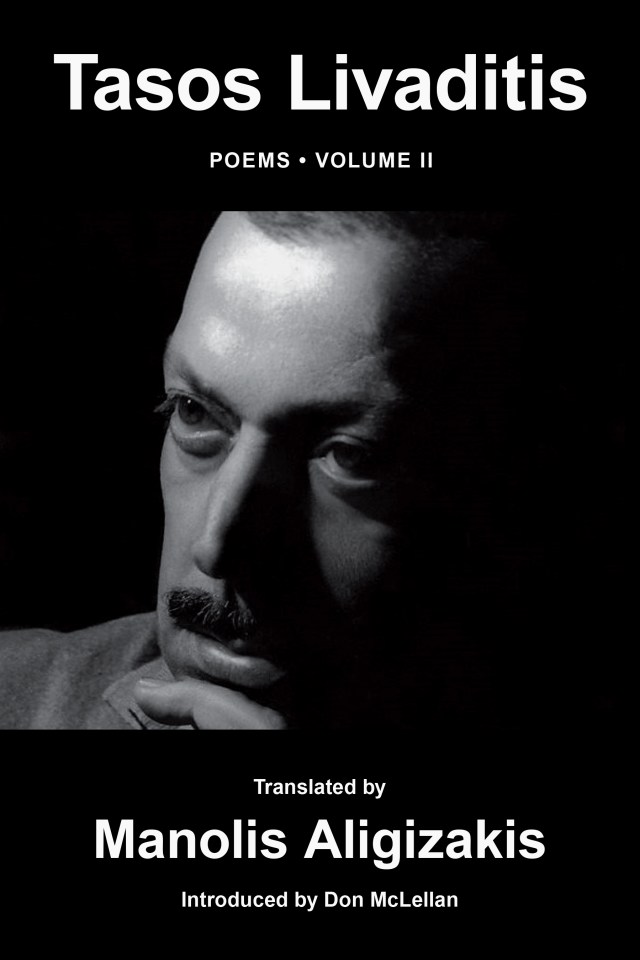
Mara: Tasos Livaditis in "Simple Talk" insists on plainness as survival — speaking, loving, dying "in a simple way." George Seferis in "The Shape of Fate" asks who orders destruction from behind, and Titos Patrikios watches a man of creative mind reduced to counting whether his wages last the month.
Mara: Antony Fostieris names "certain pain" that strikes the empty heart beyond all desire. The Neo-Hellene anthology and the Troglodytes collection round out the range, from birch-forest dawn to an invocation of the Goddess to purge the ego entirely.
Pip: Ten poets, one through-line: the thing that survives is rarely the thing you expected to keep.
Mara: The love poems take that survivorship somewhere more intimate — let's move there now.
Love At Both Edges
Pip: The love and desire poems here are not soft — they treat longing as a force with weight and consequence, something closer to weather than to sentiment.
Mara: "The Incidentals" opens the territory directly: "the seething angst of lust demands her body's contours and dark caves on the altar of Aphrodite deserving unemotional dedication, like any archon sitting up high, like any God jealous or self-absorbed and relaxed."
Pip: Desire framed as liturgy — the body as offering, the worshipper as functionary. That's a cold altar.
Mara: "Hear Me Out" pulls in the opposite direction emotionally but lands in the same isolation: two people on parallel paths going opposite directions, past the point where they first met, with only the roundness of the earth as any possible reunion.
Mara: "Wheat Ears" compresses the whole arc into image — "two bodies defining the shape of a monad," synthesis as astronomical and emotional at once. "Rendition" closes it with a line that strips possession entirely: "Of all you have amassed, none is yours."
Pip: Love, desire, and ultimately the inventory comes up empty. The novels take that emptiness and put it in a house with bad insulation — let's go there.
Novels Of Endurance And Reckoning
Pip: The fiction here keeps returning to people held in place by circumstance — weather, pregnancy, poverty, complicity — and asking what they do with the time they cannot escape.
Mara: "Fury of the Wind" makes that literal. Sarah, isolated on a prairie homestead through a brutal winter, moves house plants to the kitchen table each night to keep them from freezing, writes letters that take weeks to arrive, and waits. The passage reads: "she missed the companionship of others, especially Penny. What would she give to be able to sit down to a cup of tea in Penny's cheerful kitchen?"
Pip: A cup of tea as the full measure of what isolation costs. That's a precise kind of grief.
Mara: "The Unquiet Land" puts a different kind of waiting at its center — Mother Ross, who knows Caitlin is pregnant before the wedding, removes her own mother's ring from her finger and gives it to Michael for the ceremony. She hears Caitlin sobbing upstairs and swallows her own agony whole.
Pip: Respectability as ransom, as Mother Ross calls it — and she's already paid her installment.
Mara: "Water in the Wilderness" moves the tension into a seedy hotel corridor, Tyne's knees going weak as she waits for a deteriorated Corky Conrad to open his door. "Prairie Roots" grounds everything in the farming community's frank hierarchy — survival first, schooling second, and a father who insisted otherwise.
Mara: "Jazz with Ella" sends Jennifer onto a plane into a storm, retreating into questions about why she was chosen over Paul for a Soviet Union language tour, and what it cost her in salary to say yes. "Introspection" and "Hours of the Stars" work in verse — the first building toward "the final, greatest monad," the second catching grandparents' long faces at a christening where the names chosen feel like paganism to them.
Pip: Naming a child wrong, apparently, is its own form of hardship.
Mara: "In the Quiet After Slaughter" and "Poodie James" both circle institutions — policing and journalism respectively — where the people inside them are just competent enough to see the problem and just constrained enough to struggle with what to do about it. And "Swamped" drops into the financial world, where Eteo watches Platinum stock move and starts making his list of who gets rewarded.
Pip: Every novel here is about someone watching a system from just inside or just outside it, trying to figure out the angle of least damage.
Mara: Which is, when you step back, exactly what the Greek poets were doing too — just with fewer stock tickers.
Pip: The thread running through all of it is endurance — the blind musician climbing back upstairs, Sarah moving the geraniums, Cavafy's speaker living with the right No.
Mara: And the question underneath: what holds its shape when everything else breaks. More of that in the next episode.