“You know why I left. An excuse is irrelevant.” He could see she didn’t like his vocabulary, for which he had already been chastised by Sister Assunta. It’s good you know words, she had said, but you use them with too much pride. If saying what you know to be true is prideful, Rick decided he would have to continue to do it, and take his chances with God. “You know very well that I sent you home because you were a disruptive influence. You simply cannot pay attention and it interferes with the other children.” “I’m sorry to have to say this, Sister, but you know very well yourself that I don’t need to practise as much as the others. I can sight read and I know all the parts I have to sing by heart. And you didn’t send me anywhere, I left.” Her face was a faded parody or horror and spiteful righteousness. “You are a proud and sinful boy!” “I’m just being truthful, Sister. Isn’t it very important to tell the truth?” Rick could see that she was not willing to deal with his question. All she said was, “Well, I don’t know why you’re acting so contrary, but I just won’t have it. Now. If you are truly sorry for the way you have spoken, the Lord will forgive you.” “Forgive me? For what?” “For your sins.” “What sins? Is it a sin to know how to read music?” “Don’t get smart, young man. You know your sins. Disobedience, vanity, willful…” He cut her off. “Is it true that choir is a voluntary extra-curricular activity?” Sister Rose glared suspiciously at him out of her small, pale blue eyes, their pink rimmed lids and short blond lashes flickering with confusion. “Yes, of course, once you’ve been accepted for the privilege. But what has that got to do with anything?’ ‘Just this,” he said. “I quit.
20th of December Not a cow nor a dog in the fields; the collar of the guard is raised; wind blows away the fluff of everything nothing is soft anymore. A woman in the front step of her house lights her heater the wind took her place in the room smell of coal floats and the woman resembles a door. If someone laughs in the wind it’s not because of joy but of insistence; a laughter possesses nothing nor with the fear of possessing anything.
She’s not a bad person. The kids from church call her fast, whatever that means, but she’s not what they make it sound like.” “If you say so. Anyway, you were at her graduation ceremony yesterday. Isn’t that enough?” “It’s not the same thing, Ronnie, and you know it. The party tonight is at her place and it’s just for special friends.” “Well, you’d just better forget it.” Ronnie picked up his mug and got to his feet. “I’ve got to get to work. Morley’ll be ready to start the cutting. And listen, Rachael, give your mom a break and don’t make things harder for her. She has enough to worry about with Aunt Millie being sick.” Rachael’s look changed from one of self-pity to a worried frown. She stood up. “Ronnie, do you think … that is … is Aunt Millie going to make it?” A cloud passed over his face. “I hope so, I really hope so. But only God knows that, and all we can do is pray for her.” He put his mug in the sink, retrieved his cap and went out. Rachael stood for a minute longer staring at the closed door, then she went to the phone to call Lyssa. ͣMorley and Ronald were sitting at the kitchen table when Tyne walked in a little before nine o’clock that evening. Both men turned quickly to look at her. The aroma of coffee drew her eyes to the stove where a pot hissed and bubbled an invitation. Responding to their greeting, she bent to kiss Morley’s cheek. Sensing his intention as he started to rise, she murmured, “Don’t get up, honey. I’ll help myself to the coffee.” “But you look worn out, Sweetheart.” “And you have been working all day in the fields.” She filled a mug with coffee and sat down at the table. Both men spoke at once. “How’s Aunt Millie?”
Poetry as a Return to Origins and a Form of Resistance
By Attila Balazs
…One of the volume’s significant achievements lies in its capacity to unite seemingly incompatible registers. Mythology, philosophy, eroticism, biography, personal history, and social criticism coexist in expansive, discursive poetry that at times approaches the prose poem. The language moves from solemnity to sarcasm, from prayer to invective, and from contemplation to revolt.
Images often accumulate with torrential force. The poet does not always seek classical clarity, but rather intensity. He constructs through associations, returns, repetitions, and contrasts. Light and darkness, flesh and pneuma, humility and pride, logic and madness, life and death define one another.
Madness occupies a privileged place within this poetic system. It may represent suffering and psychological rupture, but also freedom from the logic of a diseased world. The madman possesses the right to speak the truth that rational people avoid. The poet and the philosopher stand at the margins of society precisely because they see what others refuse to see.
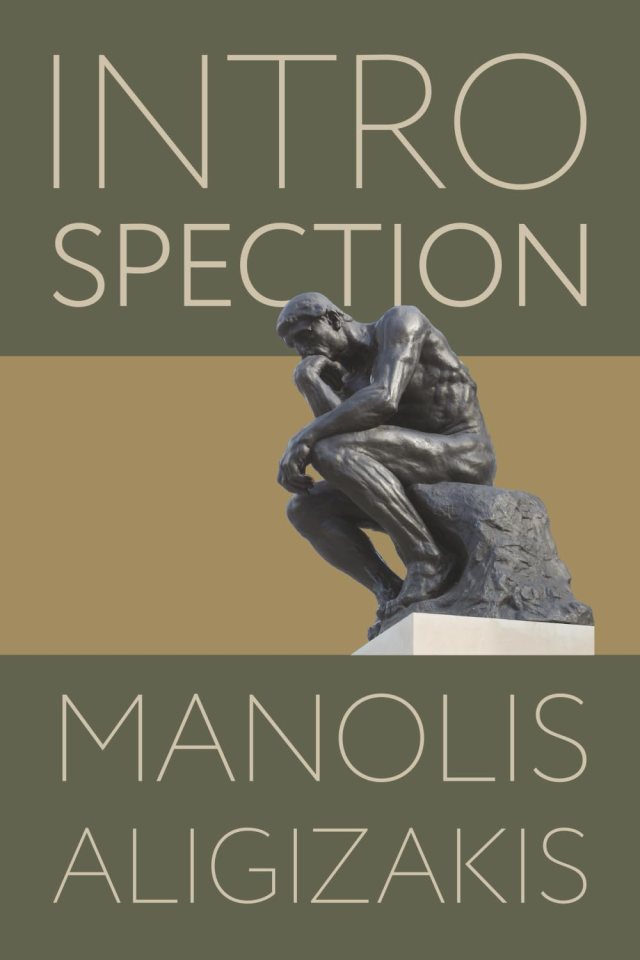
From here arises the ambivalence of the title Introspection. The inward gaze does not lead to withdrawal or passivity. On the contrary, the inner depths become the place from which the confrontation with the world begins. The self descends into its own viscera, into memory, desire, and the abyss, only to return to the surface with images and truths it offers to others.
Introspection thus becomes a form of responsibility. To know oneself means to know one’s roots, wounds, desires, and contradictions. It also means understanding that individual experience is not isolated, but belongs to a shared history and a common humanity.
The poetry of Manolis Aligizakis is a poetry of deliberate excess. It does not fear great words: destiny, eternity, truth, freedom, immortality, beauty. In an age in which such notions are often viewed with suspicion, the poet recovers them and restores their gravity. He still believes in art’s capacity to change the human being, defend dignity, and save something from death.
At the centre of the volume lies a paradox: the human being is mortal, yet consciousness aspires to immortality; man is fragile, yet dreams of the Overman; he is alone, yet speaks in the name of all humanity. From this contradiction arises the energy of the poems.
Introspection may be read as a symbolic autobiography, a modern epic, a philosophical meditation, or a testimony to the condition of the creator. All these readings are possible because the volume refuses to remain within a single genre or a single era.
Aligizakis constructs his own mythology from fragments of the Greek world, family memory, the experience of exile, and the great questions of European philosophy. Within this mythology, the poet is simultaneously child, lover, fighter, recluse, prophet, and martyr.
At the end of the book, the feeling remains that poetry is his true homeland. It is the place where the past may be revived, where the dead may be summoned back, where love may suspend time, and where the human being may transcend his limits for a moment.
Through creation, the poet does not definitively defeat death, but he refuses to grant it the final word. His traces remain imprinted in language, like the footsteps of his ancestors in the native soil. And the journey from Alpha to Omega does not end, but is transformed into a new beginning.
This is perhaps the true meaning of introspection for Manolis Aligizakis: not an enclosure within the self, but a descent into the depths of being to discover a light that may be brought to the surface and shared with others. A fragile and dangerous light, capable of burning, but also of guiding. A light that bears the name of poetry.