Pip: Manolis Aligizakis — translator, poet, publisher, and apparently a one-person archive of everything Greek literature has ever felt about mortality, love, and the road.
Mara: vequinox has been busy. Today we're moving through modern Greek poetry in translation, then into myth and mortality, and finally into fiction and travel narratives that cross borders both literal and historical.
Pip: Let's start with the poets.
Voices Across the Aegean: Modern Greek Poetry in Translation
Mara: The throughline across these translations is a question: what survives when a poem crosses languages? The Cavafy post gives us one answer through the myth of Achilles and a god who betrays his own prophecy.
Pip: And Cavafy frames it with Plato first, which is a move — citing the Republic to set up a poem about divine bad faith. The quote lands hard: "Yet, he, himself… who sang the hymn… he killed my son."
Mara: That line is Thetis speaking. Apollo sang paeans at her wedding foretelling her son's long life, and then personally went to Troy and killed Achilles. The prophecy and the killing share the same mouth.
Pip: Which is either theology or the oldest recorded case of a conflict of interest.
Mara: The Yannis Ritsos volumes — both Volume V and Volume VI — push into similar territory from a different angle. Volume V gives us the evening star as an eraser moving back and forth over a mistake that never quite disappears, birth and death as a rhythm rather than a sequence.
Mara: Volume VI's "Same Word" watches language itself tremble under its own unfamiliar meaning, like a nerve that shivers and bursts. Ritsos keeps returning to the threshold between sense and silence.
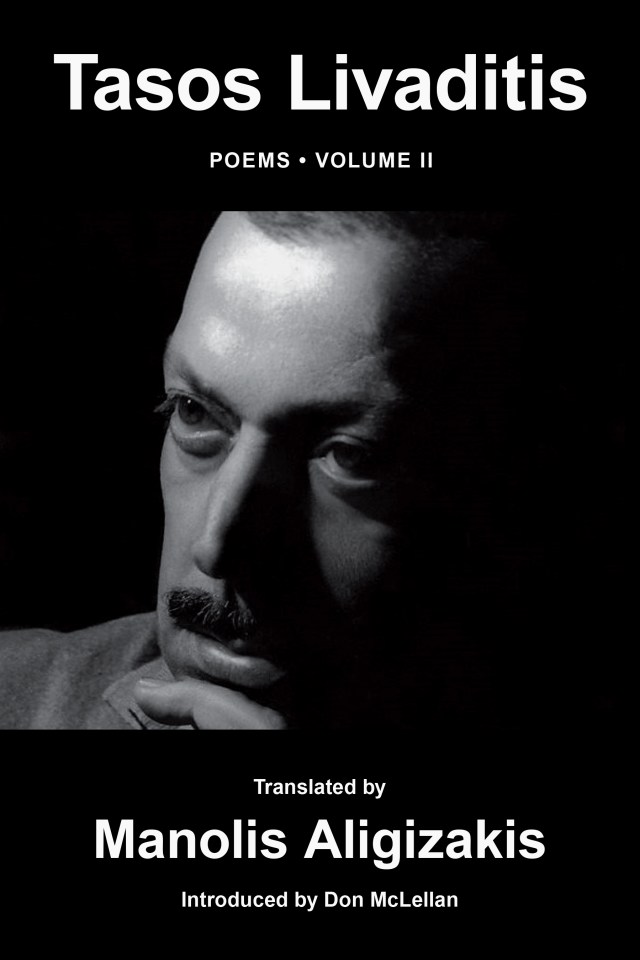
Pip: Tasos Livaditis takes that threshold into a tavern. The bouzouki player in Volume II swears every day he'll turn his life around, and every night the world deepens and pulls him back through the door.
Mara: George Seferis in the Collected Poems gives us crickets ticking out of rhythm, a house full of them, and the line "we don't even whisper, because the machine is speeding before horror and contempt." The anthology Neo-Hellene Poets lands a parable about a bird that can learn every sweet song except the words "I love you."
Pip: Katerina Anghelaki Rooke's Selected Poems counts time differently: "I count time with what I've lived and what is forthcoming that resembles the incomparable end. Only, look, the craft and the fisherman can't be separated from the blue."
Mara: Titos Patrikios in Selected Poems is more pointed — "Economic Development" watches emigration and foreign investment rise together while newspapers announce cultural ideals are being maintained. And Nuances holds the sharpest compression: a poem called "Repetitions" that names peace as something a sword erases.
Pip: Red in Black steps outside Greece entirely, finding illumination in Craiova, Romania, through Brancusi sculptures — the Blind Boy and The Kiss — connecting Greek poetic consciousness to Romanian artistic space. That range from Cavafy's Troy to a Romanian museum is the real scope of this project.
Mara: From mythic time to the present tense — which is exactly where the next set of poems lives.
Eros, Entropy, and the Weight of Ending
Pip: This cluster asks what myth and love actually cost — not in the abstract, but in the body, in the moment, in the interruption.
Mara: Medusa opens with a poem called "Gravestone" where Eros descends to a melancholic youth and a widow turns in the moonlight, and then the poem pivots without warning: "Nothing matters more than the armchair craving my body as the widow craves her late husband."
Pip: The domestic interruptions — the faucet, the table, the wife demanding full attention — aren't a joke at the poem's expense. They're the actual argument: desire and the ordinary are not separate territories.
Mara: Entropy's "Eternal Cycle" strips that argument to its bones — earth aging, returning its shine, then embracing each thing on its path toward what it always longed for. Wheat Ears traces the same arc through a single memory: beauty glimpsed through a window, understood only later when years have become dry leaves on a sidewalk.
Pip: Rendition and Life is a Poem hold the stranger registers — one a requiem tracking dawn through alcohol and fear, the other a surrealist marketplace where oaks erect monuments and white rabbits somersault on floating meadows. Hours of the Stars closes it with a prologue about those who never let their glance reach the light, and the chaste people who do.
Mara: That tension between those who see and those who can't — it runs through the fiction too.
Roads Taken Hard: Fiction and Travel Across Borders
Pip: The fiction here is about people in motion — and motion that doesn't stop even when it probably should.
Mara: Ugga frames that with unusual economy: "For the light to change the production must pause and the pause must be produced methodically." Four lines that describe filmmaking and also, quietly, everything else.
Pip: In Turbulent Times gives us Ian Anderson driving furiously south from Lisburn, cursing his own idea the entire way, and not stopping. The road is "drunken," the steering wheel swung "in fury, like a ship's skipper in a storm."
Mara: The rationing detail grounds it precisely in postwar Northern Ireland — no meal over five shillings, no more than three courses, restaurants exempt and resented for it. The historical texture is load-bearing.
Pip: Straits and Turns puts a mechanic behind a fogged window in a Vancouver train yard, rain dripping steadily, "poetically, he'd say." The Circle moves between Baghdad and a new apartment, a move organized with pizzas and a reserved elevator and a view west toward the Pacific.
Mara: Blood, Feathers and Holy Men is the furthest journey — Irish monks in North America, a guide warning that the trip takes five or six seasons and that stragglers get left behind. And Jazz with Ella lands in Moscow, a Canadian teacher stepping onto Soviet soil and remembering Churchill: "a riddle wrapped in a mystery inside an enigma."
Pip: She suspected it was hyperbole. Then she stepped off the plane.
Mara: What holds all of this together is the act of crossing — languages, borders, centuries, the distance between a prophecy and its betrayal.
Pip: Next time, we'll see where that crossing takes us.