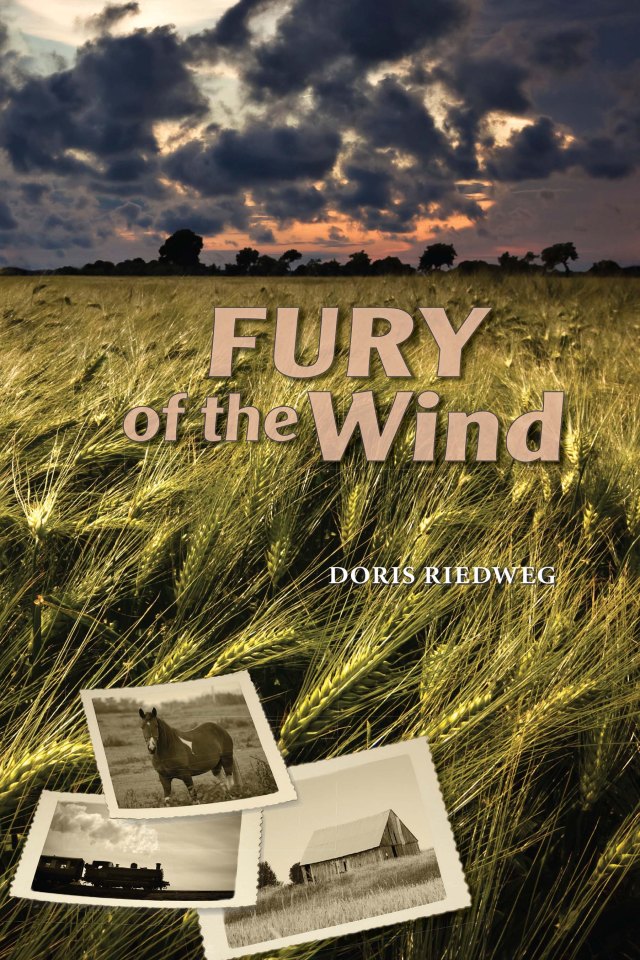
…and Sarah did not complain. The old house had no insulation, and the wind found its way in through walls that, in other seasons, appeared sturdy enough. It was not unusual for them to awaken in the morning with the flannelette sheet and blankets, where their breath had dampened the material, frozen against their chins. Each night Sarah moved the house plants – geraniums and begonias that Ben said his mother had lovingly tended – to the centre of the kitchen table where she covered them with a light cloth. She did the same with the pitchers of milk and cream, carrying them from the pantry to the kitchen where the cookstove would provide enough warmth until the early morning hours to keep them from freezing. The weeks passed slowly. No one came to the house, and Sarah was unable to ride Flicka or drive the old pickup truck to the Mc- Neill farm. She spent the days sewing new curtains and knitting socks and mitts from the wool she had bought on her last trip to Nimkus in late October. She wrote endless letters to Margaret and Elizabeth in Ontario, and waited impatiently for the mail that Ben brought home from his infrequent trips to town with the team and sleigh. For the most part they lived by their own resources on the provisions they had in the house. But Sarah looked forward to the vegetable garden she planned to plant in the spring. She had searched out Mrs. Fielding’s canning jars so that she could preserve everything she could get her hands on through the summer months. These plans and activities helped to pass the long days and the even longer evenings. But she missed the companionship of others, especially Penny. What would she give to be able to sit down to a cup of tea in Penny’s cheerful kitchen? And how she longed to see little David who, when she had last seen him, was beginning to take a few faltering steps around the furniture. By now he would be running all over the house. She thought of David when she read Margaret’s latest letter. It was four pages of the delights of motherhood, along with every detail of her new daughter’s first two months of life. As she read, Sarah felt a familiar ache deep inside her where she had been sure that, by now, new life would be growing. Why wasn’t it? Could there be something wrong with her? Ben never spoke of a family and, although she had once casually mentioned that he needed a son to…
– I guess we better get going, I said. We don’t wanna miss our rendezvous. Burt didn’t budge. Finally he said, Ain’t gonna be no rendezvous. He loosened the flaps of his pack and spilled its contents. River rock. I dumped mine — the same. – What’s going on, Burt? – Ain’t no satellite receiver, little brother. Those two buggered off long ago. And look, he said, fingering the napkin map and peering over the edge into the ravine. They were hoping we’d have ourselves a little accident. – But this cable! And the TV store! Burt chuckled. The van was leased, he said. The TV store was rented by the month. I still wasn’t convinced. – I was checking on my stash one night when I overheard the two of them talking. It was all Swanson’s idea. He’s done this before. Bud’s his stooge. – And? – I told the cops everything. Those two are probably in cuffs by now. Burt removed a nylon bag from his pack. – Open it, he said. It was stuffed with paper money, and plenty of it. – Explain, Burt . . . – While Bud was trying to find mine, I was looking for his. A couple of times we almost bumped into each other. With a little help from a friend, I found his first. All the share money, his cut of the TV sales. My brother separated the money into three piles and pointed to the tallest. The bills were stacked like a column of Chinese characters. – I figure we’d turn this in, he said. It belongs to Aunt Peggy and the others. But this one—he stuffed the second pile into the pack— is ours. After all, folks have their TVs. – And the third? – That’s for cousin Mark. A reward. He’s the one found a couple of Bud’s chewed-up toothpicks down by the river and suggested we start digging.
Ambiguous Pose In the night, on whatever side you turn, you find the same wall again up to the top with the nails and the cracks from which the shadow of the house evaporates. In the morning, the chairs step on the floor again On their four legs, on one chair, lies the headless doll, on the other chair lie the four keys and the red gloves.
Stump Tree stump soaking in lake water eagle wonders if to or not to dive and grab the lonely bass while a loon calls his faithful mate and you look at the expanse of firmament while rain soaks you like a dead stand where the osprey swoons to dock and breezes morph outlines of shapes in lucent speculum as you hook the bait and toss your line a delicate splash echoing
Pip: Manolis Aligizakis has been quietly building one of the more ambitious translation and publishing projects in Canadian letters — and vequinox has been keeping pace with it post by post.
Mara: Today we're moving through three territories: the Greek poets Aligizakis has translated and championed, his own original collections where myth and lyric reflection do the heavy lifting, and the fiction and memoir excerpts that round out the catalog. Let's start with the translated poetry.
Greek Voices, Exile, and the Weight of the Word
Pip: The Greek poetry translations here span decades and temperaments — Ritsos, Cavafy, Livaditis, Engonopoulos, and more — and the question they collectively raise is what it costs to carry that tradition into English.
Mara: The Tasos Livaditis Selected Poems, longlisted for the 2023 Griffin Poetry Prize, gives you a sense of the stakes. The poem opens: "Tonight, we decided to write a letter for you, mother. Perhaps we may hear the rain dripping on your worn-out clogs."
Pip: That "we decided" is doing a lot of work — collective survival addressed to one exhausted woman. The grief is completely specific and completely transferable.
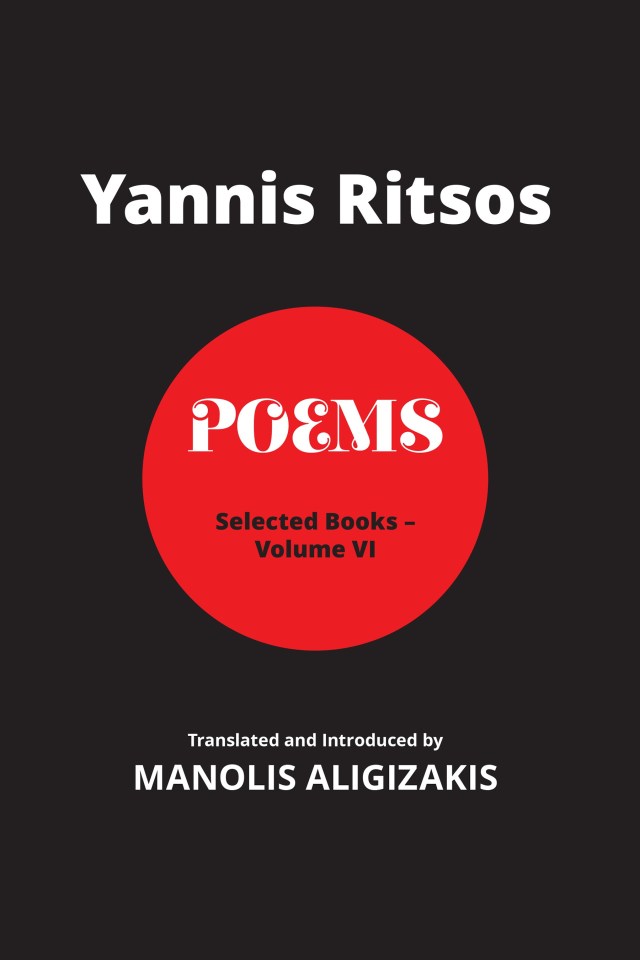
Mara: Ritsos shows up across multiple volumes here. In Volume III, the Exile Diaries entry for the thirteenth of December reads: "Ball forever between two kicks and I see myself played, the only spectator, punished not to be sad."
Pip: Ritsos in exile, watching himself from the outside. That's not self-pity — that's a man who has outlasted his own feelings and is just reporting the weather.
Mara: Volume I and Volume V extend that range considerably. Romiosini in Volume I is a long mythic address to a woman who embodies Greek endurance, while The Dead House in Volume V turns inward — a family scene held in suspension, the mother embroidering under an oil lamp while the father is away hunting.
Mara: The Katerina Anghelaki Rooke Selected Poems opens with a figure whose face extends "like the whitewashed rooms of the paternal home" — domestic scale carrying enormous emotional freight. The Kariotakis-Polydouri volume pairs two poets whose real-life tragic love story frames the work; the Cavafy collection gives us souls sitting in withered bodies, loving and fearing the miserable lives they lead.
Pip: Engonopoulos reaches for the Phoenix myth to explain why Greek cities keep burning down and rebuilding. The Neo-Hellene Anthology pulls the widest lens — a seasonal love poem that ends not with waiting but with going to find the beloved when autumn arrives. Titos Patrikios closes it out with words that never got said, slowly petrifying into silence.
Mara: What connects all of it is that translation here is not a neutral act — it is an argument that these voices belong in English.
Pip: Which makes the next territory feel like a natural extension — Aligizakis's own original work, where the myth-making is his.
Myth, Rebirth, and the Lyric Self
Pip: The original collections gathered here are doing something specific: they're using mythic structure — rebirth, dissolution, the cycle of loss and return — as a container for very immediate lyric feeling.
Mara: Mythography makes the argument plainly. The poem "Rebirth" reads: "lonely I now feel and in salinity I shall dissolve to dust I shall turn and as a vesper I shall return slowly digested breath by breath particle upon particle wave against wave I shall endure with hope over new hope."
Pip: Dissolution as a form of patience. That's a genuinely hard thing to write without tipping into sentiment, and it doesn't tip.
Mara: Entropy's "Archer of the Unfeasible" runs a similar arc — a speaker who is very late, hung between meaning and fate, spending the unfeasible. Troglodytes frames the poet himself as a force of nature entering "the heart of July's noon hour ruffling the petals of the jasmine." Wheat Ears catches an echo of a raindrop falling into a fountain and greets life directly: "splash."
Mara: Rendition, Impulses, Nuances, and UGGA each work at smaller scale — a bronze statue waiting for a shard of sun, heroes rising moistened by fish scales from old newspaper wrapping, a scarf dropped and snatched, a collective body refusing mass death. The register shifts but the underlying motion is the same: something dissolves, something returns.
Pip: From rebirth in lyric form to rebirth in narrative — the fiction excerpts are next.
Stories in Motion: Fiction and Memoir on the Page
Pip: The prose excerpts span genre and geography — a wartime thriller, a Vancouver taxi story, a painter's Arctic odyssey, a hospital corridor, a widow deciding to live — and what they share is a particular attention to physical detail carrying emotional weight.
Mara: In Turbulent Times sets the scene precisely: "Clifford cut the car's bright beams, plunging the passengers into pitch darkness. Then the interior lights came on as the Bentley doors opened. Ian took Nora's hand and helped her out." A cottage materializes around them — willow-patterned plates, a pendulum clock, a fire already set.
Pip: The physical world doing the work of welcome. You know everything about the people in that room from what they notice.
Mara: Straits and Turns goes somewhere rougher — a Vancouver cab driver named Costa, a fare that ends with a raised middle finger and eleven dollars sixty cents that nobody can produce. The scene earns its tension through accumulated small indignities before the confrontation lands.
Pip: Ken Kirkby: A Painter's Quest for Canada is the one that swings the widest. A boulder, a ten-thousand-dollar stunt, a breakfast meeting with the Speaker of the House, and eventually a private conversation with a federal minister about letting Nunavut be a land of its own ideas.
Mara: Wellspring of Love turns on a hospital doorway — a surgeon walks in and Tyne realizes she knows him from a long time ago, both of them carrying more history than the room can hold. The Circle closes on the simplest of the bunch: Cathy telling Emily to go where her heart takes her and never look back with regret. Savages and Beasts holds the balance between violence and a moment of golden evening light in Kamloops, just before Anton explains where the missing children are.
Pip: Six different worlds, all of them asking what people do when the next move is genuinely uncertain.
Mara: Across all of it — the translations, the original poems, the fiction — the through line is that language is where you go when survival requires more than silence.
Pip: Which means the next episode has a lot to live up to. We'll see what Aligizakis brings next.



 Manolis Aligizakis