
REVIEW
Poetry as a Return to Origins and a Form of Resistance
By Attila Balazs
…One of the volume’s significant achievements lies in its capacity to unite seemingly incompatible registers. Mythology, philosophy, eroticism, biography, personal history, and social criticism coexist in expansive, discursive poetry that at times approaches the prose poem. The language moves from solemnity to sarcasm, from prayer to invective, and from contemplation to revolt.
Images often accumulate with torrential force. The poet does not always seek classical clarity, but rather intensity. He constructs through associations, returns, repetitions, and contrasts. Light and darkness, flesh and pneuma, humility and pride, logic and madness, life and death define one another.
Madness occupies a privileged place within this poetic system. It may represent suffering and psychological rupture, but also freedom from the logic of a diseased world. The madman possesses the right to speak the truth that rational people avoid. The poet and the philosopher stand at the margins of society precisely because they see what others refuse to see.
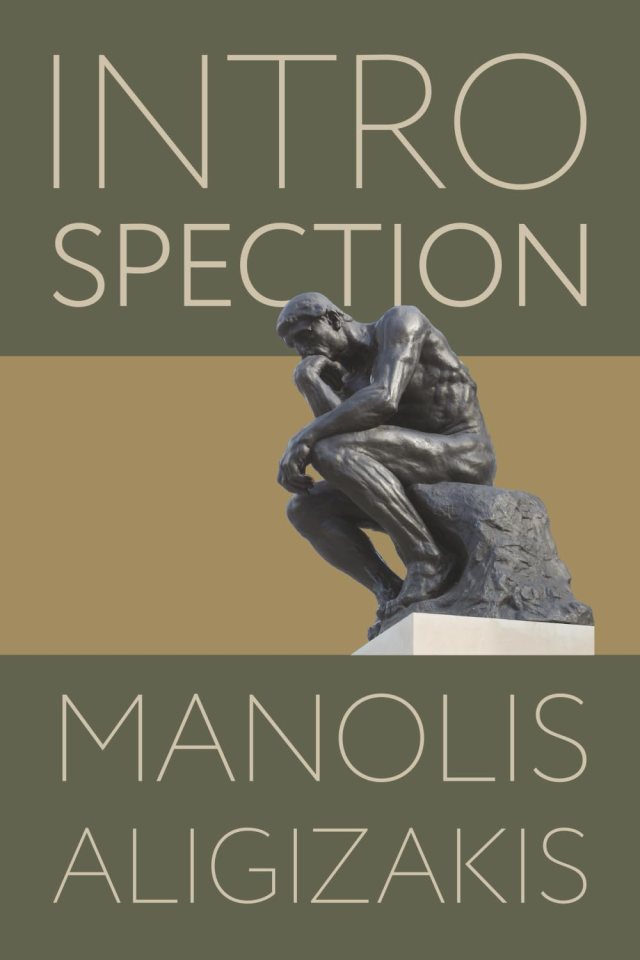
From here arises the ambivalence of the title Introspection. The inward gaze does not lead to withdrawal or passivity. On the contrary, the inner depths become the place from which the confrontation with the world begins. The self descends into its own viscera, into memory, desire, and the abyss, only to return to the surface with images and truths it offers to others.
Introspection thus becomes a form of responsibility. To know oneself means to know one’s roots, wounds, desires, and contradictions. It also means understanding that individual experience is not isolated, but belongs to a shared history and a common humanity.
The poetry of Manolis Aligizakis is a poetry of deliberate excess. It does not fear great words: destiny, eternity, truth, freedom, immortality, beauty. In an age in which such notions are often viewed with suspicion, the poet recovers them and restores their gravity. He still believes in art’s capacity to change the human being, defend dignity, and save something from death.
At the centre of the volume lies a paradox: the human being is mortal, yet consciousness aspires to immortality; man is fragile, yet dreams of the Overman; he is alone, yet speaks in the name of all humanity. From this contradiction arises the energy of the poems.
Introspection may be read as a symbolic autobiography, a modern epic, a philosophical meditation, or a testimony to the condition of the creator. All these readings are possible because the volume refuses to remain within a single genre or a single era.
Aligizakis constructs his own mythology from fragments of the Greek world, family memory, the experience of exile, and the great questions of European philosophy. Within this mythology, the poet is simultaneously child, lover, fighter, recluse, prophet, and martyr.
At the end of the book, the feeling remains that poetry is his true homeland. It is the place where the past may be revived, where the dead may be summoned back, where love may suspend time, and where the human being may transcend his limits for a moment.
Through creation, the poet does not definitively defeat death, but he refuses to grant it the final word. His traces remain imprinted in language, like the footsteps of his ancestors in the native soil. And the journey from Alpha to Omega does not end, but is transformed into a new beginning.
This is perhaps the true meaning of introspection for Manolis Aligizakis: not an enclosure within the self, but a descent into the depths of being to discover a light that may be brought to the surface and shared with others. A fragile and dangerous light, capable of burning, but also of guiding. A light that bears the name of poetry.

