In the back seat of Tyne’s car, Bobby chattered almost non-stop all the way home from Emblem. He’d had a grand day at Mrs. Milligan’s, he told her. “Aunt Millie came and we played outside on the swing, and then Mrs. Milligan and Aunt Millie played ball with me. Then we all had ice cream on the lawn before you came from work.” “I see,” Tyne said, raising her eyebrows at him in the rearview mirror. “And you didn’t save any for Rachael and me?” “Guess not. Sorry.” Tyne chuckled and turned her attention to the girl who sat beside her. “How was school today, Rachael?” A shrug, then a muttered, “All right, I guess.” “Just all right?” For a moment Rachael didn’t answer, then she blurted, “Lyssa was being mean again.” Tyne’s antennae rose. “What did she do? Can you tell me?” Rachael glanced towards the backseat. Seeing Bobby occupied with his dump truck and talking quietly to himself, she lowered her voice and said, “She’s always telling me my brother is a freak because he hasn’t got all his fingers. And today she said it was my fault.” “Oh, Rachael,” Tyne murmured. “We’re almost home, honey, let’s talk in the house.”
thirteen Hunger eliminated many thirst even more money kept them all dead both the living and the corpses this was first created or was the Gods no one could answer whether the bum gave birth to the philosopher or the philosopher to the bum no one will answer us
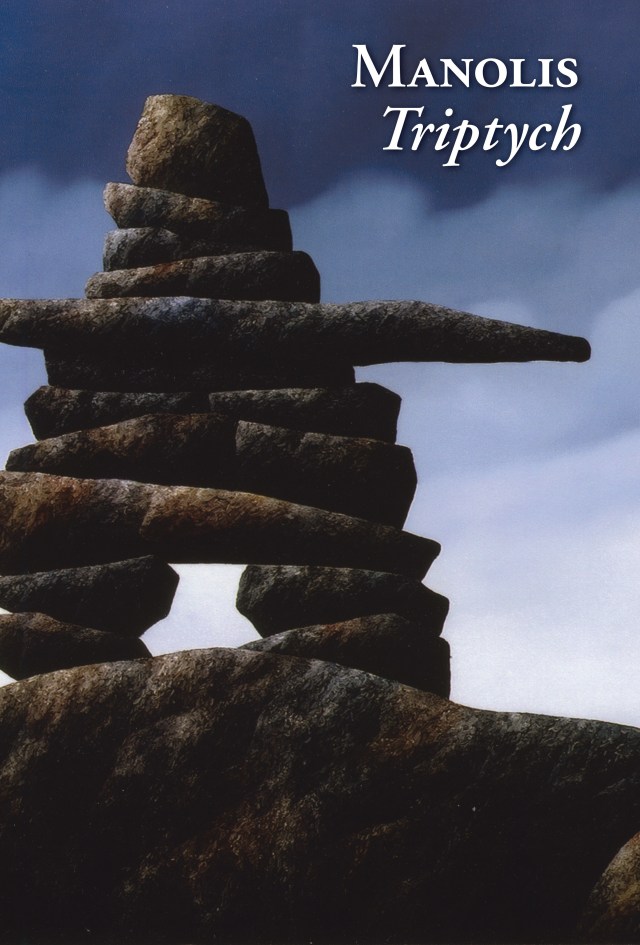
Love, Loss, and the Ethics of Witness: Manolis Aligizakis’s Triptych
“Valiant” offers one of the clearest examples of this ethical use of myth and heroism. The poem confronts a warrior with the violence hidden beneath his own story of glory: the maiming of enemies, the killing of children, and sexual violation. What had appeared as courage is revealed as a form of moral blindness. The poem’s achievement lies in its refusal to let “valiant” remain an uncomplicated description. It asks who has the power to name an act heroic and whose suffering is excluded from that naming.
The collection also meditates on aging and the passage of time. “Eye Shadow” and “Recount” consider the changes that occur in the body and in self-presentation. Youth is not idealized without qualification; it is remembered as a period of insecurity, desire, aspiration, and social performance. In “Molecules,” the body is subjected to the clock’s continual reminder of death. “Inexorable” challenges the human assumption that life extends indefinitely. These poems do not deny aging’s losses, but they also resist the illusion that youth alone offers meaning.
The domestic poems are essential to this aspect of the collection. “Evening,” with its salad, bread, wine, napkins, and remembered first encounter, creates a quiet counterpoint to the book’s grander mythic and political rhetoric. Its attention to shared food and routine restores value to ordinary companionship. Likewise, “Terminus,” though not part of this collection, finds a parallel here in Triptych’s repeated focus on the fragile rituals that give life its emotional shape. This poetry is strongest when it allows the domestic scene to bear the weight of larger questions.
The final movement of the collection returns to questions of language and poetic responsibility. “Goldfinch” imagines the poem as a song continually threatened by routine but capable of renewal. “Stigmata” interrogates the words upon which human beings base their identities: “war and death,” “peace and light,” “bread and butter.” These phrases appear stable, but the poem reveals their hollowness when treated as unquestioned foundations. This is a significant conclusion to a collection deeply concerned with rhetoric. Words can conceal violence, perpetuate old myths, or define a self too narrowly. But words can also become instruments of attention and resistance.
The strengths of Triptych are its visual energy, thematic range, and ethical ambition. Aligizakis works with a painterly palette of crimson, azure, white, gold, pewter, violet, and black. His poems often construct memorable visual scenes: a red carnation facing a tank, an empty chair at night, a flag continuing to dance as soldiers die, a statue in rain, a child chasing ducks, a lover remembered in an empty room. Such images give the collection much of its force.
At times, the book’s abundance can make its syntax or emotional centre difficult to follow. Abstract terms such as “meaning,” “purpose,” “glory,” “freedom,” “void,” and “dream” appear often, and their effectiveness varies according to how firmly they are anchored in concrete scenes. The collection’s most persuasive poems are those that let an image carry the argument rather than state it directly. Yet this tension between abstraction and image is itself central to Aligizakis’s poetics. The poems are attempts to think through large questions without abandoning the body, the room, the landscape, or the human gesture.
Ultimately, Triptych offers a poetic ethics of witness. It insists that beauty cannot be separated from historical suffering, that private desire cannot be separated from mortality, and that political rhetoric must be tested against the vulnerable body. The collection’s title is therefore not simply descriptive. It identifies a method of reading: the reader must look across love, loss, and violence, allowing each panel to transform the others. Triptych is an ambitious collection whose most compelling achievement is its refusal to let any one form of experience—erotic, political, natural, spiritual, or personal—claim complete authority over the rest.
Pip: Manolis Aligizakis runs a site where the ancient and the urgent share a page — Greek masters in translation, fiction across three continents, and poetry that knows exactly what generals are hiding behind their speeches.
Mara: vequinox has been busy across all of that territory this week. We're moving through translated Greek poetry, prose excerpts from several novels, and writing that takes a hard look at war and institutional power. Let's start with the poetry and translation work.
Greek Verse and the Work of Translation
Pip: The question underneath all these poetry posts is what survives the crossing — from Greek into English, from one century into another, from a specific grief into something a stranger can hold.
Mara: "Twelve Narratives of the Gypsy" puts it plainly near its close: "Teach me how to read secrets of the far and beyond in the school of your embrace in the sweetness of your kiss everything around calls you omniscient and wise only one thing you're missing here, we together, the ONE!"
Pip: So the poem is asking language itself to be a teacher — the embrace, the kiss, the union. Translation becomes an act of intimacy, not just transfer.
Mara: That frame holds across the other work here. The Ritsos volume, "Yannis Ritsos — Poems, Volume V," gives us masked men entering communal baths and discarding everything except the masks — an image that stays compressed and strange in English precisely because the translation doesn't explain it away. And "Yannis Ritsos — Poems, Volume IV" takes a different register: "Another body inside his body, large, untraceable, dumb — an omnipotent silence."
Pip: Ritsos apparently had a thing for the unbearable thing you feed without knowing it.
Mara: "George Seferis — Collected Poems" asks the harder navigational question: "we must consider to what direction we go ahead not the way our pain desires it." Seferis is resisting the easy emotional compass. "Tasos Livaditis — Poems, Volume II" — longlisted for the 2023 Griffin Poetry Prize — takes that further into the absurd, with a dead man arriving to collect a debt.
Pip: Livaditis sends a corpse on an errand and somehow that reads as the most reasonable thing in the collection.
Mara: "Hours of the Stars," "Antony Fostieris — Selected Poems," "Red in Black," and "Wheat Ears" round out the range — from the visceral image of silver coins taking shape in a rabbit's viscera, to Fostieris asking Hypnos for "a few degrees of your helpful myopia," to the speaker in "Red in Black" ordering his golden gravestone with a full wallet, to "Wheat Ears" giving life to a dream before the day's duties crowd in.
Pip: A lot of these poems are about the moment just before the ordinary reasserts itself.
Mara: Which is exactly where the fiction picks up — in ordinary rooms where something is about to shift.
Fiction Across Continents and Registers
Mara: These prose excerpts span a one-room schoolhouse, an Irish pub during the Troubles, a ranch on the edge of a land dispute, a Cretan village church, a classroom confrontation, and a secret-police interrogation — and what connects them is pressure applied quietly.
Pip: "Fury of the Wind" opens in a schoolroom where a new teacher, Sarah, is already reading the room: "The Tippitt children's clothes were not patched and, Sarah suspected, seldom washed." That detail about the unpatched clothes is doing a lot of work — patched means someone cared enough to mend; unpatched means past that.
Mara: The excerpt establishes class and vulnerability through what children carry in their lard-pail lunch boxes — a single jam sandwich — without editorializing once.
Pip: "The Unquiet Land" moves to an Irish pub where a Black and Tans officer joins two men at a table, and the scene is all posture and subtext — who pays for whose drinks, who sits where.
Mara: "He Rode Tall" runs on a similar low-boil tension: a ranch hand warning a younger man about a land-hungry neighbor named Buck Smith, whose truck is already cresting the hill before the conversation is finished. "Small Change" puts a teacher and a student in an empty classroom after hours, and the student realizes with relief that she's only diagnosing his pride — not the thing he was actually afraid she'd found.
Pip: "Gospel of Silence" is the one that doesn't let anyone off that easily. A secret-police officer offers a pen and a blank space for a code name, and frames signing as wisdom: "You may decide whether you wish to be a strong man or a clever one."
Mara: That line lands because it sounds almost reasonable. "Straits and Turns" closes the fiction segment with a slower pace — a stone church in a Greek village, the women standing at the back, old Demetre kissing the icon of the Virgin before the mass begins.
Pip: Stone walls, painted saints, the sea visible from the cliff edge. From there the writing moves somewhere considerably less serene.
War, Power, and What Gets Said Out Loud
Pip: This segment is about the machinery of control — religious, military, psychological — and the specific language each institution uses to make itself sound inevitable.
Mara: "The Qliphoth" puts a man mid-breakdown in a psychiatric facility, and the excerpt catches him screaming at his therapist: "It's a ragbag of lies. All lies. I'll tell you the truth. Lucas walked out because he hates the entanglements of her brain. She's a walking ambush. She's trying to destroy my pearly secret. It's all part of your plan."
Pip: The institution stays calm. The patient rages. The file gets updated. That's the whole dynamic in one scene.
Mara: "Troglodytes" traces the same structure back to its origin — a crowd gathering at a forest's edge, a woman with a "prostituting voice" speaking "meaningless words dressed in passion," and the poem's final two lines naming what just happened: religious bureaucracy, assembled from bewilderment and nascent faith.
Mara: "Medusa" makes the military version explicit: "They defended our freedom the general said don't you ever forget it" — and the poem notes that details about profits paid to defense contractors and war machine shareholders are never mentioned alongside that sentence.
Pip: The general's speech is the mask that the Ritsos poem's men never removed.
Mara: "The Incidentals" brings it to the economic scale — a shoemaker who spent a life hand-crafting shoes for a village, rendered obsolete by a factory button. "Blood, Feathers and Holy Men" works the colonial frontier, where a priest resolves to convert "the heathen masses" while remaining oblivious to what is actually happening among the people around him. And "Images of Absence" steps outside the critique entirely — a poem of lavender and desire that insists on the private, the bodily, the ungovernable.
Pip: Which turns out to be its own kind of resistance.
Mara: Across everything this week — the translations, the fiction, the social critique — the recurring pressure point is what language conceals as much as what it reveals.
Pip: Ritsos keeps the masks on. The officer keeps the pen ready. The general keeps repeating the sentence. Next time, we'll see what else gets left unsaid.