Between Minimal and Infinite No one is born in his homeland some souls welcome us to life others say goodbye departing in between we float at the mercy of a foreign language rusted words empty shells meaningful urns beings focused on the foolishness of love sailors of heavenly seeds, unwritten music scores sailboats unload light and colourful allegories mythology memory of light and darkness I would trade my days to regain a new birth in the loss this Edem is not in our time it is a fiber of the heart blind music shadow of the mind searches for a world habituated different light overflowing but doesn’t change wedged in the flow of ecstasy between the minimal and infinity
Cyber Love What strange games our minds play with us, my love! I started falling in love with you, without even knowing you. I have never heard your voice yet I dream of you and I find myself worrying about you. I “feel” you sad, tired and stressed. I expect your messages, you vanish for a day and I miss you so much. Slowly I fall in love with you. You come into my mind and in my soul deviously you coil yourself around me like a spider its web, it becomes my sweet routine. How are you in reality? Is your smile the way I imagine it? Is your hug the way I close my eyes and imagine it? Your arms? And that sadness and melancholy that goes through the words and reaches my soul? Is it true as I feel it?
The picnic brought out most of the people who lived in the vicinity of the school or whose children attended the school. As well, because it was a Sunday, people from other school districts as well as relatives and friends of the parents came to gossip and to munch on a few goodies. It was usually a relaxing day for the adults and their only concern was to avoid sunburn and prevent their children from consuming so much food that their little stomachs would rebel and reject the contents. Which frequently happened. They came on foot or in wagons and some even in cars. Those who arrived by wagon would unhitch their horses, lead them into the barn for the day and join their friends and neighbours beside the school and the confectionery stalls. They stood around in circles or brought out chairs or sat on the grass in the shade to smoke and talk. Thewomen watched their children, compared notes and exchanged information on various women things. We found out in the evening whether any of our school indiscretions had been leaked from the loose lips of our friends, then through their mothers to our mother, and were relieved when no accusations were made or suspicious questions posed to us. The children did what children always do; they began by spending some of their money on the various goodies before gathering on the sports field to play games, as they waited for the official program to begin. On a nice warm day, the merchants would be very busy selling pop and ice cream, not to mention a variety of candies, suckers and chocolate bars as well as items such as oranges and hundreds of hot dogs. Even though the prizes awarded to the winners were chits for food items, the children could not resist the temptation of the smells and sights and just had to have some of the good things before the races started. At approximately 1:00 PM the main organizer, usually the principal, would get his teachers and other helpers together and they would walk out to the sports field to begin the various races.
…At the same time, the collection’s erotic gaze can become rhetorically intense, even overwhelming. “Nonchalance,” “Labyrinth,” “At the Restaurant,” “At the Metro,” “Shopping,” “Heatwave,” and “Conches” frequently place the beloved body at the centre of the speaker’s imaginative world. This is consistent with the poet’s lyric practice, in which Eros is a cosmic and metaphysical force. However, the strongest poems are those that preserve the beloved as an active participant rather than only an object of description. “Music,” for example, works because touch, kiss, and the word “transcendence” are shared gestures. The poem’s lyric force comes from mutuality.
Greek mythology is another important source of the collection’s vocabulary. Eros, Hades, Elysium, Chronos, Thanatos, and ancient figures of fate or divinity appear beside phones, buses, supermarkets, restaurants, news broadcasts, and military technology. This collision between mythic and contemporary registers is central to the book’s aesthetic. Myth allows the speaker to enlarge ordinary experience, while contemporary details prevent the mythological language from becoming merely ornamental. In “Hunters,” two men with rifles become participants in a fatal, almost mythic encounter with Thanatos. In “Hummingbird,” the speaker imagines rebirth through the primordial womb before being recalled to the immediate task of watching a bird feed.
The book’s use of imagery is consistently painterly. Red, black, white, blue, gold, and purple recur with symbolic intensity. Red is particularly mobile: it is blood, carnation, wine, erotic heat, political violence, and the colour of the book’s title. Black appears in mourning clothes, coal dust, weaponry, night, industrial extraction, and the fear of death. Their interaction is never stable. The book’s world is not divided cleanly into passion and darkness; each colour enters the territory of the other.
“Retired Collier” and “Bitumen” provide a powerful late pairing. The former portrays a former miner whose body and memory remain marked by coal: black lungs, tunnels, quotas, labour, old age, and the residual darkness of industrial work. “Bitumen” expands this blackness into a critique of resource extraction, multinational profit, atherosclerosis, ecological damage, and financial abstraction. The poems suggest that black is not merely a colour of death but an economic and environmental condition. It accumulates in the body, the landscape, and the language of corporate value.
Formally, Red in Black is composed primarily of short free-verse poems, often one per page. This presentation gives each lyric a visual autonomy and allows for sharp tonal shifts. The book’s structure is associative rather than narrative. Eros gives way to war, war to domestic observation, domestic observation to philosophical meditation, and then back again. This movement can be disorienting, but it is also meaningful. The collection insists that no experience can be safely compartmentalized. A supermarket can contain both erotic reverie and economic decay; a bus can contain marital loss and public violence; a restaurant can contain paradise while war persists elsewhere.
At times, the collection’s density of imagery and abstraction works against precision. Words such as “eternity,” “transcendence,” “totality,” “freedom,” “meaning,” and “perfection” recur often. They are most effective when rooted in a concrete situation: Fatima’s lentils, Paul’s missing leg, the old man’s maple leaf, the driver’s glass partition, or the bread crumbs offered to sparrows. The poems gain particular force when the philosophical claim emerges from a material scene rather than preceding it.
This tension is nevertheless integral to the poet’s work. Red in Black is ambitious because it wants lyric poetry to address both the intimate and the geopolitical, both sensual experience and public systems of violence. It refuses the false choice between erotic beauty and ethical responsibility. Its most compelling poems reveal that these domains are already connected: the body that desires is also the body that can be wounded, displaced, aged, exploited, or mourned.
Ultimately, Red in Black is a collection of ethical contrasts. It contrasts private pleasure with public catastrophe, political rhetoric with bodily injury, industrial profit with environmental and human damage, and death with the small acts of care that keep life meaningful. Its governing colours therefore become moral as well as aesthetic categories. Red is not only passion, and black is not only despair. Both are elements of a world that must be seen clearly if poetry is to remain a language of witness.


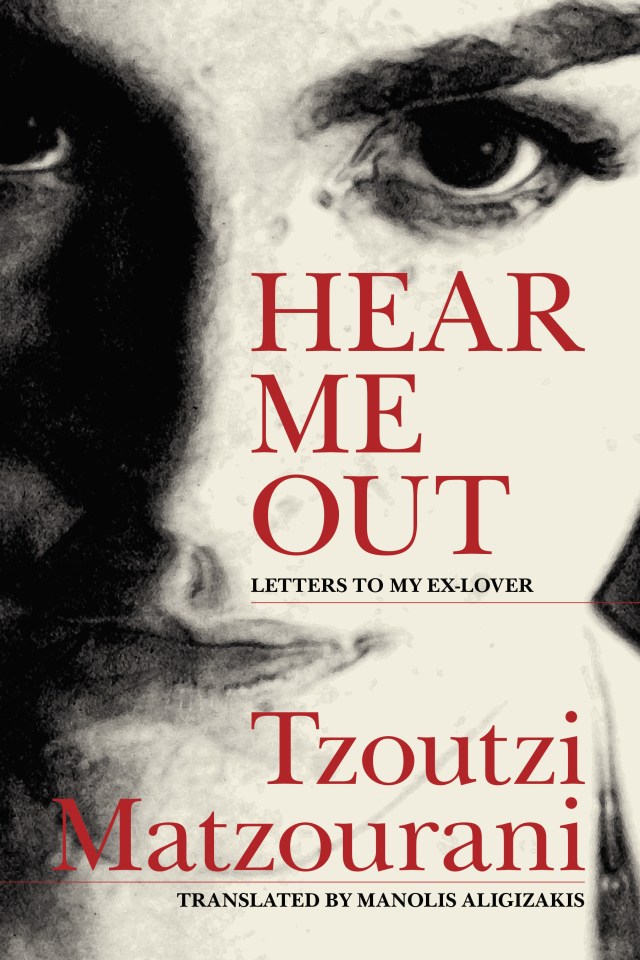


 Manolis Aligizakis