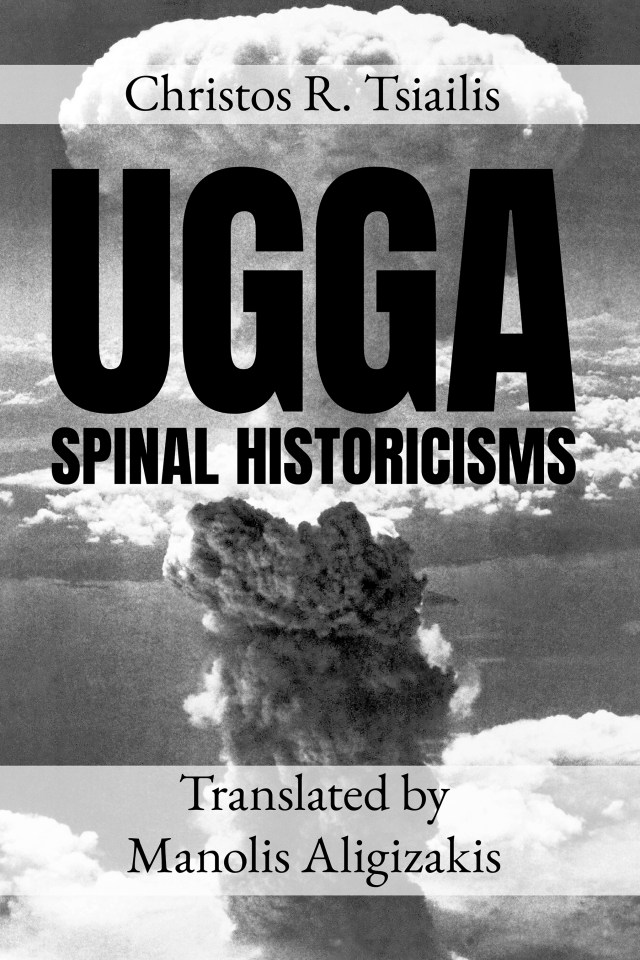
Belisarius as the holy empire groaned under the suffering when the nation bent under the attacks of the barbarians and the whole state kneeled under the endless enemy strikes they always seek him to save the country from the suffering they hoped for the saving and salvation of the land from him and then? afterwards they didn’t know him thus during the last years of the `30s period among the vague plans of philosophers who were raging, despite their poor tools for a possibly better predominance and the immature, salivating, beggars and thieves of glory the young Belisarius started along with Andreas Embiricos to create and to live
“There won’t be any children, Mrs. White. It’s summer holidays,” Lona said with a smirk. Paul rolled his eyes skyward. Jennifer felt a little sheepish. Lona was probably correct. However, it was irritating the way she always ensured that everyone knew she was correct. It was time to change the subject. “How did you happen to study Russian, David?” she said, leaning back in the grass, ignoring Lona and fixing on the young man. He had an intelligent, open face with sparkling white teeth but even at the age of 25, his hairline was just starting its slide toward the back of his head. She knew that his family was of English descent, not unlike her own history on her father’s side. “My father’s in the Air Force,” said David, “and I guess we’ve lived on a dozen different bases as I grew up—Germany, Italy and NORAD in Colorado. I picked up a little of every language but never Russian.” “So why Russian?” Lona asked. “Well, six years ago I got chosen along with a lot of other army and air force brats to go on a teen cultural exchange to the U.S.S.R. I had no knowledge of the country before that. We were just supposed to be shining examples of North American kids. It was sure different than this tour. It had been organized by Sputnik—that’s the youth tour group—and we had cocky Komsomol leaders not much older than us in charge.” “So you have more than a nodding acquaintance with Lenin?” “And Marx. And Brezhnev. The Komsomol is seriously political, and this was before the signing of the SALT treaty so east-west tensions were high. Believe it or not, it’s more relaxed now.” “But how did you learn the language?” Paul asked. “Oh, we had a crash course before the trip. Then we stayed in a dormitory for four months and ate with the Eastern European kids, so we learned a lot that way. We didn’t visit the churches back then because they tried to pretend that they didn’t exist. Instead, we had to study in the dorm a lot and debate the class struggle or dialectical materialism with our team leader. Most of us didn’t have a clue!” “My god, I’m not sure I could define them now,” laughed Jennifer. “But I bet we’ll know by the end of this trip.” “Well, that was what sparked my interest in Russian. Learning by talking is the best way. That’s why I didn’t pack my Ozhegov.”
twenty-five Two hundred and fifty thousand years before zero all the Mitochondrion Eves fight inside the same Paradise in a valley strewn with gigantic bones until one overtakes: the first Mother. On the same day the first democracy is established the first church inside the cave the club higher in the hand of the first, powerful symbol of authority for the same purpose they all vote for the one Cave Master since the Homo Erectus devised the appropriate submission as a bequest to the Homo Antecessor.
The strengths of Nuances lie in its imaginative range, its ethical seriousness, and its refusal to divorce lyric beauty from social reality. Aligizakis writes with a notably visual imagination. His poems are saturated with colour—red, white, azure, pewter, gold, black—and with tactile materials such as stone, flesh, wind, water, cloth, metal, and wood. His diction frequently reaches toward the elevated, incorporating mythological, religious, philosophical, and erotic vocabularies. This can create a heightened, ceremonial tone well suited to the collection’s central concerns.
At times, however, the density of the language can work against precision. Some poems accumulate images so quickly that their syntactic or emotional centre becomes difficult to locate. Certain abstractions—“meaning,” “glory,” “freedom,” “opulence,” “greatness,” “void,” “dream”—recur frequently, and their force is strongest when grounded by the concrete material world that the book handles so well. The collection’s most effective poems are often those that allow a particular object or scene to carry the argument: a doll with a missing arm, a rusted bicycle, a flowerpot, a park bench, a syringe, a tank, a food court, or a coffee cup.
This is not a weakness so much as a productive tension within the poet’s poetics. Nuances want to make large claims, but it is most persuasive when those claims emerge from a small, exact image. Its best work reveals how philosophical inquiry can remain rooted in the body and in ordinary experience. The collection’s frequent shifts between sublime imagery and everyday detail are not accidental. They express a central conviction: human beings do not encounter death, love, violence, religion, or freedom in abstract space. They encounter them in rooms, streets, kitchens, workplaces, hospitals, public squares, and landscapes.
Nuances, therefore, are best understood as a collection of ethical lyricism. It asks readers to attend to the shades of feeling and responsibility that are often lost in public language, ideological certainty, or personal habit. Its poems are willing to be sensuous, rhetorical, mournful, comic, politically alert, and metaphysically restless. At its strongest, the book demonstrates that nuance is not a retreat from moral seriousness. It is a way of seeing more clearly: of recognizing that every claim to beauty contains a history, every gesture of love includes vulnerability, and every act of violence leaves behind a world which language must struggle to describe.